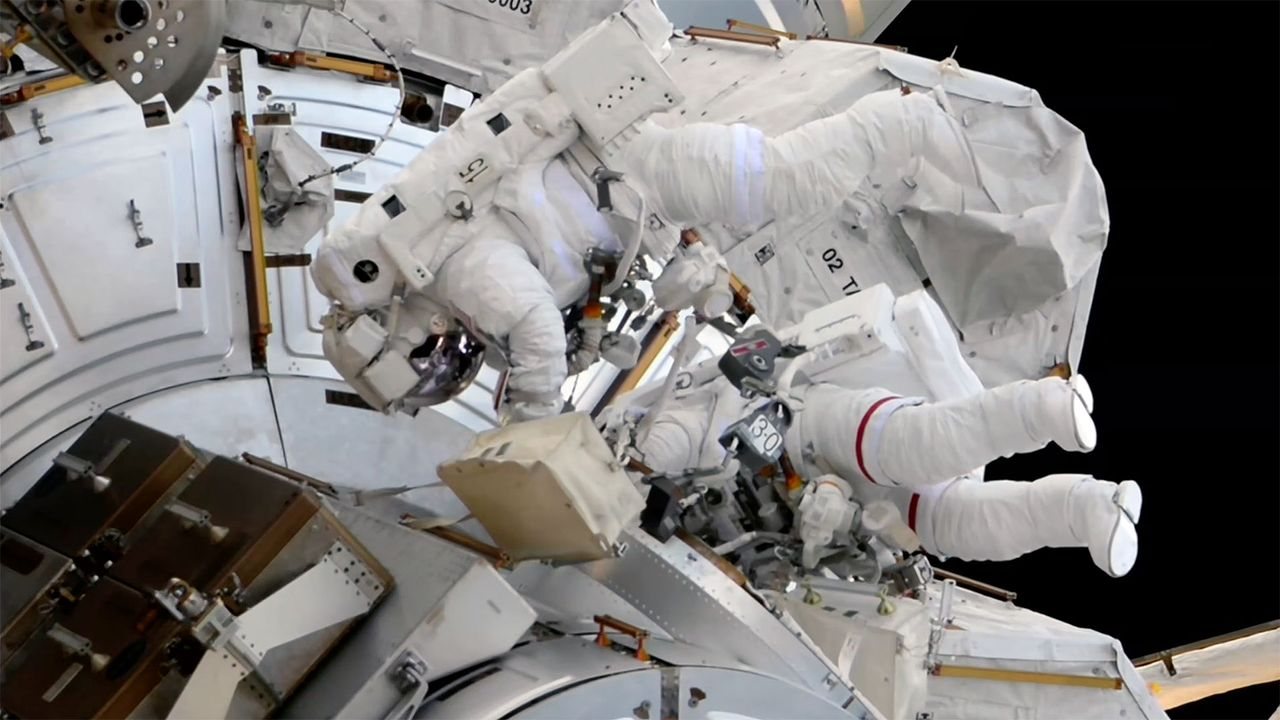
Two astronauts completed a spacewalk outside the International Space Station on Thursday, replacing a camera and a docking aid in what marked only the sixth all-female spacewalk in history. The operation, which lasted several hours, saw the pair work through a series of maintenance tasks on the exterior of the orbiting laboratory.
The spacewalk focused on upgrading equipment critical to the station's operations. The astronauts installed a new high-definition camera and replaced a docking aid used by visiting spacecraft, ensuring that future arrivals can approach and attach to the station safely. Both components had been in service for years and were due for replacement as part of routine maintenance.
All-female spacewalks remain rare. The first took place in October 2019, when NASA astronauts Christina Koch and Jessica Meir stepped outside the station together. Since then, only a handful of similar missions have followed, with Thursday's outing adding to that short list. The achievement has been widely noted as a milestone for women in spaceflight, though astronauts and agency officials have emphasized that the work itself is standard station maintenance.
The two astronauts involved in Thursday's spacewalk were not named in the initial reports, but the mission continues the station's long-running schedule of external maintenance and upgrades. The ISS has been continuously inhabited since November 2000, and its crew regularly performs spacewalks to repair equipment, install new hardware, and conduct scientific experiments that require exposure to the space environment.
Spacewalks are physically demanding operations. Astronauts wear pressurized suits that provide oxygen and protection from the vacuum of space, and they must carefully manage their movements to avoid damaging the suits or the station. Each excursion is meticulously planned, with crews rehearsing procedures on the ground and in simulation before venturing outside.
The replacement of the camera and docking aid is part of a broader effort to keep the station's systems current. Cameras on the exterior of the ISS provide views used by ground controllers and astronauts to monitor the station's condition, guide robotic operations, and document scientific work. Docking aids, meanwhile, are essential for the safe arrival of crewed and uncrewed spacecraft, including the commercial vehicles that now regularly ferry astronauts and cargo to the station.
Thursday's spacewalk was the latest in a series of maintenance outings planned for the current expedition. The station's orbit, roughly 250 miles above Earth, means that spacewalks must be carefully timed to avoid extreme temperature swings and to maintain communication with ground teams. The crew will continue with additional tasks in the coming weeks as part of the station's ongoing upkeep.
The significance of the all-female crew has drawn attention beyond the technical details of the mission. Women have been part of the astronaut corps since the 1970s, but their representation in spacewalks has grown only gradually. The first all-female spacewalk was originally scheduled for March 2019 but was postponed due to a shortage of properly sized spacesuits, a delay that highlighted the logistical challenges of accommodating a diverse astronaut corps.
Since that first outing, all-female spacewalks have become more frequent, though they still represent a small fraction of the more than 250 spacewalks conducted at the ISS. Agency officials have said they expect the trend to continue as more women join astronaut classes and as spacesuit designs are updated to fit a wider range of body types.
The station itself remains a hub of international cooperation, with astronauts from the United States, Russia, Japan, Europe, and Canada living and working together in orbit. The maintenance work completed Thursday will support the station's operations as it continues to host scientific research in microgravity, from studies of human health to experiments in materials science and biology.
155