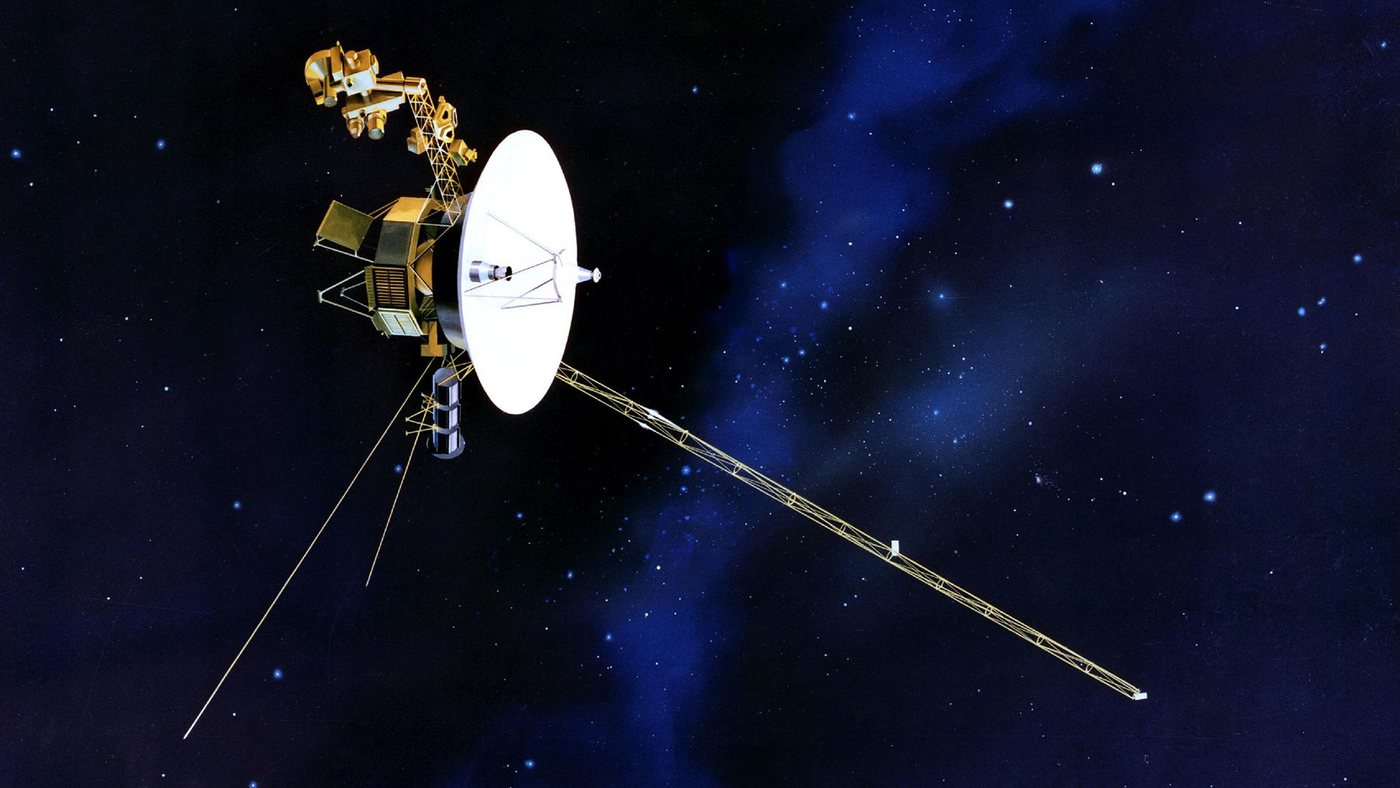
NASA's Voyager 1 spacecraft has crossed a symbolic distance, reaching one light-day from Earth, roughly 26 billion kilometers away. The milestone came on November 18 at about 10:16 UTC. Yet the probe is currently unable to share the scientific data it is collecting, because of a computer glitch aboard the aging craft.
Launched in September 1977, Voyager 1 was born from a concept called the Planetary Grand Tour. Gary Flandro, a scientist, had identified in 1964 a rare alignment of the outer planets that occurs about once every 175 years, offering a chance to visit several worlds on a single trajectory. The original plan was to explore four planets, but in 1972 the mission was scaled back to focus on Jupiter and Saturn. Its primary goals centered on those giant planets and on Titan, Saturn's moon, which has a nitrogen-rich atmosphere.
After its planetary encounters, Voyager 1 went on to become the first human-made object to enter interstellar space, which it did in August 2012 at a distance of roughly 121 astronomical units from the Sun. It has been operating for more than four decades, and its age is now the central challenge facing engineers who maintain it.
The spacecraft's power supply has weakened steadily. Its radioisotope thermoelectric generators produced about 470 watts at launch and now deliver around 270 watts. Thrusters that were meant to re-aim the antenna toward Earth have become clogged. In late 2023, a data corruption problem made the probe's communications unreadable for a period, and engineers worked to restore the link.
To extend the life of the remaining instruments, NASA carried out a power-saving procedure nicknamed the "Big Bang" in September 2026. Officials expect that power will become insufficient at some point during the 2030s. Earlier, in April 2026, one instrument, the Low-Energy Charged Particle experiment, was shut off to conserve energy. The current glitch means that even as Voyager 1 continues to travel farther from home, the data it gathers from the edge of the Sun's influence is not reaching scientists on Earth.
Credit. Based on reporting by Brandon Specktor for Live Science. Is this your work? Write to us.
7