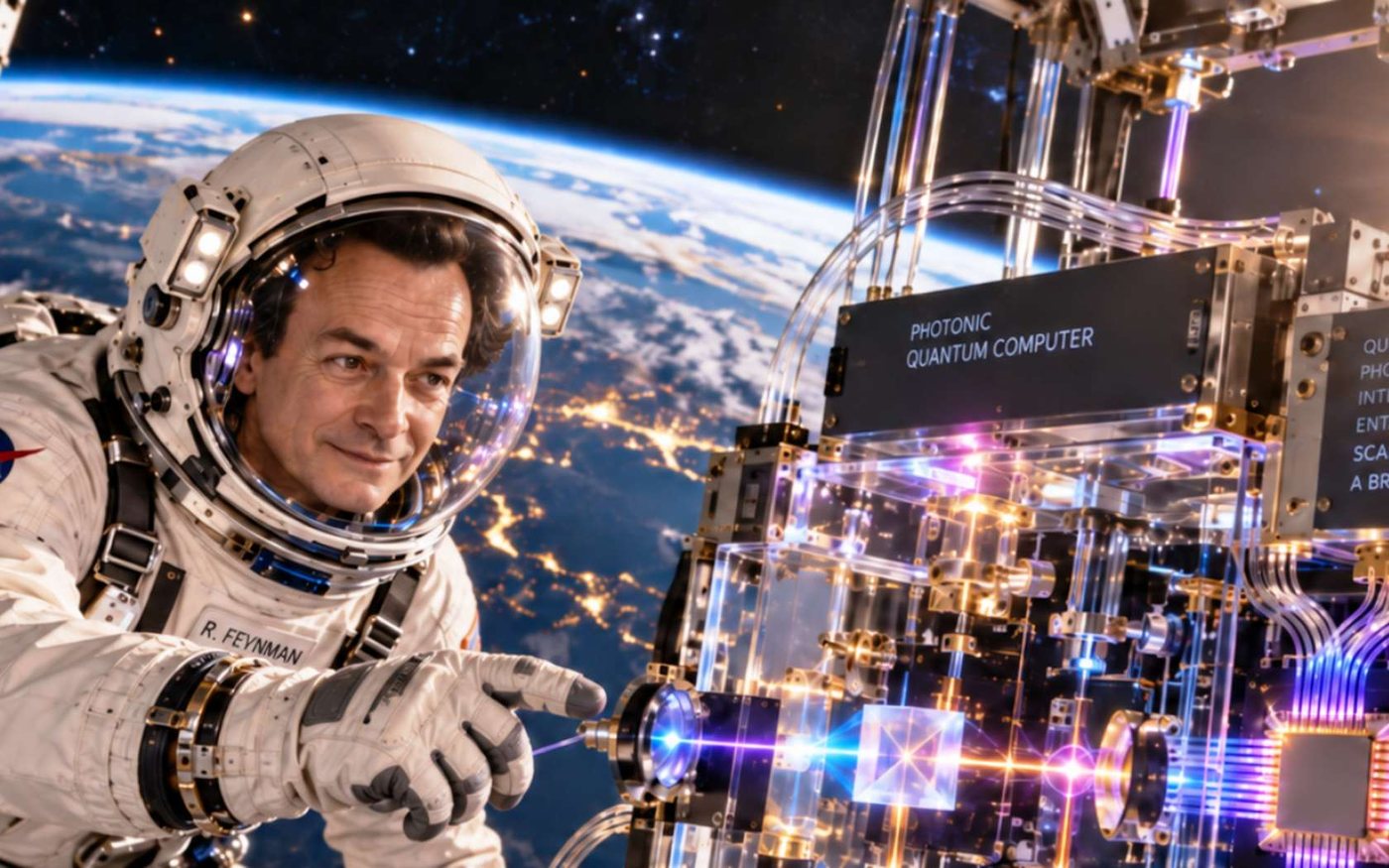
A quantum computer has operated successfully in space, marking a significant step toward deploying quantum computing technology beyond Earth-based laboratories. The demonstration suggests that quantum processors can function in orbital environments, potentially enabling a new class of space-based data infrastructure.
The achievement points to broader applications for quantum computing than the materials science and drug discovery problems typically associated with the technology. Researchers have long anticipated that quantum computers could revolutionize fields such as chemistry and pharmacology by simulating molecular interactions at scales impossible for classical machines. But the ability to operate a quantum computer in space introduces another dimension: the possibility of building an equivalent to the internet's data center network, but powered by quantum processing and located in orbit.
Quantum computers leverage the principles of quantum mechanics — superposition and entanglement — to perform certain calculations exponentially faster than classical computers. However, these machines are notoriously fragile, requiring extreme cooling and isolation from environmental interference. Operating one in space, where radiation, temperature swings, and microgravity present unique challenges, represents a notable technical milestone. The success implies that quantum hardware can be hardened sufficiently for spaceflight, or that the space environment offers compensating advantages.
One likely motivation for space-based quantum computing is the prospect of quantum-secured communications. Quantum key distribution, which uses quantum states to encode encryption keys, can in principle provide theoretically unbreakable security. Satellites have already been used to distribute quantum keys over long distances, and a space-based quantum computer could serve as a node in a global quantum network. Such a network might one day form the backbone of a quantum internet, connecting quantum processors, sensors, and users across continents.
The demonstration also raises the possibility of orbital data centers that exploit quantum acceleration for specific tasks. While classical data centers dominate cloud computing, quantum co-processors in space could handle specialized workloads — such as cryptographic analysis, optimization problems, or scientific simulations — while benefiting from solar power and vacuum cooling. The concept remains speculative, but the successful operation of a quantum computer in space is a necessary first step.
Details about the specific hardware, the mission profile, and the duration of operation were not immediately available. It is also unclear whether the computer performed a meaningful calculation or merely demonstrated basic functionality. Nonetheless, the milestone is likely to accelerate interest in space-qualified quantum technologies, from both government space agencies and private aerospace companies.
The development comes amid growing investment in quantum computing worldwide, with major technology firms and startups racing to build machines with increasing qubit counts and error correction. Space-based quantum computing could complement these efforts by enabling distributed quantum processing and secure global communication. For now, the successful operation in orbit signals that the technology is no longer confined to Earth — and that the next generation of computing infrastructure may extend far above it.
15