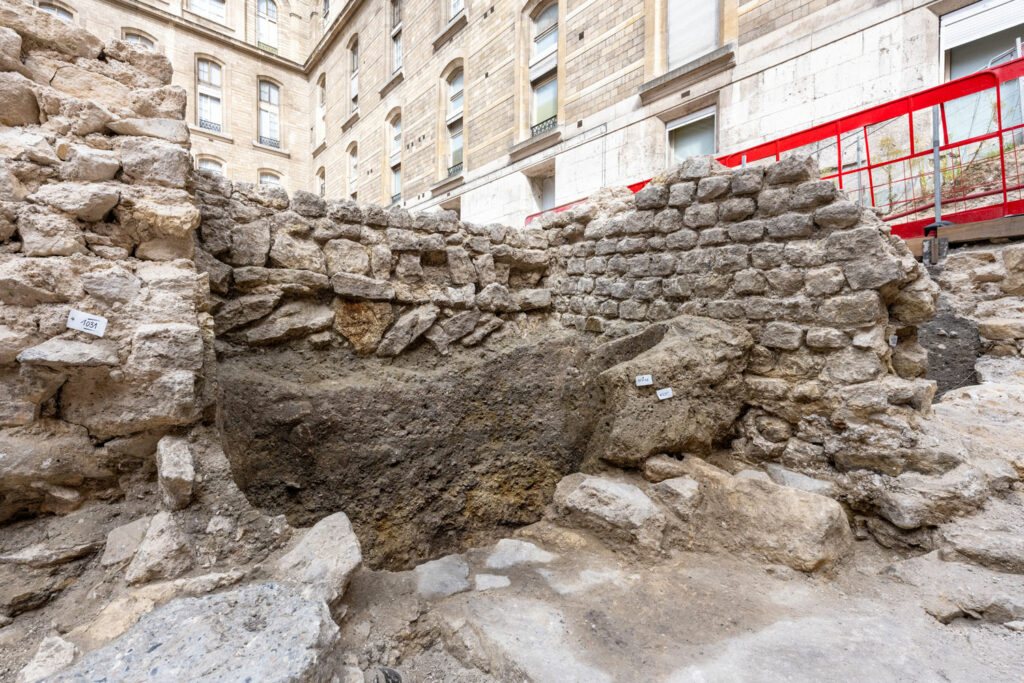
A 65-foot section of ancient wall uncovered beneath central Paris may belong to the ramparts of Lutetia, the original settlement of the Gallic Parisii tribe, according to archaeologists working at the site. The structure was found under the Hôtel-Dieu hospital on the Île de la Cité, close to Notre Dame Cathedral, placing the discovery at the historic heart of the modern city.
Carbon dating of charred material found along the wall indicates that it burned sometime between 200 and 10 B.C. That window overlaps with one of the most famous episodes in the region's ancient history: Julius Caesar's account of the Gallic Wars, in which he describes the Gauls burning their own town before the Battle of Lutetia against the Romans in 52 B.C.
«We may be looking at one of the most important remains ever discovered for understanding Gallic Lutetia,» said Catherine Pégard, France's Culture Minister. She tempered the announcement with a call for continued scientific rigor, noting that the wall's precise function and chronology still require verification. «Scientific caution still requires that we verify its function and its chronology, but the convergence of evidence is particularly remarkable at this stage,» she added.
The discovery offers a rare physical trace of the settlement that preceded Roman Lutetia and, eventually, the city of Paris. The Parisii were a Gallic tribe whose oppidum on the Île de la Cité is generally regarded as the seed of the later metropolis. Much of what historians know about the community's final days comes from Caesar's commentaries, which describe a scorched-earth strategy intended to deny the advancing Roman legions resources and shelter.
If the wall is confirmed as part of Lutetia's defenses, it would rank among the most significant archaeological finds related to the pre-Roman city. The site's location beneath a working hospital in one of the most densely built parts of Paris also makes excavation unusually complex, requiring careful coordination between researchers and the institution above.
Archaeologists have not yet published a full assessment of the wall's construction or its relationship to other known features of Gallic Lutetia. The carbon-dating range is broad, spanning nearly two centuries, and the burned material could reflect a single destructive event or a longer period of activity and decay. Those questions are likely to shape the next phase of research at the site.
For now, the convergence of the wall's location, its age, and the literary record of the Gallic burning has drawn attention from scholars and the public alike. Further study is expected to clarify whether the structure was a defensive rampart, a boundary, or part of some other installation, and whether its destruction can be tied to the Roman conquest.
13