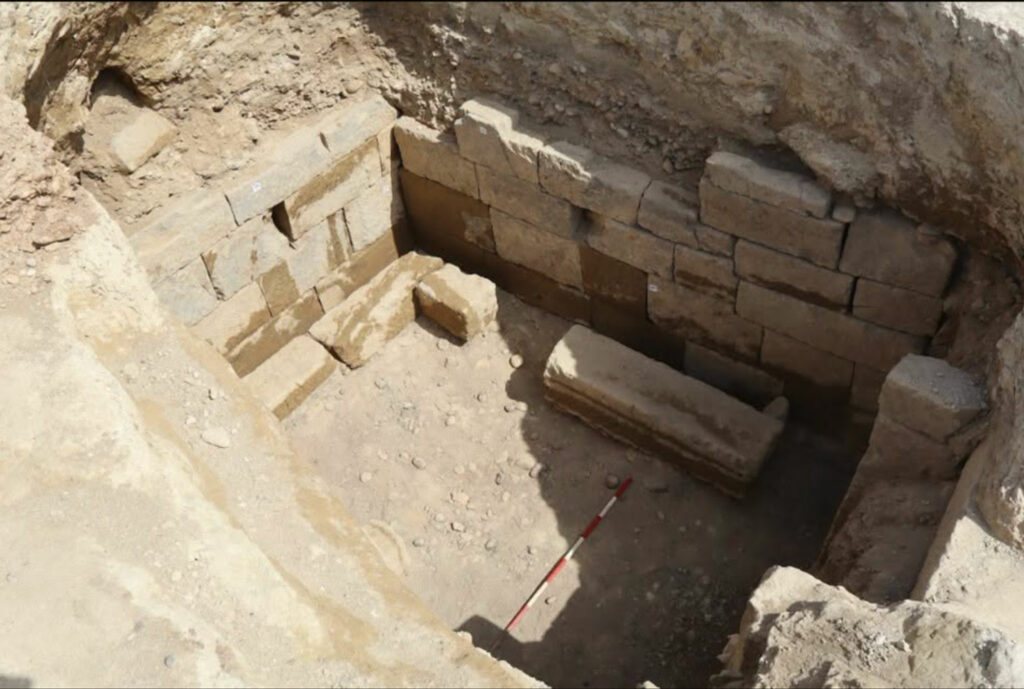
Archaeologists from Egypt's Supreme Council of Antiquities have unearthed a pyramid-shaped tomb at Bir Al-Shaghala in the Dakhleh Oasis, dating to the late third or early fourth century A.D. The discovery adds a significant new monument to the necropolis of Mothis, the oasis capital during the Ptolemaic and Roman periods.
Beneath the pyramid superstructure, the excavation team found a mudbrick hall with a vaulted ceiling. Two mudbrick burial chambers were positioned to the right of the hall. The tomb's staircase and sandstone entrance were built in the Egyptian style, featuring hieroglyphic inscriptions of funerary spells and protections. A cornice decorated with a winged sun disk and two cobras, along with a funerary scene from the Egyptian Books of the Netherworld on the lintel, further reflect Egyptian artistic and religious conventions.
Among the artifacts recovered were a sandstone offering table, a sandstone purification basin, pottery, and a bronze coin bearing an image of the emperor Constantine. The coin provides a useful chronological anchor for the tomb's use or reuse. Greek influence at the site is evident in 19 lines of Greek text inscribed on a stone funerary stele. The inscription is dedicated to a man named Pisechtes, who is thought to have been a judge.
The archaeologists suggest the tomb may have been reused after its initial construction. A mudbrick chapel and a shrine with four square mudbrick columns were added to the main entrance at that later stage. Such additions point to the continued significance of the burial site over time and to the blending of architectural and ritual practices in the region.
Bir Al-Shaghala formed part of the necropolis serving Mothis, the capital of the Dakhleh Oasis during the Ptolemaic and Roman periods. The site's location in Egypt's Western Desert places it within a broader network of oasis settlements that connected the Nile Valley to trade and administrative routes in the desert. The mix of Egyptian and Greek elements in the tomb reflects the cultural interactions that characterized Egypt under Ptolemaic and Roman rule.
The pyramid-shaped superstructure is a notable feature, as pyramid tombs are more commonly associated with earlier pharaonic periods, though smaller pyramid forms continued to be used in some later contexts. The combination of a pyramid above ground with a vaulted mudbrick hall and burial chambers below illustrates the adaptation of Egyptian funerary architecture in a Roman-era oasis setting.
The hieroglyphic inscriptions of funerary spells and protections, together with the Books of the Netherworld scene, indicate that traditional Egyptian beliefs about the afterlife remained important to the tomb's owners or users. At the same time, the Greek stele dedicated to Pisechtes shows that Greek-language commemorative practices were also part of the funerary landscape at Bir Al-Shaghala.
The bronze coin of Constantine offers a clue to the tomb's later history. Constantine ruled in the early fourth century A.D., and the coin's presence may relate to the period when the chapel and columned shrine were added. The archaeologists' interpretation of reuse is based on these structural additions and the associated finds.
Excavations at Bir Al-Shaghala continue to shed light on the Dakhleh Oasis during the Ptolemaic and Roman periods. The tomb's combination of Egyptian-style architecture and inscriptions with a Greek funerary stele makes it a valuable example of the cultural synthesis that shaped Egypt in late antiquity.
9