A newly described fossil from northeastern China points to an early relative of mammals that may have been able to suckle its young and chew its food at the same time. The find, reported by a team led by Zhe-Xi Luo of the University of Chicago, could help scientists understand how one of the defining features of living mammals first came about.
The specimen was discovered by local farmers in Daohugou, in Inner Mongolia, and dates to between 163 and 168 million years ago, during the Middle to Late Jurassic. The researchers have named it Megacauda sungei, a name that refers to the animal's broad tail and honors the paleontologist Sun Ge. The creature was not a mammal in the strict sense of the word today, but a mammaliform, a group that sits close to the lineage that gave rise to modern mammals and predates the common ancestor of the three living branches: monotremes, marsupials and placentals.
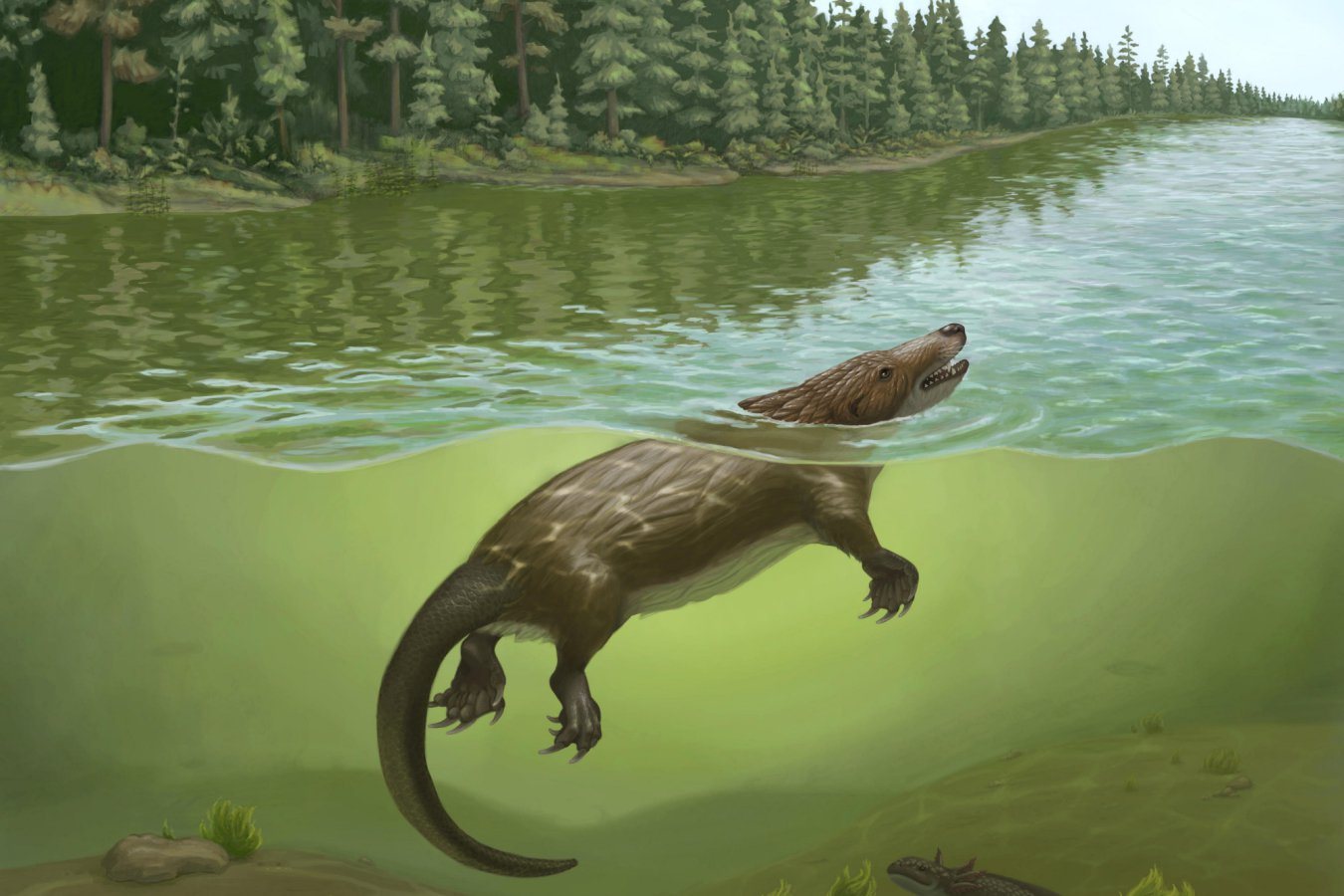
The animal weighed roughly one kilogram, making it the largest known mammaliform from the Middle to Late Jurassic. Its body combined unusual traits. The tail and hind half resemble those of a platypus, while the skull and teeth look more like those of a river otter. Because the pelvis, hyoid bones and roof of the mouth are preserved, the researchers were able to reconstruct its throat in detail. That reconstruction led them to suggest that Megacauda may be the earliest known animal capable of both suckling and chewing, although the researchers present the link between throat mechanics and suckling as an inference drawn from anatomy rather than a direct observation.
Stomach fragments found with the fossil suggest that the animal's last meal included salamander-like prey, and its build points to a semi-aquatic way of life, making it the earliest known mammal relative adapted to living partly in water. The discovery adds a detailed piece to the picture of how early mammal relatives lived and fed long before the modern groups diverged.
We rewrote this story on 4 November 2026 after an editorial review.
Credit. Based on reporting by James Woodford for New Scientist. Is this your work? Write to us.
157