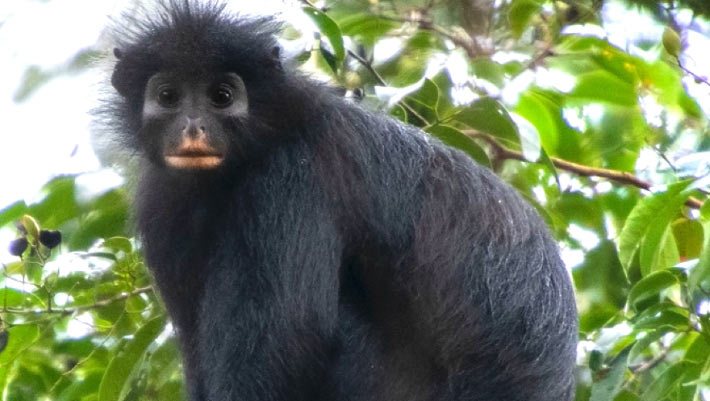
Scientists have formally described a new species of African monkey from the genus Colobus, discovered in the remote interior of the Democratic Republic of Congo. The finding represents only the fifth new monkey species identified on the African continent in the past 75 years, underscoring the region's rich but still poorly understood biodiversity.
The newly identified primate, named Colobus congoensis, was found deep within the Congo Basin rainforest, an area known for its dense vegetation and limited accessibility. Researchers from multiple institutions collaborated on the study, which involved genetic analysis, morphological comparisons, and field observations to confirm that the specimens represented a distinct species previously unknown to science.
Colobus monkeys are characterized by their striking black-and-white fur, long tails, and the absence of thumbs, which gives them a distinctive appearance. The new species exhibits unique physical traits, including a distinctive orange-red patch on its lips and a vocalization pattern described as a combination of roars and snorts, setting it apart from other known Colobus species. These vocalizations are believed to play a role in territorial communication and social bonding within troops.
The discovery was made during a series of expeditions to the Lomami National Park and surrounding forest reserves in central DRC. The region has been a focus for primatologists due to its high levels of endemism and the presence of other rare species, such as the bonobo and the okapi. The research team spent several years collecting data, including fecal samples for DNA analysis, photographs, and audio recordings of the monkeys' calls.
Genetic sequencing revealed significant divergence between the new species and its closest relatives, the Angolan colobus and the mantled guereza. The study, published in the American Journal of Primatology, estimates that the lineage leading to Colobus congoensis split from other Colobus monkeys approximately 1.5 million years ago, during the Pleistocene epoch. This deep evolutionary history suggests that the species has been isolated in the Congo Basin for a considerable period, likely due to historical changes in forest cover and river systems.
Conservationists have expressed concern about the species' long-term survival. The Congo Basin faces increasing threats from deforestation, mining, and bushmeat hunting. While the exact population size of Colobus congoensis remains unknown, researchers estimate that its range is limited to a relatively small area of intact forest, making it vulnerable to habitat loss. The species has not yet been assessed by the International Union for Conservation of Nature (IUCN), but experts recommend that it be classified as endangered or vulnerable based on its restricted distribution and ongoing threats.
Local communities living near the discovery sites have long been aware of the monkey, which they refer to by a local name that translates to «the one that roars.» The researchers worked closely with village elders and trackers, who provided invaluable knowledge about the animal's behavior and habitat preferences. This collaboration highlights the importance of integrating traditional ecological knowledge with modern scientific methods in biodiversity research.
The discovery of Colobus congoensis brings the total number of recognized Colobus species to 18. It also emphasizes the critical need for continued exploration and conservation in Africa's remaining wilderness areas. The Congo Basin is one of the most biodiverse regions on Earth, yet large portions remain scientifically unexplored. Each new discovery provides insights into evolutionary processes and helps inform conservation strategies.
Lead author Dr. John Hart, a primatologist with the Lukuru Wildlife Research Foundation, noted that the finding «reminds us how much we still have to learn about the natural world.» He added that protecting the habitat of the new monkey will also benefit countless other species that share its forest home. The research team plans to continue monitoring the population and working with Congolese authorities to establish protected corridors that connect fragmented forest patches.
The announcement has generated excitement among primatologists and conservation biologists, who see it as a rare and significant addition to the primate family tree. With only five new monkey species described from Africa in the last three-quarters of a century, each discovery carries substantial scientific weight. The find also underscores the urgency of preserving the Congo Basin's ecosystems before more species are lost to extinction.
125