Simulated zero gravity leaves the human genome's structure and dynamics largely undisturbed, while removing Earth's magnetic field alters mitochondrial energy metabolism in ways that can extend lifespan in a fruit fly model of Parkinson's disease, according to two separate studies from research groups in the United States and the United Kingdom.
The findings could inform planning for long-duration space travel and point toward a new avenue for treating neurodegenerative conditions, though the two lines of research remain at an early, laboratory-based stage.
At New York University, physicist Alexandra Zidovska and colleagues built a random positioning machine that rotates cells in two or three dimensions to mimic weightlessness on timescales shorter than those on which cellular processes unfold. The device resembles the larger training equipment used by astronauts.
Earlier studies of this kind typically relied on biochemical assays or immunofluorescence imaging of fixed cells. The NYU team instead imaged live cells with a high-resolution confocal technique, culturing them on a glass-bottomed dish while carefully avoiding air bubbles that stress or even kill cells.
The researchers also tuned the machine's speed and three-dimensional rotation path to minimize fluid flow caused by the rotation. Such flow does not exist in genuine zero-gravity environments and can damage cells, so reducing it was essential to isolating the effects of gravity itself.
After 24 hours in the simulated weightless environment, the genome's organization and dynamics held up unexpectedly well, the team reported in Science Advances. Zidovska said the result could matter for assessing cellular effects during space travel, while cautioning that weightlessness is not the only genetic hazard in space.
Cosmic radiation is known to damage DNA, and until now it has been difficult to separate its effects from those of zero gravity. The NYU experiments simulated weightlessness without that confounding factor, offering a cleaner look at gravity's role as a mechanical stressor that is omnipresent on Earth.
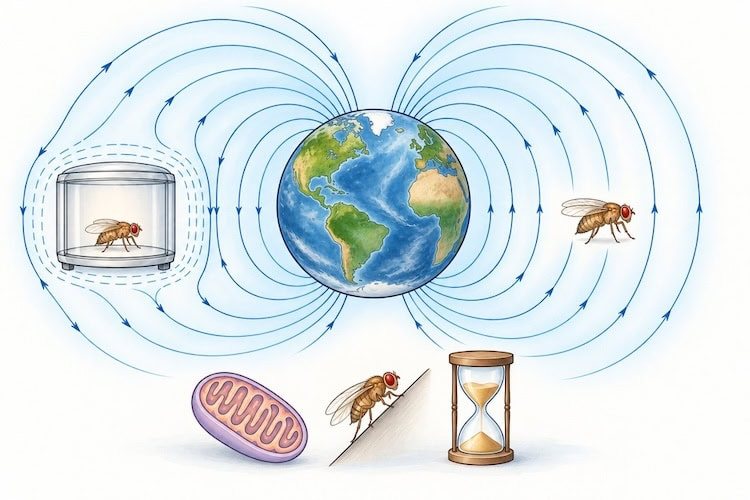
In the second study, a team at the University of Nottingham led by biochemist Lisa Chakrabarti examined how Earth's magnetic field, which ranges in strength from about 25 to 60 microtesla, affects mitochondria, the structures that generate energy for cells and are vital to the health and lifespan of organisms with complex cells.
Much prior work on the geomagnetic field's biological effects focused on its role in shielding organisms from cosmic radiation or on how magnetoreception helps migrating birds and marine mammals navigate. The Nottingham group took a different approach.
They studied healthy fruit flies alongside flies engineered to carry a defect in the Pink1 B9 gene, a model that replicates key features of early-onset Parkinson's disease, including malfunctioning mitochondria, degraded dopaminergic neurons, and reduced activity and lifespan.
The flies were placed inside a chamber surrounded by four layers of passive mu-metal shielding and nine internal active field-cancelling coils, keeping the ambient magnetic field below 5 nanotesla. The researchers tracked lifespan by counting dead and living flies, measured activity by recording the percentage crossing a marked line every five days, and used a high-resolution respirometer and quantum sensors based on nitrogen-vacancy centers in diamond to monitor superoxide, a highly reactive molecule produced by mitochondria.
Shielding the Pink1 flies from Earth's magnetic field increased their lifespan by around 20%, although they became less physically active. Healthy flies, by contrast, became more active but lived shorter lives. The researchers attribute these effects to changes in mitochondrial energy metabolism through the electron transport system when the magnetic field is reduced, and reported the work in Aging-US.
The two studies address different forces but share a common question: how pervasive environmental factors that are easy to overlook on Earth shape the machinery of cells. For space agencies, the genome results suggest that weightlessness alone may be less disruptive to DNA organization than feared, sharpening attention on radiation and other hazards. For medicine, the magnetic-field findings hint that mitochondrial metabolism can be manipulated without drugs, a prospect that would require extensive further testing before any clinical application.
19