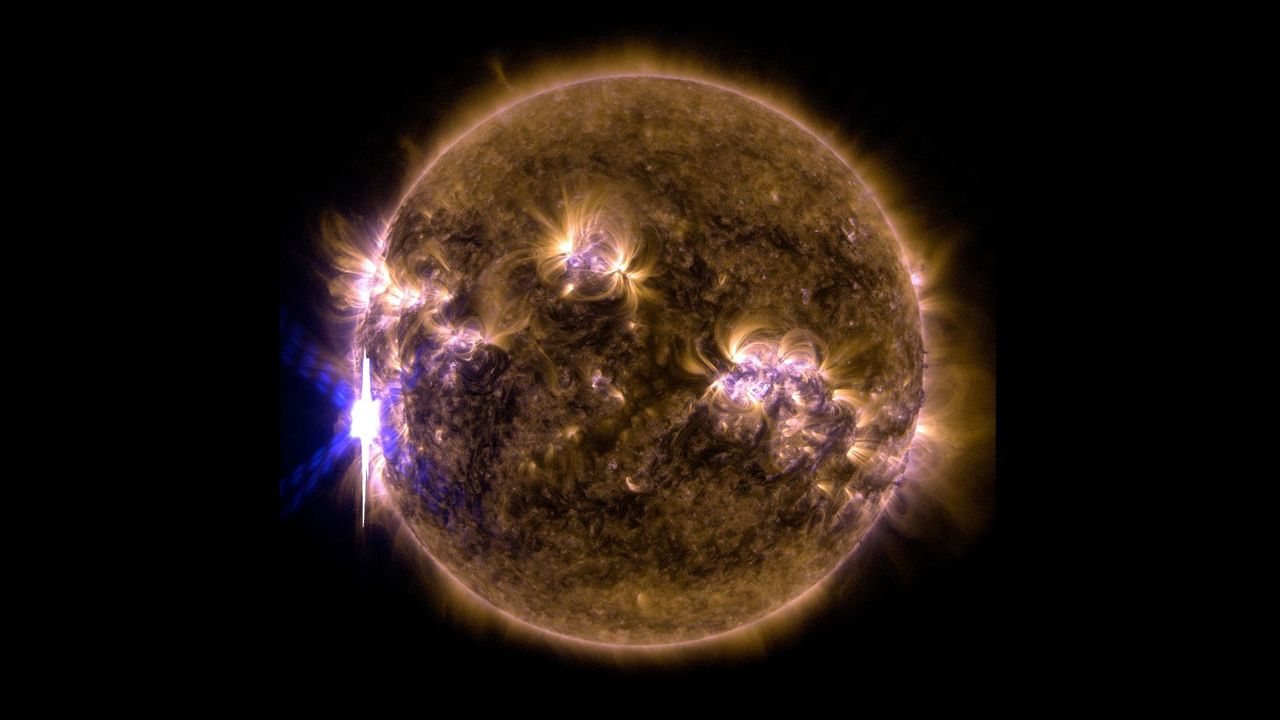
For decades, astronomers have been puzzled by a persistent discrepancy: the Sun's atmosphere contains significantly less silver than theoretical models predict. Now, a team of scientists may have finally unraveled this cosmic mystery, offering new insights into the chemical composition of our nearest star and the processes that govern its interior.
The Sun, like all stars, is a vast nuclear furnace that fuses hydrogen into helium and produces heavier elements over time. By analyzing the spectrum of sunlight, scientists can determine which elements are present in the solar atmosphere. These observations have generally matched theoretical predictions for most elements, but silver has been a notable exception. The measured abundance of silver in the Sun's photosphere is only about one-tenth of what standard stellar models expect, a discrepancy that has challenged researchers for years.
In a new study published in the journal Astronomy & Astrophysics, a team led by researchers from the University of Montpellier in France and the University of Geneva in Switzerland proposes a solution. They suggest that silver may be preferentially transported into the Sun's interior, where it becomes trapped and hidden from spectroscopic observations. Alternatively, the nuclear reaction rates that produce silver in stars may need to be revised downward, meaning less silver is actually created than previously thought.
«The missing silver problem has been a thorn in the side of stellar astrophysics for a long time,» said lead author Dr. Arthur Le Gal, a researcher at the University of Montpellier. «Our work shows that either the Sun is hiding its silver deep inside, or our understanding of how silver is made in stars is incomplete.»
The team reached their conclusion by combining detailed spectroscopic observations of the Sun with advanced computer models of stellar structure and evolution. They examined the behavior of silver atoms in the Sun's turbulent plasma and considered how gravitational settling and other physical processes might affect the element's distribution. Their models showed that silver, being a relatively heavy element, could sink into the Sun's interior over time, especially if the mixing in the outer layers is weaker than assumed.
This process, known as atomic diffusion, is already known to affect other elements in stars. For example, the Sun's lithium abundance is lower than expected because lithium is destroyed in the interior and not fully replenished. Silver, however, is not destroyed by nuclear reactions in the Sun's core, but it could be transported downward and stored in deeper layers where it is not visible to telescopes.
If this explanation is correct, it would mean that the Sun's total silver content is actually close to the predicted value, but most of it is hidden from view. This would resolve the discrepancy without requiring major changes to stellar nucleosynthesis models. However, the researchers caution that more work is needed to confirm this hypothesis.
«Our models are consistent with the idea that silver is sinking, but we cannot rule out the possibility that the nuclear reaction rates are different,» said co-author Dr. Maria Bergemann, an astrophysicist at the University of Geneva. «Future laboratory measurements of the relevant nuclear reactions will be crucial to distinguish between these two scenarios.»
The study also has implications beyond the Sun. If silver is indeed hidden in the interiors of Sun-like stars, similar discrepancies might exist for other heavy elements. This could affect our understanding of galactic chemical evolution, as astronomers often use the Sun as a reference point for the composition of other stars and galaxies.
«The Sun is our best-studied star, and if we are getting its composition wrong, it could have ripple effects across astrophysics,» Dr. Le Gal added. «Understanding the missing silver is not just about one element; it's about testing the foundations of how we model stars.»
The mystery of the Sun's missing silver has persisted for more than two decades. Early measurements in the 1990s first hinted at the discrepancy, but it was only with improved telescopes and spectral analysis techniques that the problem became clear. The new study represents a significant step forward, but the researchers emphasize that the final answer may require a combination of both revised nuclear physics and improved models of stellar mixing.
In the meantime, the work highlights the power of combining observations, theory, and computation to solve long-standing puzzles in astronomy. As telescopes become more sensitive and computer models more sophisticated, scientists hope to uncover even more secrets hidden in the Sun's brilliant light.