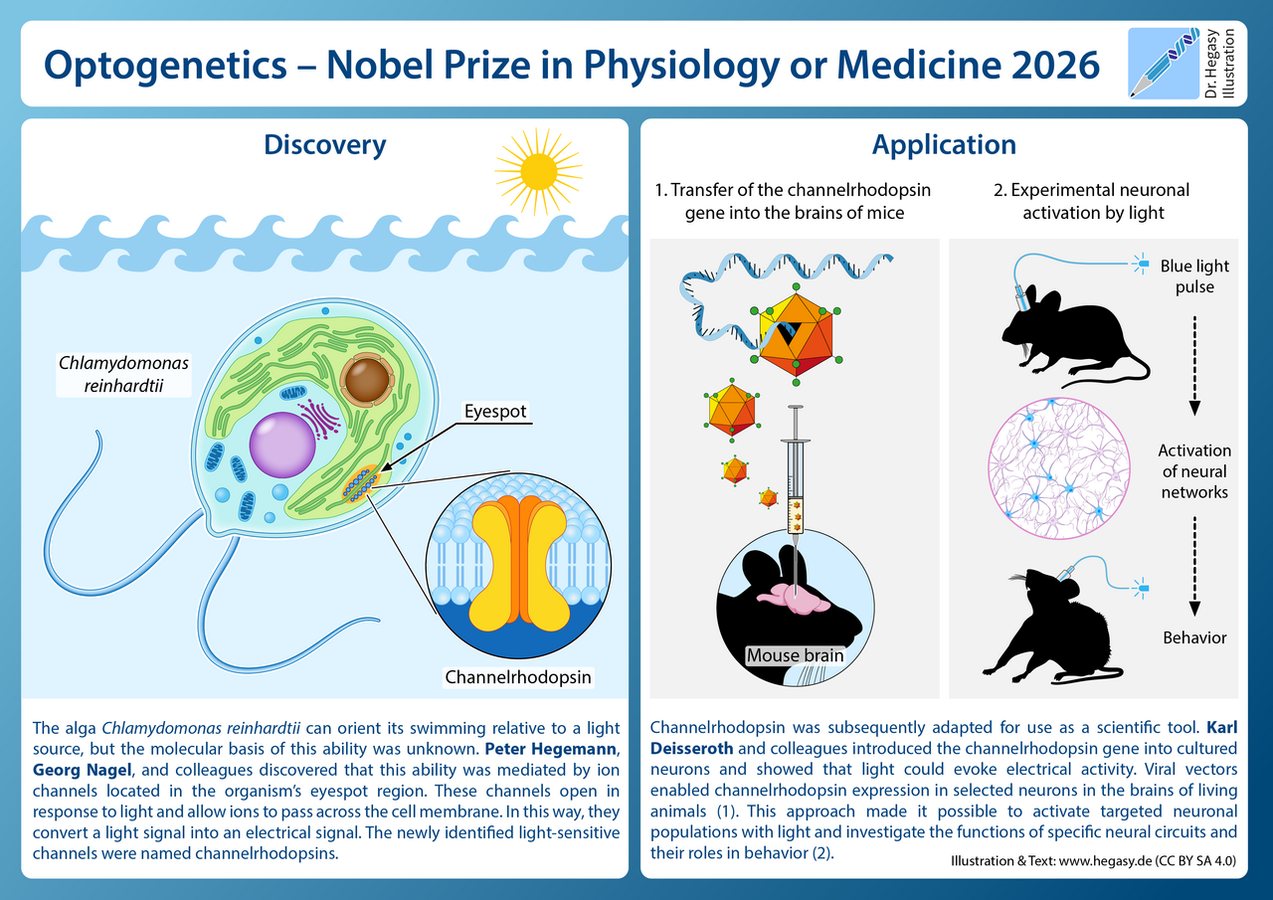
The 2026 Nobel Prize in Physiology or Medicine has been awarded to the scientists who developed optogenetics, a technique that allows researchers to switch individual brain cells on and off using light. The method, which grew out of a light-sensitive protein found in tiny algae, has become one of the most powerful tools in neuroscience and is now opening new possibilities for restoring vision and treating brain disorders.
Optogenetics works by inserting light-sensitive proteins, known as opsins, into specific neurons. When light of the right color is shone on those cells, the proteins respond by activating or silencing the neurons. This gives researchers precise control over neural activity in living tissue, something that traditional electrical stimulation could not achieve with the same speed and cell-type specificity. The approach has already helped scientists activate memories in laboratory animals, demonstrating that specific neural circuits can be switched on at will.
The discovery at the heart of the prize came from an unexpected place: single-celled algae that use light-sensitive proteins to sense and respond to their environment. Researchers recognized that these microbial proteins could be adapted for use in mammalian neurons, and the field of optogenetics was born. Since then, the technique has spread rapidly through neuroscience laboratories worldwide, becoming a standard method for probing how brain circuits produce behavior, emotion, and memory.
The implications extend well beyond basic research. Because optogenetics can restore light sensitivity to cells that have lost it, scientists are exploring its use in gene therapy approaches for inherited blindness. In these experimental treatments, light-sensitive proteins are delivered to surviving retinal cells so that they can respond to light again, potentially restoring some visual function in people with degenerative eye disease. Clinical trials in this area are already under way.
Optogenetics is also being investigated as a tool for treating neurological and psychiatric conditions. By targeting specific populations of neurons, researchers hope to develop more precise interventions for disorders such as Parkinson's disease, epilepsy, and depression, where conventional treatments often affect broad regions of the brain and produce unwanted side effects. The ability to control defined circuits with light could eventually lead to new classes of therapies that act with far greater precision.
The Nobel committee's recognition reflects how quickly optogenetics moved from a curiosity in algal biology to a cornerstone of modern neuroscience. The technique has transformed the study of the brain by making it possible to test causal relationships between neural activity and behavior, rather than merely observing correlations. Researchers can now ask which specific cells drive a given behavior and then confirm the answer by switching those cells on or off in real time.
The prize also highlights the value of basic research on seemingly obscure organisms. The light-sensitive proteins that make optogenetics possible were not discovered with brain science in mind; they were studied because they helped algae navigate toward light. That work, carried out without any expectation of medical application, provided the foundation for a technology now used in thousands of laboratories and moving toward the clinic.
As the field advances, scientists are working to overcome remaining obstacles, including the delivery of light deep into brain tissue and the long-term safety of introducing foreign proteins into human cells. The award is expected to accelerate interest and investment in optogenetic research, particularly in the areas of vision restoration and circuit-based therapies for brain disorders.
10