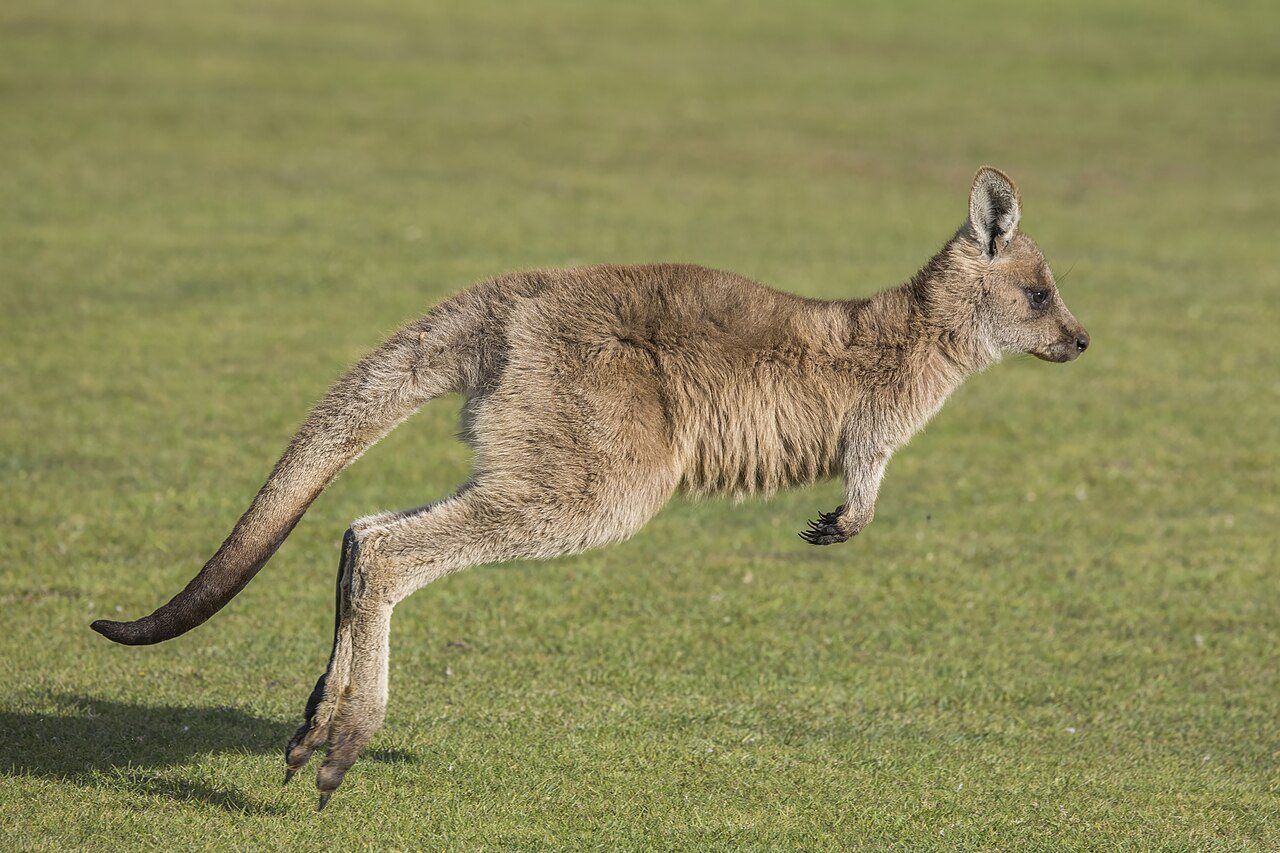
Kangaroos are instantly recognizable by their bounding gait, a mode of travel that sets them apart from nearly all other large mammals. Far from being a quirk of nature, the hop is a highly specialized adaptation finely tuned for energy efficiency, allowing these marsupials to cover vast distances across the Australian landscape while expending minimal effort.
The mechanics of the hop rely on the kangaroo's powerful hind legs and long, elastic tendons. As the animal lands, these tendons stretch and absorb the kinetic energy of the impact. On the next push-off, that stored energy is released, propelling the kangaroo forward with little additional muscular work. This spring-like action becomes more efficient at higher speeds, meaning a fast-moving kangaroo uses less energy per unit of distance than a slower one, a trait that is the opposite of what is seen in most running animals.
This efficiency is crucial for survival in the arid and semi-arid environments where kangaroos live. Food can be scarce and widely dispersed, forcing the animals to travel long distances between feeding grounds. The ability to move quickly and economically allows them to conserve precious energy reserves, which are vital for growth, reproduction, and escaping predators. The tail also plays a critical role, acting as a counterbalance and providing additional propulsion, particularly during slower movement.
The kangaroo's unique gait is a prime example of evolutionary problem-solving. While other large mammals, such as horses and dogs, have evolved for endurance running with a four-legged stride, the kangaroo has taken a different path. Its bipedal hopping is not merely a way to get from one point to another; it is a sophisticated energy-saving strategy that has proven remarkably successful for over 20 million years of evolution in Australia.
Scientists continue to study the biomechanics of the kangaroo hop, drawing inspiration for robotics and prosthetics. The principles of elastic energy storage and release observed in these animals are being applied to the design of more efficient legged robots and artificial limbs. The iconic hop, therefore, is not only a symbol of the Australian wilderness but also a subject of ongoing scientific inquiry with potential applications far beyond the outback.
118