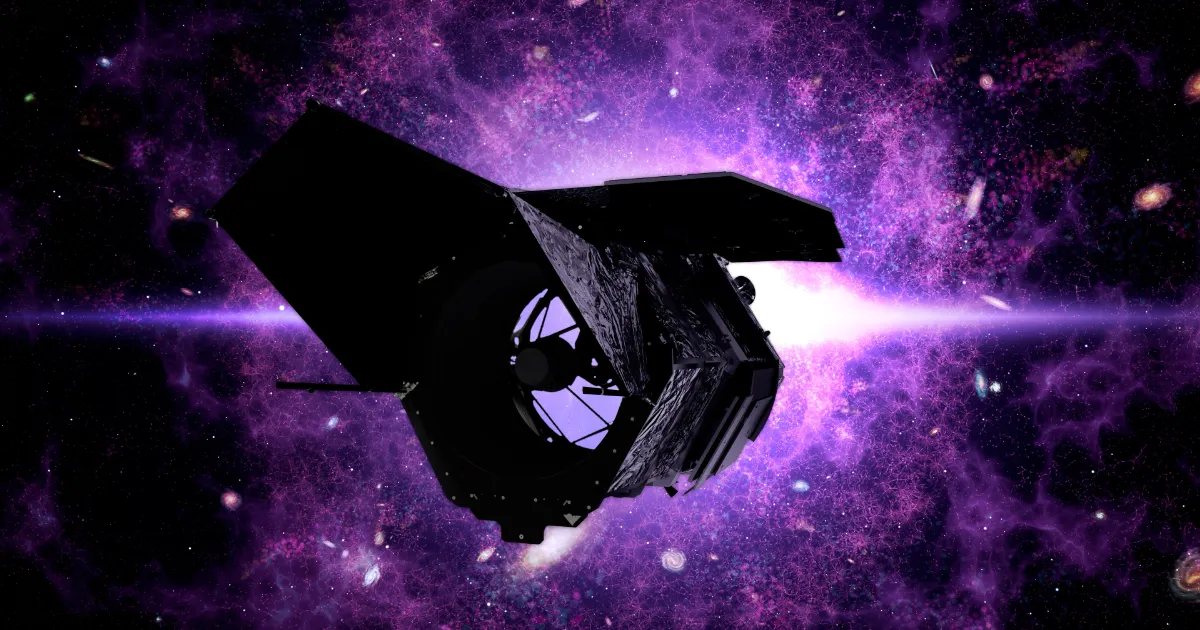
NASA is preparing to launch the Nancy Grace Roman Space Telescope, a next-generation observatory designed to investigate the universe's darkest secrets — dark energy and dark matter — and to transform humanity's understanding of cosmic evolution. The mission, named after NASA's first chief of astronomy, is positioned as a successor to the James Webb Space Telescope with a distinct focus on wide-field surveys rather than deep, targeted observations.
The Roman telescope's primary scientific goal is to unravel the nature of dark energy, the mysterious force believed to be accelerating the expansion of the universe. By measuring the distribution of galaxies and the subtle distortions of light from distant supernovae across vast swaths of the sky, Roman will provide unprecedented data on how the universe's expansion rate has changed over billions of years. These measurements could help determine whether dark energy is a constant force or something that evolves over time.
Dark matter, the invisible substance that makes up roughly 27 percent of the universe's mass-energy content, is another central target. Roman will use a technique called gravitational lensing — observing how massive foreground structures bend the light from background galaxies — to map dark matter's distribution with far greater precision than current instruments allow. This mapping could reveal whether dark matter interacts with itself or with ordinary matter in ways not yet understood.
Beyond cosmology, the Roman Space Telescope is expected to conduct a massive survey of exoplanets using gravitational microlensing, a method that detects planets by the way their gravity briefly magnifies the light of a background star. This approach is particularly sensitive to planets that orbit far from their host stars or that are free-floating, worlds that other detection methods often miss. Roman's wide field of view will allow it to monitor hundreds of millions of stars simultaneously, potentially discovering thousands of new exoplanets.
The observatory will also carry a coronagraph instrument, a technology demonstration designed to block the glare of distant stars so that faint planets can be directly imaged. If successful, this instrument could pave the way for future missions capable of studying the atmospheres of Earth-like worlds for signs of habitability or biological activity.
Roman's design emphasizes speed and breadth. Its wide-field instrument can capture an area of the sky 100 times larger than the Hubble Space Telescope's infrared view in a single exposure. This capability will enable large-scale surveys that would take Hubble centuries to complete, according to mission planners. The telescope is slated for launch in the mid-2020s, though the exact date depends on ongoing development and testing.
The mission's findings could have profound implications not only for astrophysics but also for philosophy and society. Understanding dark energy and dark matter addresses fundamental questions about the nature of reality, the fate of the universe, and humanity's place within it. As Roman begins its survey, scientists expect a flood of data that will keep researchers busy for decades and may force revisions to the standard model of cosmology.
NASA has emphasized that the Roman Space Telescope is a collaborative effort involving multiple institutions and international partners. Its success will depend on the continued support of the scientific community and the public, both of whom have long been captivated by the mysteries of the cosmos. With Roman, the search for the universe's dark secrets is about to enter a new and powerful phase.
11