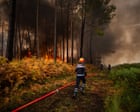
Global heating has made the extreme heat, drought and wind fueling huge wildfires in Spain and France far more likely, according to a new analysis from the World Weather Attribution (WWA) consortium. Researchers calculated that the hot, dry and windy conditions driving the blazes are now at least 20 times more probable in Spain because of climate change, and twice as likely in France.
The study is the latest to pin the blame for Europe's sweltering and deadly summer firmly on the warming caused by the burning of oil, gas and coal. As huge fires have burned across parts of both countries, the analysis provides one of the clearest measures yet of how much the climate crisis has altered the odds of wildfire weather.
The conditions at the center of the study are what scientists describe as fire weather: high temperatures, dry air and strong winds that leave vegetation parched and allow flames to spread quickly. In Spain, such conditions are now at least 20 times more likely than they would be in a world without climate change. In France, the probability has roughly doubled.
Attribution science, the approach used by the consortium, estimates the role of global heating in extreme weather by comparing the likelihood of an event in today's climate with its likelihood in a world that had not warmed. The new figures apply that method to the fire-prone weather that has gripped Spain and France, giving a fast and quantified assessment of climate change's contribution. The approach does not claim that climate change caused any single fire; rather, it shows how the background conditions that allow fires to ignite and expand have become more common.
The results were described by researchers as « extremely scary findings », a phrase that reflects how rapidly the climate crisis is reshaping fire seasons in southern Europe. What might once have been an exceptional spell of fire weather is now far more likely to occur, and the heat and wind that feed the flames are the very conditions that make fires hardest to bring under control.
The analysis also makes explicit the chain of cause and effect behind the summer's fires. Extreme heat and drought have left forests and scrubland dry across wide areas, and strong winds have given any spark the means to grow into a large blaze. The consortium's calculation puts a number on that chain: the heating produced by burning oil, gas and coal has made these conditions far more probable.
The findings come in a summer already marked by deadly heat across the continent. For the WWA experts, the message is that the weather now stoking fires in Spain and France is not a random event but an increasingly likely outcome of a warming climate. Because the analysis traces these changes to the burning of oil, gas and coal, it also underscores that the future of Europe's fire seasons will be tied to how quickly emissions are brought down.