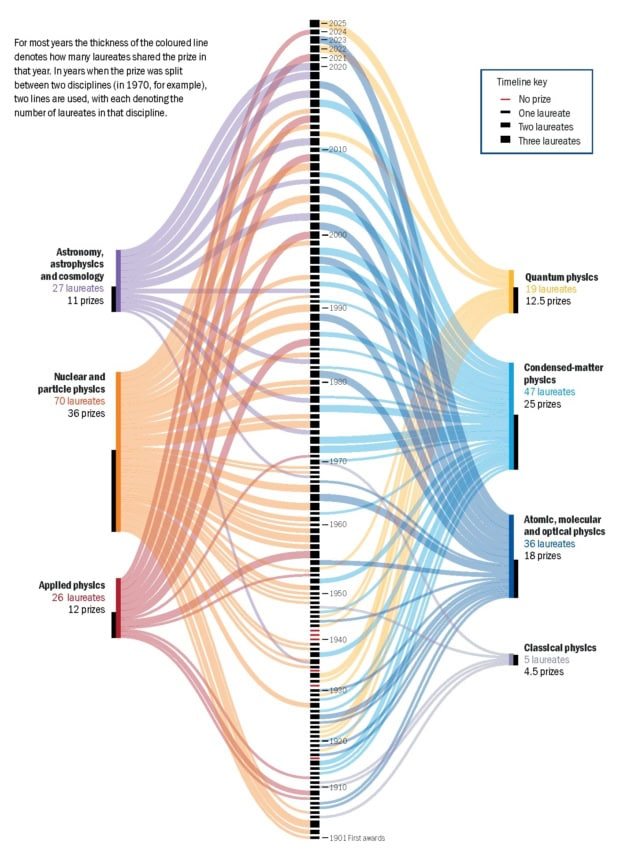
Condensed matter physics has emerged as the leading contender for the 2026 Nobel Prize in Physics, according to citation analysis and recent award patterns that suggest the field is overdue for recognition. The analytics company Clarivate has released its Citation Laureates 2026 in physics, and all three predictions fall within condensed matter — a concentration that signals both the field's vitality and the difficulty of choosing among its many advances.
The first prediction recognizes Chihaya Adachi, Stephen Forrest, and Mark Thompson for work leading to ultrahigh-efficiency organic light-emitting diodes. Their research has already transformed display technology and continues to drive energy-efficient lighting. The second honors Nicola Spaldin for her theoretical work on room-temperature magnetoelectric multiferroics, materials that couple magnetic and electric order and could enable new paradigms for energy-efficient devices. The third cites Qikun Xue for the experimental observation of the quantum anomalous Hall effect, a phenomenon with potential applications in quantum computing and precision metrology.
What unites these three predictions is a relatively immediate connection to technological development. Spaldin, profiled in 2023, has spoken about the joy of combining blue-sky research with the design of real materials — a hallmark of condensed matter physics, where fundamental discoveries often translate into practical devices within a generation.
Beyond Clarivate's picks, other prestigious awards offer clues. The 2026 Kavli Prize in Nanoscience went to Eva Andrei, Pablo Jarillo-Herrero, and Allan MacDonald for pioneering work on twistronics, a burgeoning field that involves rotating the relative angle between two sheets of 2D material such as graphene. These rotations create moiré superlattices with a wide range of electronic properties, including superconductivity. The recognition suggests the Nobel Committee may soon follow suit.
Applied physicist Federico Capasso is another strong candidate. He has developed a wide range of semiconductor technologies, including the quantum cascade laser, and has done seminal work on optical metamaterials. An award for metamaterials could be shared with John Pendry, a 2024 Kavli nanoscience laureate who developed a mathematical framework for designing optical metamaterials. Potential partners include David Smith, a pioneer in microwave-frequency metamaterials, and Andrea Alù, a prolific researcher in photonic metamaterials. Other possible winners in this area are Ulf Leonhardt, Nader Engheta, George Eleftheriades, and Vladimir Shalaev.
Particle and nuclear physics, by contrast, faces structural obstacles. The field is also due for a prize based on historical patterns of gaps between awards in specific subfields. One contender is a prize for physicists working on CERN's ATHENA and ALPHA collaborations, who first trapped cold antihydrogen atoms and then studied them in detail. Jeffrey Hangst, a Denmark-based American physicist and founder of both collaborations, would be a likely laureate. Precise comparisons of antihydrogen and hydrogen could reveal why the universe appears to contain far more matter than antimatter — a major unsolved mystery. However, these experiments have yet to find significant deviations from the Standard Model description of antihydrogen, which might preclude a Nobel. Moreover, many of the innovations at ATHENA and ALPHA arguably belong to atomic and molecular physics, not particle and nuclear physics.
Another potential particle physics prize would recognize the creation of the quark–gluon plasma, a state of matter that occurs briefly when large nuclei such as lead or gold are collided at high energies. The resulting soup of quarks and gluons is thought to resemble the early universe shortly after the Big Bang. But because the experimental work has been done by large collaborations at CERN in Switzerland and at Brookhaven National Laboratory in the US, selecting just three individuals for the prize would be difficult. This challenge has led some to call for lifting the three-person limit on Nobel winners.
Finally, an intriguing possibility comes from Clarivate's 2025 Citation Laureates in physics, which proposed Ingrid Daubechies, Stéphane Mallat, and Yves Meyer for advancing wavelet theory — a revolution in mathematics and physics with practical applications including signal processing and data compression. While not strictly condensed matter, wavelet theory's broad impact across physics could make it a dark-horse contender.
As the Nobel Committee prepares to announce its decision, the balance of evidence suggests that condensed matter physics, with its rich portfolio of technological breakthroughs and fundamental discoveries, may finally get its turn in the spotlight.
11