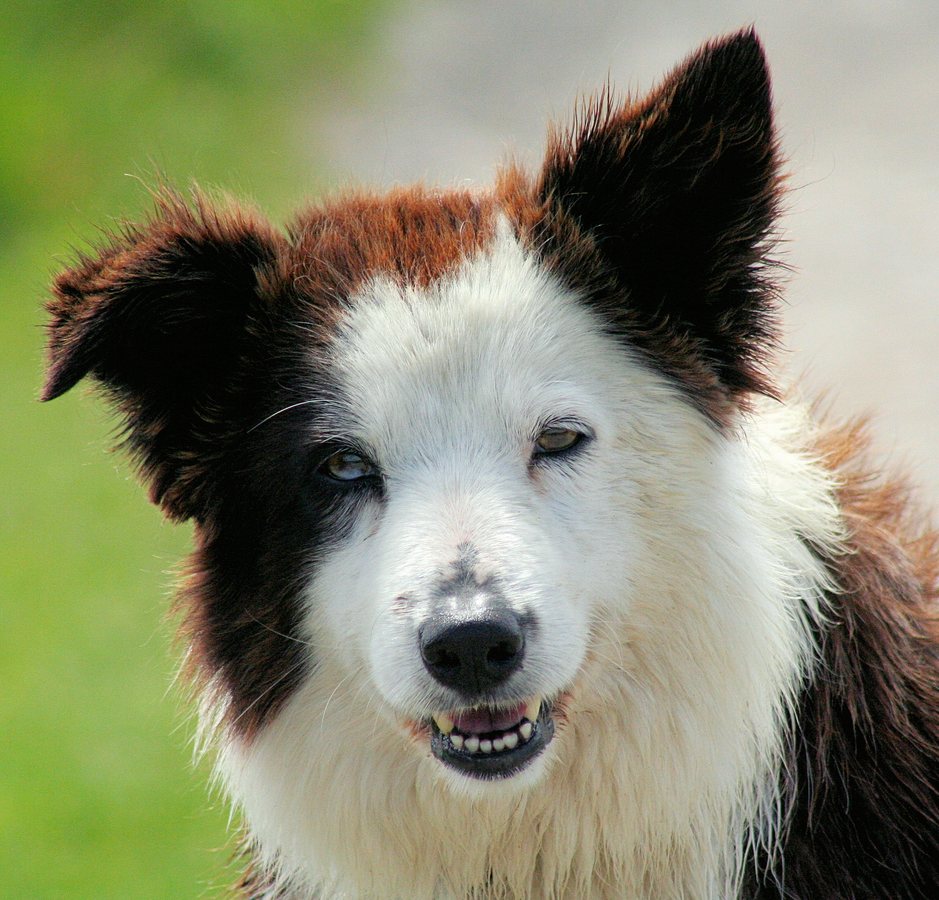
An fMRI study of awake pet dogs has found that the canine brain contains distinguishable representations of some human negative facial expressions. Whole-brain patterns separated fear from anger and fear from sadness, while anger and sadness were not reliably separable.
The work, published in iScience and accompanied by an open research dataset, used two experiments to move from a broad emotional contrast toward finer-grained classification. Dogs were trained to remain awake and still in an MRI scanner while photographs of unfamiliar human faces were presented.
Experiment 1 included eight dogs. They viewed happy and neutral faces. The happy condition produced greater activity in a right temporal cluster extending to the caudate nucleus, including the rostral Sylvian gyrus. The caudate is widely associated with reward-related processing, making this response consistent with previous canine neuroimaging work on positive social cues.
Experiment 2 included twelve dogs and four expressions: happiness, anger, fear and sadness. The researchers first used the region identified in Experiment 1 as a region of interest. A classifier trained on patterns within that ROI distinguished happiness from each negative expression. It did not reliably distinguish the negative expressions from one another.
A whole-brain representational similarity analysis revealed information that the ROI analysis missed. Angry versus fearful faces differed in patterns involving the right mid ectosylvian and left splenial gyri. Sad versus fearful faces differed in a right rostral suprasylvian region. No reliable distinction was found between angry and sad faces.
The authors characterize the findings as the first evidence that dog brains can differentiate between two human facial expressions of the same negative valence. The result refines an older experimental framework that often asked whether dogs can discriminate broadly positive from negative emotional signals.
The most obvious interpretation is functional rather than linguistic. Fear, anger and sadness can imply different conditions for an observer. Fear may indicate an external threat; anger may signal that the displaying individual is itself a threat; sadness may carry social information without immediate danger. The paper’s authors suggest that differences in threat type could help explain why fear was neurally distinct.
That interpretation remains a hypothesis. Neural discriminability does not establish that a dog possesses human-like concepts of “fear,” “anger” or “sadness.” fMRI measures hemodynamic responses associated with neural activity, and multivariate analyses test whether patterns differ systematically. They do not reveal subjective emotional understanding.
The sample sizes are another important limitation. Eight and twelve dogs are small groups, even though awake canine fMRI imposes unusual practical constraints. Replication across more animals, breeds, ages and rearing histories will be needed to estimate how general the effect is.
Using unfamiliar faces reduces one confound: the observed differences cannot be explained solely by a dog’s learned history with its primary caregiver. At the same time, static photographs simplify natural social perception. In daily life, dogs integrate faces with vocal prosody, body posture, movement, odor and prior interactions.
The methodological contrast between analyses is especially informative. A localized ROI captured the broad positive-negative division, but same-valence distinctions emerged only at the whole-brain level. That result is consistent with the idea that complex social categories are represented by distributed neural patterns rather than one discrete detector.
The study now creates testable behavioral predictions. If a fearful human face represents a different kind of information from an angry face, dogs might orient differently, alter interpersonal distance or search the environment for a source of threat. Eye tracking, autonomic measures and behavioral choice tasks could be paired with neuroimaging to test those predictions.
The scientific advance is therefore modest but clear: the canine brain’s representation of human facial emotion is not exhausted by emotional valence. At least one negative expression—fear—can be distinguished from other negative expressions in distributed neural activity, offering a sharper tool for studying how domestication and shared social life shaped the dog-human relationship.
142