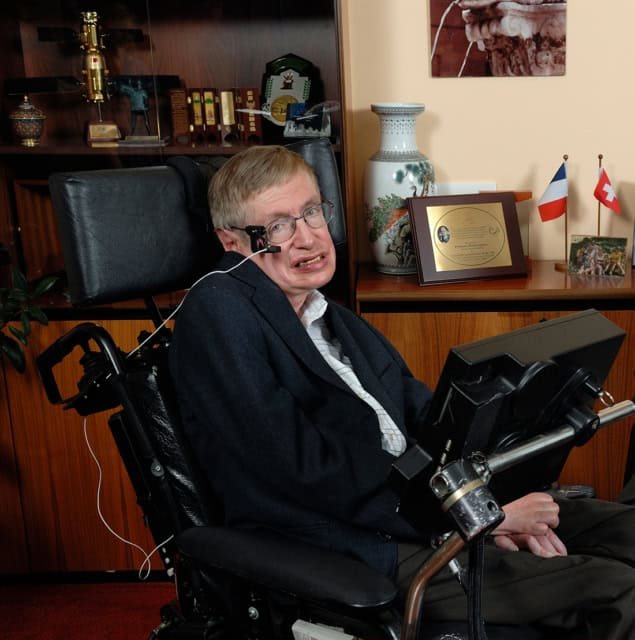
Stephen Hawking, one of the most famous physicists of his era, is the subject of a new authorized biography by the science writer Graham Farmelo. Titled Hawking: His Life and Work, the book was commissioned after Hawking’s death in 2018 at the age of 78, at the invitation of his family, and has just been published by John Murray. Farmelo, who is himself a physicist by training, previously wrote the well-received 2009 biography of Paul Dirac, The Strangest Man.
Hawking made decisive contributions to cosmology and astrophysics, notably to the physics of black holes. Farmelo said that his main concern at the outset was whether there was anything new to learn about a life already told in many documentaries, books and Hollywood films. He said he counted himself lucky on that front. He had access to the Hawking archive at the University Library in Cambridge and, about six months into the project, learned from Hawking’s older sister, Mary, that she was willing to give him access to their parents’ writings.
Hawking’s father kept a high-quality diary for nearly 60 years, which Farmelo described as talkative, interesting and not evasive. His mother began writing around 1970 and, in Farmelo’s words, was a very talented writer who was direct and unforgiving. Farmelo also drew on information from Hawking’s friends, including the Nobel laureate Kip Thorne, one of the scientists who discovered gravitational waves, and Hawking’s childhood friends John McClenahan and Robert Donovan.
According to Farmelo, these sources gave a far more vivid picture than the bland statements often repeated about Hawking. His father knew Stephen was very bright and skilled at mathematics but worried he would squander the talent by not concentrating. Farmelo said Hawking worked only on subjects that interested him: if a teacher failed to capture his imagination he barely bothered, and he was dismissive of parts of physics he considered trivial. A strong mathematics teacher, however, helped inspire his enthusiasm for pure mathematics.
Asked what trait stood out beyond the public persona, Farmelo pointed to Hawking’s colossal determination and stubbornness, alongside the wit and dry humour that most people associate with him. He recalled that the physicist David Gross had said he had met many clever physicists but none with anything like Hawking’s determination.
On Hawking’s standing in theoretical physics, Farmelo said physicists have a habit of ranking one another, a practice he considers largely pointless. He said he regards Albert Einstein as the greatest physicist of the 20th century, and placed Hawking in relation to Einstein and to figures such as Paul Dirac, Werner Heisenberg and Erwin Schrödinger, whom Hawking himself regarded as great physicists for discovering fundamental theories of nature. Farmelo said there is a good case that nobody did more to advance understanding of black holes than Hawking, and that the physicists he consulted did not dismiss his work as overrated. When he asked one leading physicist how famous Hawking would have been without his disability, the answer was that he would be as famous as Murray Gell-Mann or Steven Weinberg.
22