Half a century after a frustrated graduate student first sketched an impossibly intricate pattern of nested bands and gaps, Hofstadter's butterfly has not faded into scientific nostalgia. Instead, the fractal energy spectrum of electrons moving through a two-dimensional crystal lattice under a magnetic field has become more important than ever, resurfacing in new materials, new experiments, and theoretical territory that its discoverer never imagined.
The story began in 1974, when Douglas Hofstadter, then a PhD student at the University of Oregon, was struggling to solve a problem that had defeated his advisor, the solid-state physicist Gregory Wannier. The challenge centered on Harper's equation, which describes how electrons behave on a 2D lattice when a perpendicular magnetic field is applied. The equation displayed a puzzling sensitivity to whether the magnetic flux passing through each unit cell was a rational or irrational number — a dichotomy that captured Hofstadter's imagination.
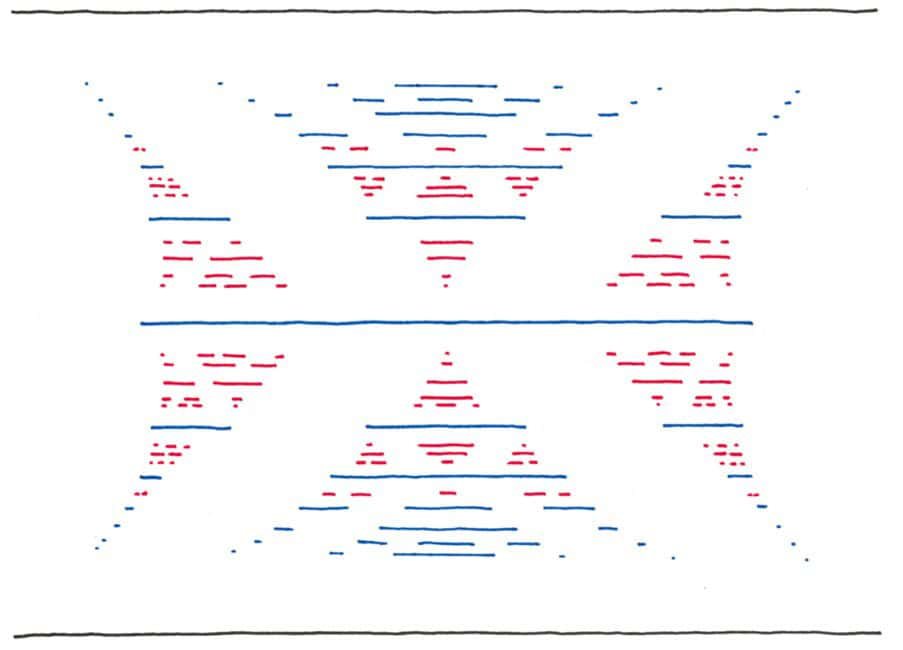
Frustrated by analytical approaches, Hofstadter turned to numerical computation, using a programmable Hewlett-Packard desktop calculator that by modern standards looks laughably primitive. He plotted the energy of electrons against magnetic flux and watched a complex recursive shape emerge — a self-similar fractal resembling a butterfly. «All at once my eyes were opened,» Hofstadter later recalled.
Wannier was initially unimpressed. According to Hofstadter, his advisor dismissed the result as «numerology» and even threatened to withdraw his funding. But after nearly a year, Wannier recognized the validity and significance of the work, ultimately awarding Hofstadter his PhD and accepting the butterfly as a legitimate description of the energy spectrum. Wannier later published a paper titled «A result not dependent on rationality for Bloch electrons in a magnetic field,» and further studies with physicist Francisco Claro introduced a set of integers uniquely labeling every gap in the graph, providing a simplified description of the spectrum.
The original hand-drawn diagram, codenamed «Gplot,» has been lost, but Hofstadter created a reconstruction in 2016. The pattern was first published in 1976 in Physical Review B, and its influence has only grown since. Recent research by Kazuki Ikeda of the University of Massachusetts and Yaron Oz at Stony Brook University suggests that related patterns may even surface in the physics of black holes, published in the Journal of High Energy Physics.
Each new realization adds another chapter to a story that is not really about a single graph or a single discovery, but about the unity of patterns across the physical world. A structure first seen in a simple model has become a symbol of how richness can emerge from basic rules, how beauty can arise from constraint, and how the quantum world still harbors forms strange enough to surprise us.
Douglas Hofstadter, born in 1945, is the son of Nobel-prize-winning nuclear physicist Robert Hofstadter. Four years after publishing his butterfly paper, he published the Pulitzer-prize-winning popular-science book Gödel, Escher, Bach, which tackles cognition, mathematics, and symmetry. He is currently a professor of cognitive science and comparative literature at Indiana University in Bloomington and remains active as a researcher, having written a follow-up book, I Am a Strange Loop, in 2007.
In 2016, Hofstadter reunited with colleagues Indu Satija and Francisco Claro, all wearing T-shirts emblazoned with the butterfly to celebrate its 40th anniversary. As the pattern turns 50, it stands as a testament to how a simple model, pursued with persistence and a willingness to abandon conventional methods, can reveal structures that resonate across vastly different scales of nature — from tabletop crystals to the edges of black holes.
12