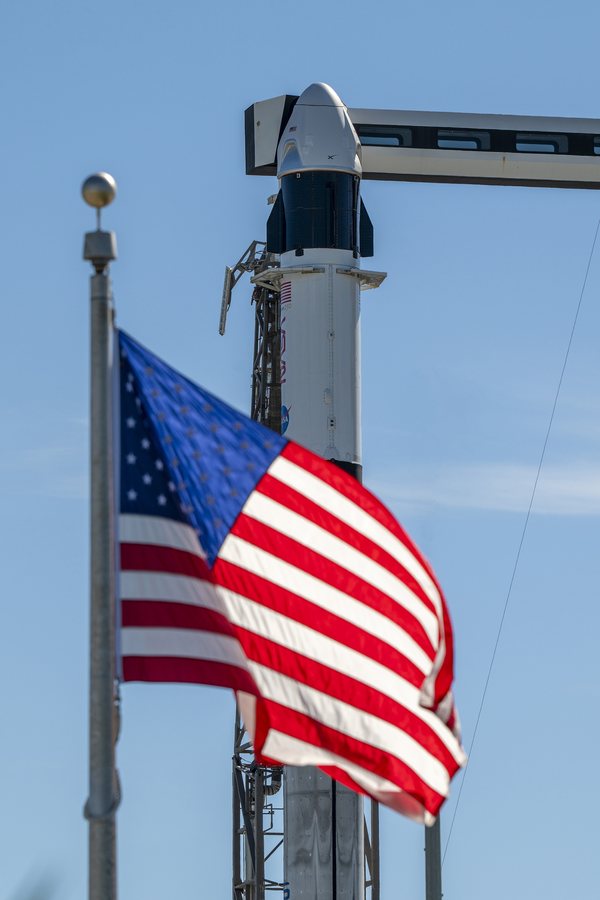
NASA's SpaceX Crew-13 mission has reached a key milestone ahead of launch, with a Falcon 9 rocket and its Dragon spacecraft now standing vertical at the launch pad at Space Launch Complex 40 at Cape Canaveral Space Force Station in Florida. The rocket was raised into position on Sunday, Sept. 27, 2026, as final preparations for liftoff continue.
The Crew-13 flight is the latest in NASA's commercial crew rotation program, which uses SpaceX hardware to ferry astronauts to and from the International Space Station. The Falcon 9 rocket carries the Dragon capsule at its top, where the crew will ride during ascent. Once in orbit, the spacecraft will separate from the rocket's second stage and begin a carefully timed series of maneuvers to catch up with the station.
Placing the rocket vertical at the pad is one of the last major steps before launch. It allows teams to complete final checks of the vehicle, its systems, and the launch infrastructure. Engineers will verify that the rocket and spacecraft are ready for the fueling and ignition sequence that begins on launch day. The Dragon spacecraft itself has already been mated to the Falcon 9, a process that involves securing the capsule to the rocket's upper stage and confirming all connections between the two vehicles.
The mission is part of a broader effort to maintain a continuous human presence in low Earth orbit. Crew rotations like Crew-13 ensure that the space station remains staffed with astronauts who conduct scientific research, maintain the orbiting laboratory, and carry out spacewalks and technology demonstrations. The station's research spans biology, physics, materials science, and Earth observation, and the crew's work supports both current missions and future exploration beyond low Earth orbit.
SpaceX's Falcon 9 is a reusable two-stage rocket that has become a workhorse for NASA and commercial launches. Its first stage is designed to return to Earth and land on a drone ship or at a land-based pad, allowing it to be refurbished and flown again. The Dragon spacecraft is likewise reusable, with SpaceX recovering and refurbishing capsules between flights. This approach has helped lower the cost of reaching orbit and increased the frequency of launches from the United States.
Space Launch Complex 40 has hosted many Falcon 9 missions, including previous crewed flights for NASA. The pad is located on Florida's Space Coast, a region that has seen a surge in launch activity in recent years from both government and private operators. The site's proximity to the Atlantic Ocean provides a safe trajectory for launches heading to the space station's orbital inclination.
While the exact launch date and time have not been detailed in the latest update, the placement of the rocket at the pad signals that the mission is in its final preparation phase. NASA and SpaceX will continue to monitor weather conditions and technical readiness before proceeding with the launch. Once the crew arrives at the station, they will join the existing Expedition crew and begin a months-long stay in orbit.
The Crew-13 mission underscores the ongoing partnership between NASA and private industry in human spaceflight. Under the commercial crew program, SpaceX and Boeing were selected to provide astronaut transportation services, ending the United States' reliance on Russian Soyuz spacecraft for crewed launches. The program has now flown multiple operational missions, each contributing to the station's scientific output and international collaboration.
As the Falcon 9 stands ready at the pad, teams will conduct final rehearsals and reviews. The next visible step will be the rollout of the crew to the launch site and the start of the launch countdown. For now, the vertical rocket serves as a clear sign that another crew is preparing to leave Earth for the International Space Station.
13