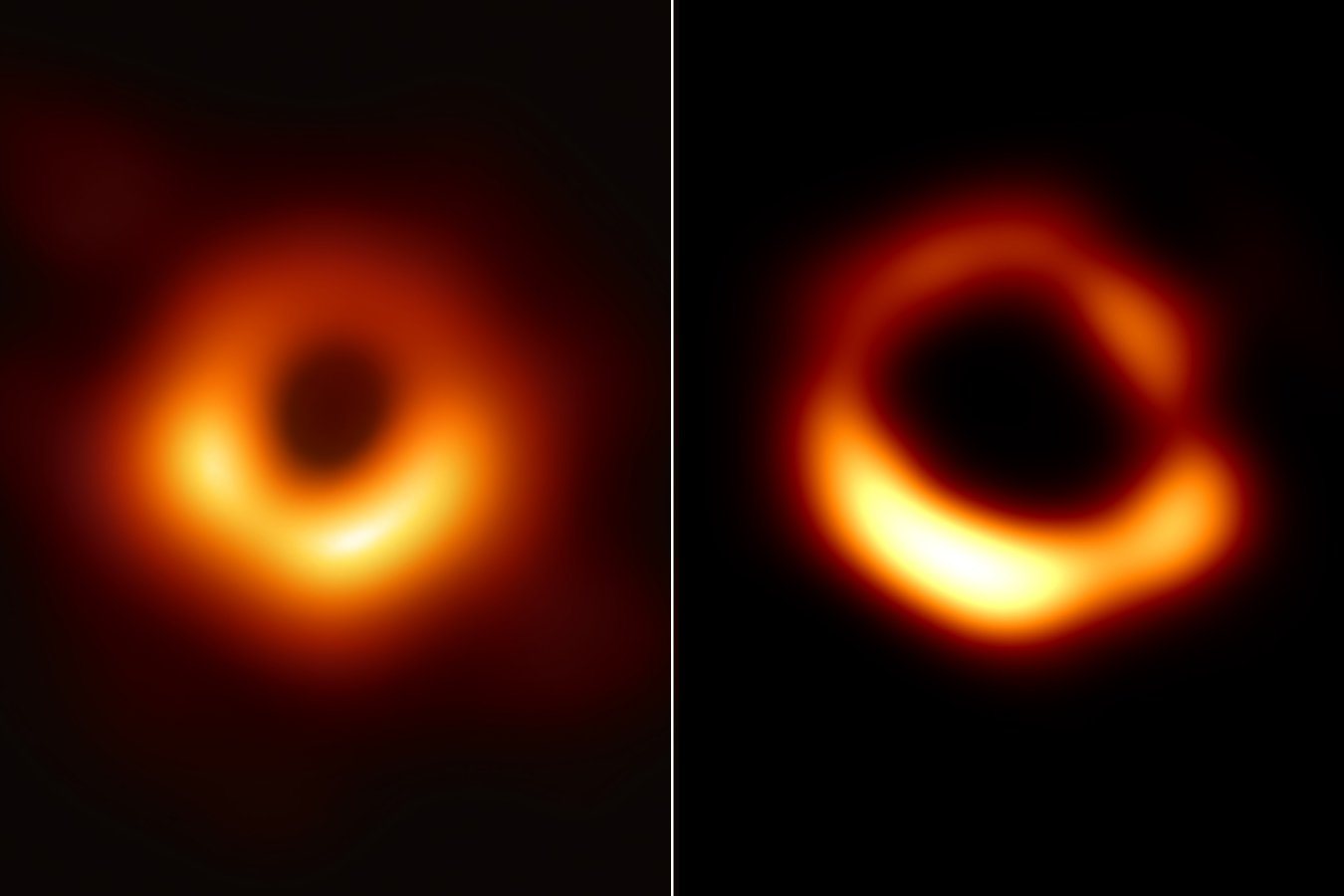
An independent team has reanalysed the observations behind the first image of a black hole and found that the bright ring at its centre is really there. The work, led by Nithyanandan Thyagarajan of Australia's national science agency CSIRO, was published in Nature in November 2026 and strengthens confidence in the 2019 picture of the object known as M87*.
The Event Horizon Telescope collaboration released that original image in 2019. It showed a ring of light around a dark centre, a shape that matched the predictions of Albert Einstein's general theory of relativity. Some later reanalyses of the same data, however, reported that no ring could be found, and doubt about the result grew in the scientific community.
Thyagarajan's team approached the problem differently. Rather than using the standard pairs of telescopes, they used groups of three, known as triplets. Combining signals this way cancels out errors introduced by the atmosphere, which otherwise blur and distort radio observations. The researchers also trained a machine-learning system on images that contained no black hole, in order to reduce the risk that their expectations would shape the result.
The new image is nearly identical to the original ring picture. For the team, that agreement is the key finding: the ring survives a different method of processing the same raw data. The result supports the view that general relativity accurately describes spacetime close to a black hole.
The researchers are careful about the limits of the findings. The Event Horizon Telescope uses only a small number of telescopes, leaves large gaps in its data and works at short radio wavelengths, all of which make the images hard to pin down. The team also noted that the outcome depends heavily on choices made during data processing, which is why the independent check matters.
Credit. Based on reporting by Leah Crane for New Scientist. Is this your work? Write to us.
22