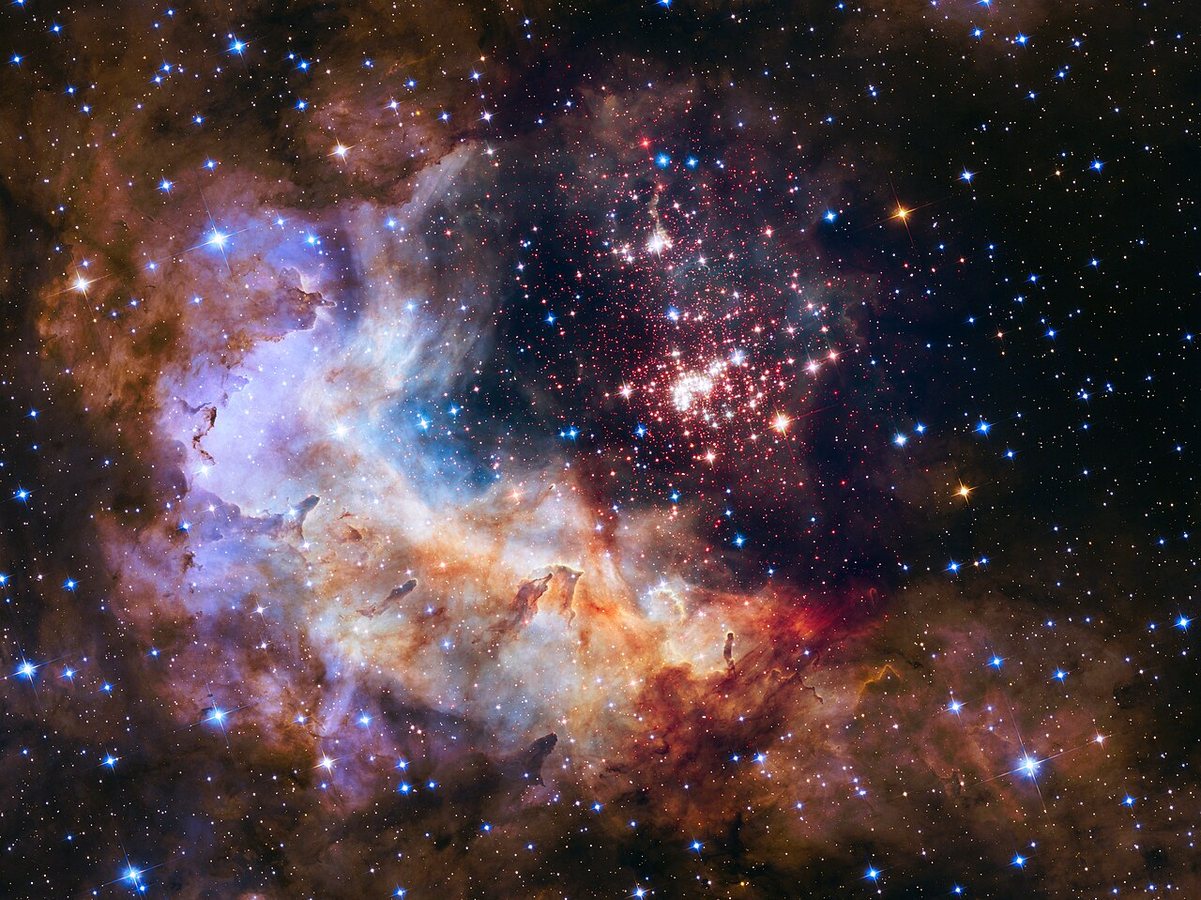
An international research team has identified 353 candidate brown dwarfs in the distant super star cluster Westerlund 2, including objects with masses as low as ten times that of Jupiter. The discovery, made using observations from the James Webb Space Telescope, marks the first time such a low-mass substellar population has been detected within a super star cluster, providing new insight into how these unusual objects form in high-energy environments.
Brown dwarfs occupy the murky boundary between stars and planets. Too massive to be classified as planets yet not massive enough to sustain hydrogen fusion in their cores like true stars, these compact, cool objects slowly radiate away their stored energy over time. The lower mass limit for a star is approximately 0.075 solar masses; below that threshold, the core cannot ignite the thermonuclear reactions that define stellar life. Brown dwarfs fall just beneath this limit, making them scientifically valuable for understanding the full spectrum of objects formed by gravitational collapse.
Because brown dwarfs are small and cold, their radiation is extremely faint, which makes them difficult to detect. Typically, astronomers have only been able to find them in the immediate solar neighborhood. This limitation has constrained scientific understanding of their formation and evolution, since the environments around the Sun are relatively similar to one another, characterized by low mass and low energy. Finding brown dwarfs in young, massive stellar environments such as super star clusters is of great scientific importance, as it allows researchers to investigate how the formation and evolution of these objects vary depending on the surrounding environment.
The team, led by astrophysicist Victor Almendros-Abad of the National Institute for Astrophysics in Palermo, Italy, analyzed data from Westerlund 2 obtained with the NIRCam instrument aboard the James Webb Space Telescope. The observations were part of the Extended Westerlund 1 and 2 Open Clusters Survey collaboration. Westerlund 2 is located approximately twenty thousand light-years from the Sun, and its crowded, distant nature makes it an ideal target for testing the telescope's capabilities.
Some of the photometric filters used in the observations were specifically designed to isolate the absorption bands of molecules that populate the atmospheres of brown dwarfs. This approach allowed the team to identify and isolate 353 candidate substellar objects within the cluster, reaching down to masses of just ten times that of Jupiter. According to the researchers, this is the first time such an extensive substellar population, extended to such low masses, has been identified inside a super star cluster.
«What surprised me most», Almendros-Abad said, «is how much information is hidden in these images. JWST not only offers extraordinary sensitivity: some of the filters used for these observations were chosen specifically to sample features produced by molecules like water in the atmospheres of very cold objects. By combining the brightness measured through many different filters, we can obtain a sort of low-resolution fingerprint of each source and distinguish promising brown dwarf candidates among the thousands of stars present in the images. Seeing the brown dwarf sequence emerge from data obtained at more than four thousand parsecs away shows very concretely how much JWST has radically changed what we are able to study».
The findings are detailed in a paper titled «EWOCS-IX: JWST/NIRCam observations of Westerlund 2 — Identification of candidate substellar members», led by Almendros-Abad and accepted for publication in the journal Astronomy & Astrophysics. The study involved a large international collaboration of researchers from institutions across Europe, the United States, and elsewhere. The large sample of candidate brown dwarfs will serve as an important foundation for future studies aimed at understanding the birth mechanisms of these objects in high-energy star-forming environments, as well as their internal structure, magnetic activity, atmospheric characteristics, and the possibility that they might host planetary systems.
76