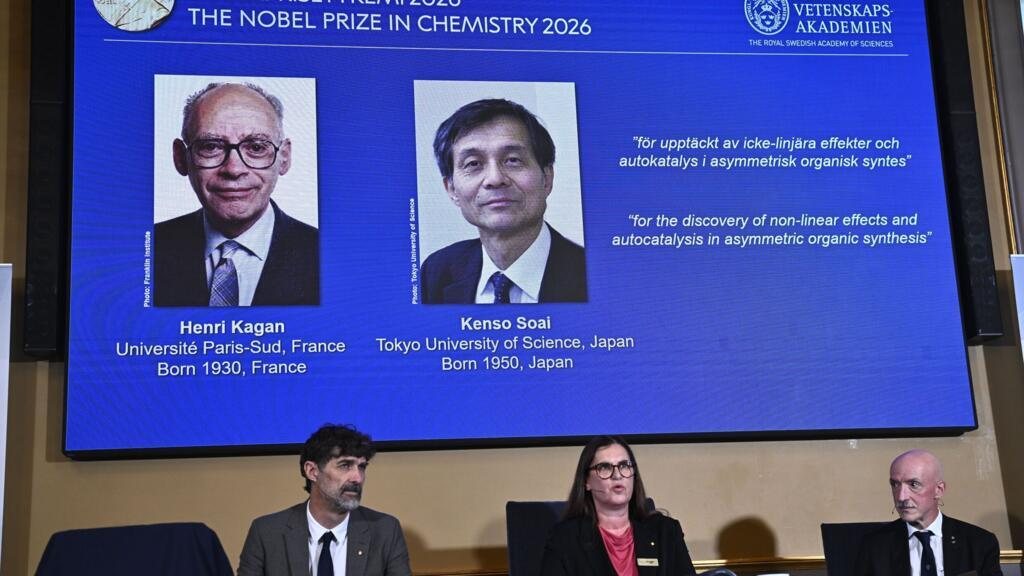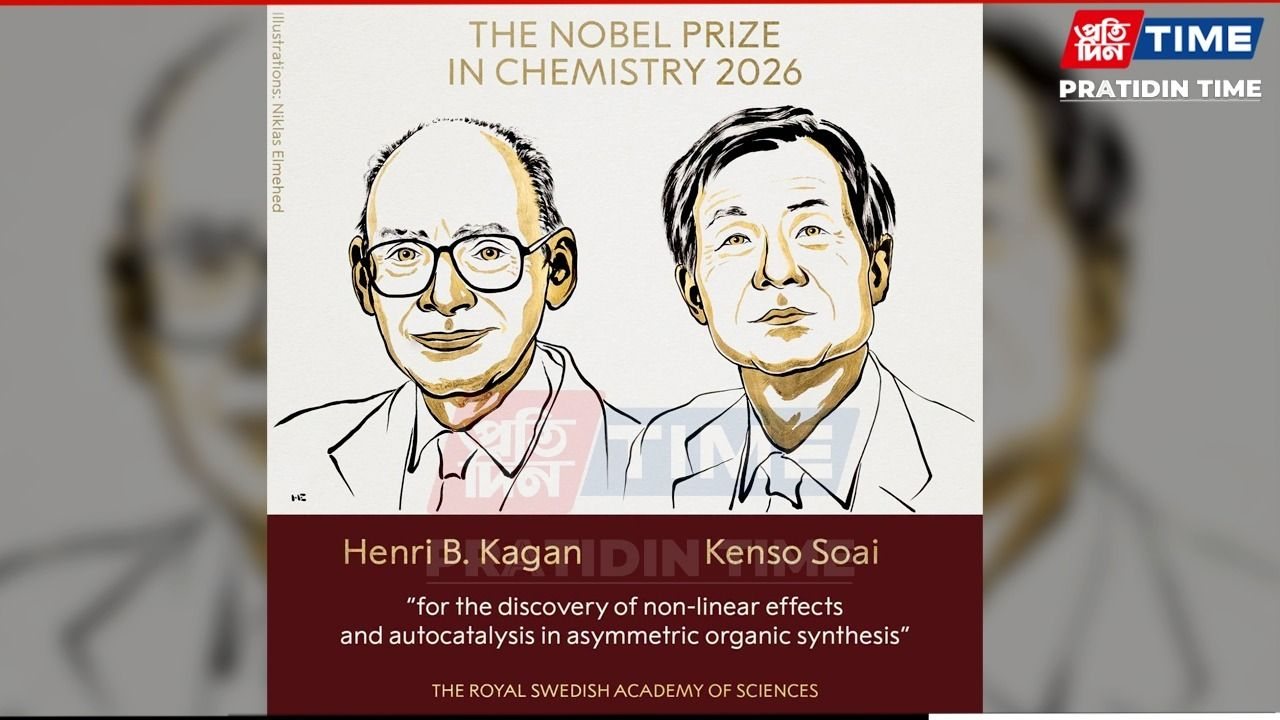
The Royal Swedish Academy of Sciences has awarded the 2026 Nobel Prize in Chemistry to Henri B. Kagan and Kenso Soai for their pioneering work on non-linear effects and autocatalysis in asymmetric organic synthesis. The two researchers were recognized for helping answer a question that has puzzled chemists for decades: how the chemical asymmetry found in living organisms, known as homochirality, could emerge.
Many molecules, including amino acids, exist in two forms that are mirror images of each other. Both forms can be produced through certain chemical reactions, yet living organisms overwhelmingly use only one of these mirror-image forms. That preference has long stood as one of chemistry's most stubborn mysteries, and it carries weight far beyond the laboratory, since the two forms of a molecule can behave very differently inside a living body.
Kagan made a major breakthrough in 1986 by discovering a new way to manipulate chemical reactions. His work demonstrated that it was possible to produce a greater excess of one mirror-image molecule than scientists had previously believed possible. That finding reshaped how researchers thought about the limits of asymmetric synthesis and opened the door to further inquiry.
Soai later built on that understanding. In 1995, he published research describing a chemical reaction with the potential to produce a homochiral outcome. In 2003, he reached a major milestone by demonstrating a reaction in which only one of two possible mirror-image molecules was formed. Taken together, the discoveries of Kagan and Soai have provided important insights into how homochirality can emerge through chemical processes.
The implications extend well beyond theory. Asymmetric synthesis is particularly important in pharmaceutical research. When developing medicines and other compounds that interact with living organisms, the two mirror-image forms of a molecule can have very different biological effects. Being able to selectively produce one form is therefore crucial in the manufacture of many pharmaceuticals, where an unwanted mirror-image version can alter a drug's action or safety.
The 2026 Nobel Prize in Chemistry recognizes the two scientists for discoveries that have fundamentally advanced the understanding and control of such asymmetric chemical reactions. Their work connects a deep question about the origins of life's chemical preferences to the practical demands of making modern medicines, a link that gives the award significance for both basic science and applied research.
9