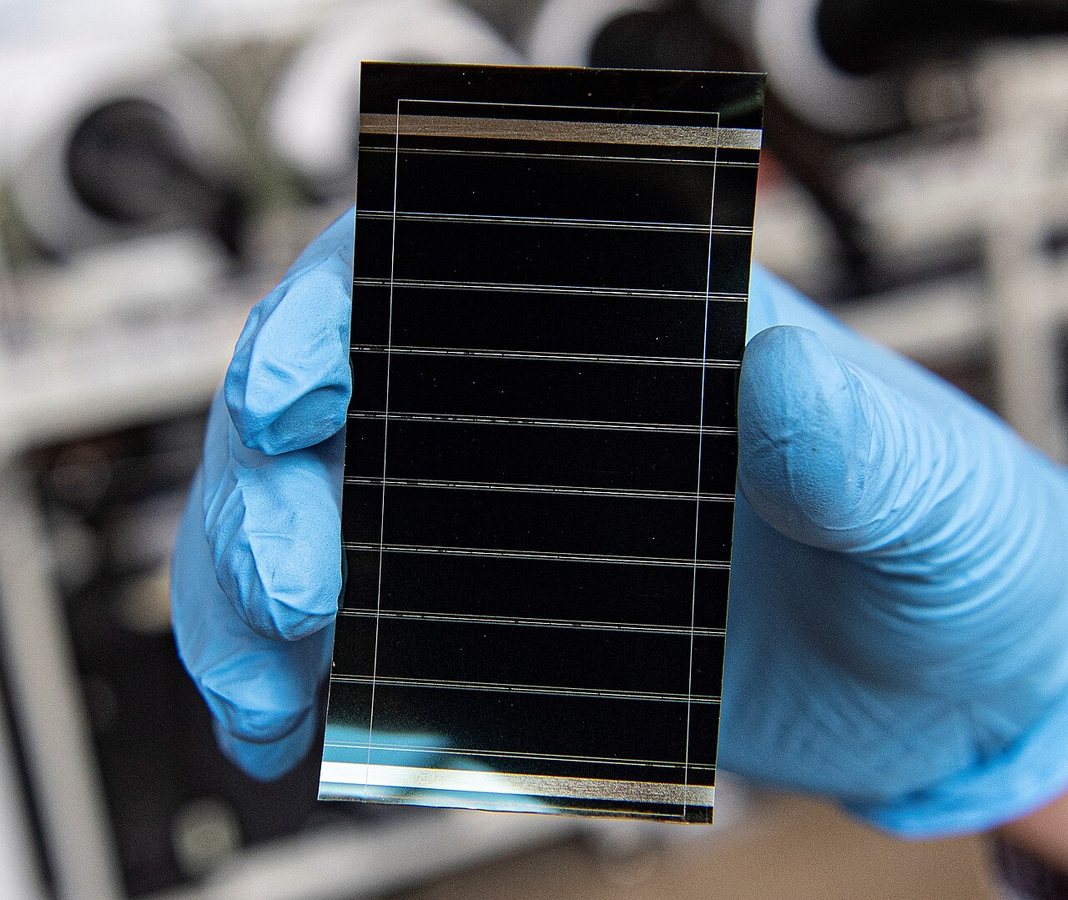
Advanced optical microscopy and spectroscopy techniques are giving scientists an unprecedented view of what happens inside halide perovskite solar cells while they operate, according to a webinar to be presented by Dr. Sudipta Seth, a research associate at KU Leuven in Belgium. The talk will focus on how in situ and operando measurements can uncover the local fields, transport bottlenecks, and defect chemistry that ultimately determine device performance.
Perovskite materials have emerged as a promising class of semiconductors for optoelectronic applications, particularly solar cells, but their performance is governed by complex processes that unfold across vast ranges of length and time. Carrier transport, recombination, ion migration, and phase segregation occur on length scales from nanometers to micrometers and on timescales from picoseconds to hours. Conventional characterization methods average over this heterogeneity, rarely capturing the dynamic events that take place in an operational device.
Optical microscopy and spectroscopy offer a way to recover this hidden picture. By converting local material function directly into optical contrast, these techniques can resolve the processes where they actually happen. Dr. Seth will show how local optical signatures translate into a mechanistic understanding of device operation, and how that understanding feeds back into the design of better probes, interfaces, defects, and devices.
The webinar is aimed equally at materials scientists curious about what happens inside their samples and at microscopists and spectroscopists looking for new problems suited to their tools. A certificate of attendance will be awarded upon completion.
Dr. Seth is a research associate at KU Leuven, where he conducts advanced research at the intersection of materials chemistry, optoelectronic devices, and spectroscopy through the development of innovative microscopy methodologies. He leads the nanoscale device spectroscopy research line at the Hofkens Laboratory. He completed his PhD at the University of Hyderabad and subsequently worked as a postdoctoral fellow at Lund University and as a visiting junior fellow at the Tokyo Institute of Technology.
His work integrates single-particle spectroscopy, super-resolution and nanoscale microscopy, and ultrafast spectroscopy to investigate fundamental photophysics in semiconductor materials and optoelectronic devices. He has received several academic fellowships, including INSPIRE-SHE from India, the Wenner-Gren Postdoctoral Fellowship from Sweden, an FWO Research Stay Abroad from Belgium, and a Marie Sklodowska-Curie Postdoctoral Fellowship from the European Commission.
The presentation will highlight how in situ and operando optical methods can interrogate halide perovskite materials and their corresponding optoelectronic devices under conditions relevant to real operation. This approach is particularly valuable because the performance of these devices relies on processes that are difficult to observe with traditional techniques. By capturing the local optical response, researchers can identify the specific regions and mechanisms that limit efficiency and stability.
Understanding these nanoscale phenomena is critical for the continued development of perovskite solar cells, which have attracted intense interest for their rapidly rising power conversion efficiencies. However, challenges related to stability and scalability remain. Insights from advanced optical characterization could help guide the rational design of more efficient and durable devices.
The webinar will be of interest to a broad audience, from those focused on fundamental materials science to those developing new imaging and spectroscopic tools. It will demonstrate how cutting-edge optical methods can bridge the gap between laboratory studies and real-world device performance, providing a foundation for future innovations in optoelectronics.