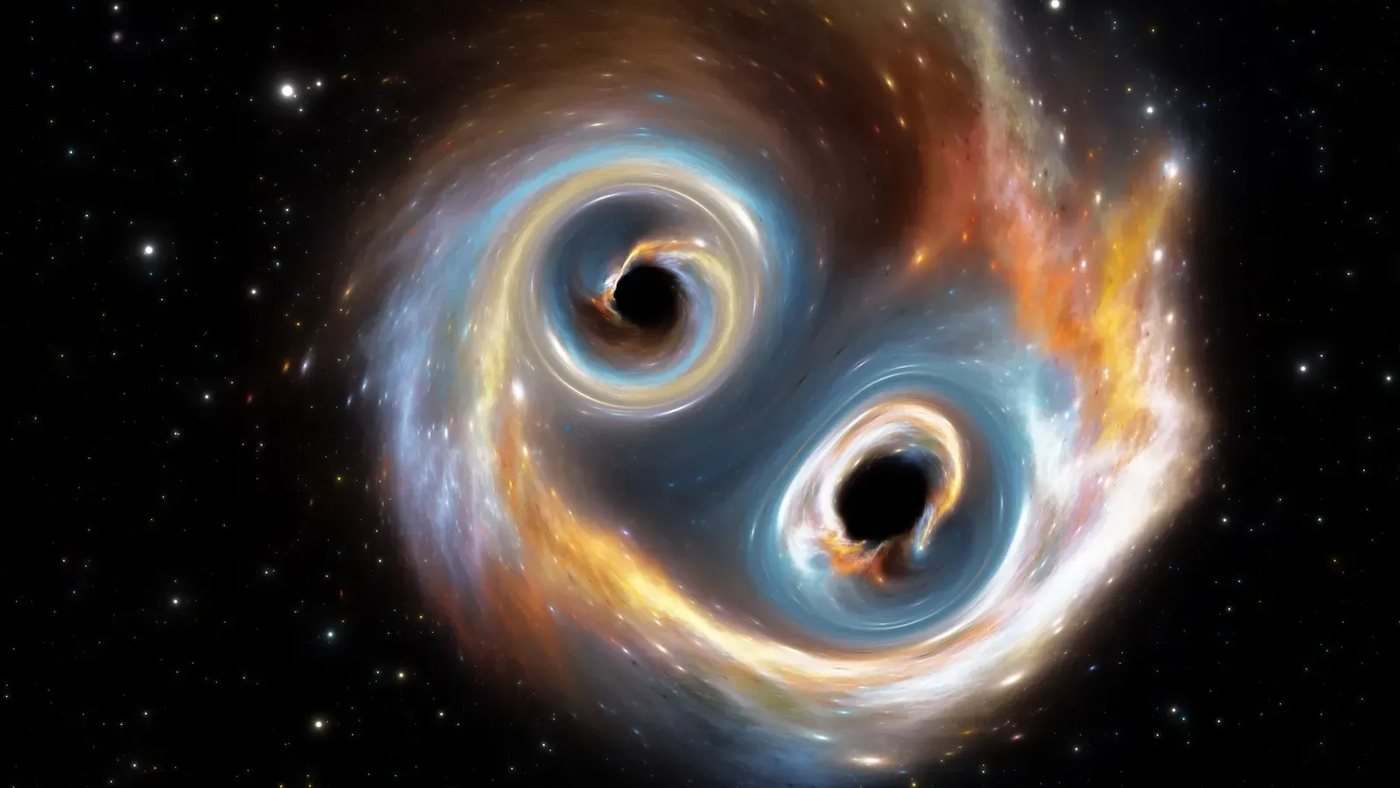
A black hole merger that appeared to violate established physics may finally have an explanation rooted in Albert Einstein's theory of general relativity. The event, detected by the LIGO and Virgo gravitational-wave observatories, involved two black holes with masses that seemed too large for their inferred spins, challenging conventional models of how such systems form. Now, researchers propose that the signal was not a single merger at all, but the same event seen twice through gravitational lensing — a phenomenon predicted by relativity in which a massive foreground object bends and magnifies light and gravitational waves from a distant source.
Gravitational lensing occurs when a galaxy or cluster of galaxies lies between Earth and a distant astrophysical event. The intervening mass warps spacetime, creating multiple paths for the signal to reach detectors. If a black hole merger is lensed, observatories may record two or more copies of the same chirp, each arriving at different times and with different apparent properties. This misidentification could explain why the original event seemed to produce an impossibly massive black hole with unusual spin characteristics.
The lensing hypothesis, if correct, resolves the immediate paradox. But it introduces a more profound problem: the universe may contain far more black holes than previously estimated. Lensing amplifies the apparent rate of mergers, meaning that some fraction of detected events are duplicates. If even a small percentage of signals are lensed, the true population of merging black holes could be significantly larger than current models suggest. This has implications for understanding how black holes form, evolve, and populate galaxies.
Researchers are now combing through gravitational-wave data for more lensed candidates. Identifying a clear pair of lensed signals would confirm the theory and open a new window into the universe's hidden black hole population. It would also provide a novel way to study the distribution of matter in foreground galaxies, using gravitational waves as a backlight. For now, the mystery remains unresolved, but the lensing explanation offers a testable path forward — one that relies on the same relativistic principles Einstein formulated more than a century ago.