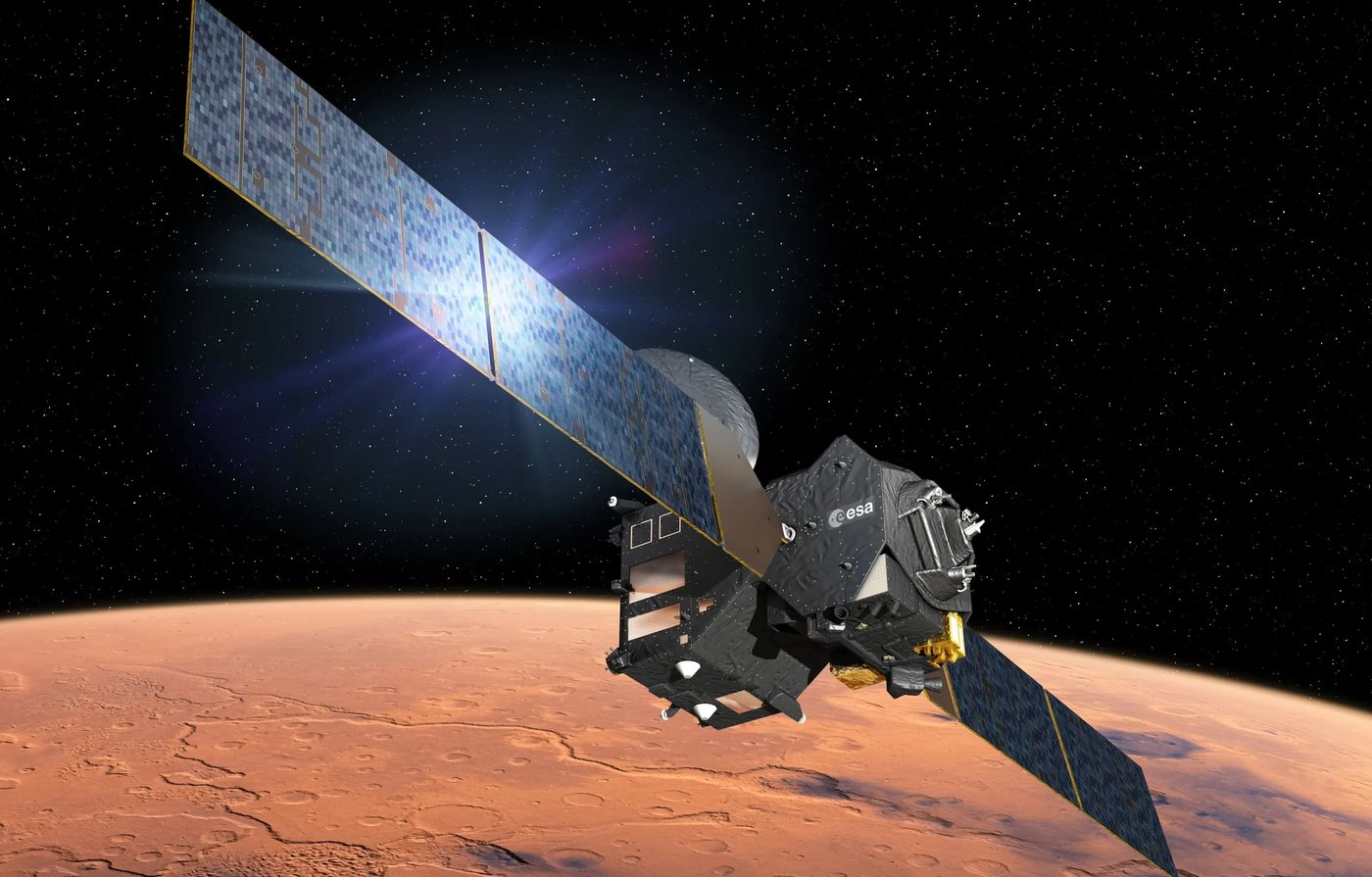
Gas seeping from fresh cracks in the Martian surface suggests that the planet may still have active volcanism, according to new observations from the Trace Gas Orbiter. The findings, published in the journal Science Advances on November 4 by a team led by planetary scientist Daniel Mège, point to a dormant magma system beneath one of Mars's largest volcanoes.
The researchers focused on fissures near Alba Mons, the largest Martian volcano by surface area, located in the northern part of the Tharsis region. Hydrogen chloride levels spiked over the area during the northern early summer, and instruments aboard the orbiter traced the gas back to the fissures. Those cracks are tens to hundreds of meters long, and some of the surrounding deposits are more than three billion years old, while the fissures themselves appear much younger.
The mechanism appears to work seasonally. During the winter, ice seals the fissures, trapping gas beneath the surface. When the ice melts in warmer months, the gas is released into the atmosphere. The orbiter's Atmospheric Chemistry Suite spectrometers located the source of the gas, while the CaSSIS camera imaged the fissures at a resolution of 4.5 meters per pixel, giving the team detailed views of the features.
The team links the gas release to a magma chamber lying dormant below Alba Mons, though the researchers have not yet seen an actual eruption on Mars. The activity may come and go, and it remains unclear whether it is ongoing. The researchers also note that if magma were to meet groundwater beneath the surface, it could create subsurface environments that might be habitable, a possibility that makes the site of interest for future study.
Credit. Based on reporting by Haygen Warren for NASASpaceflight. Is this your work? Write to us.
15