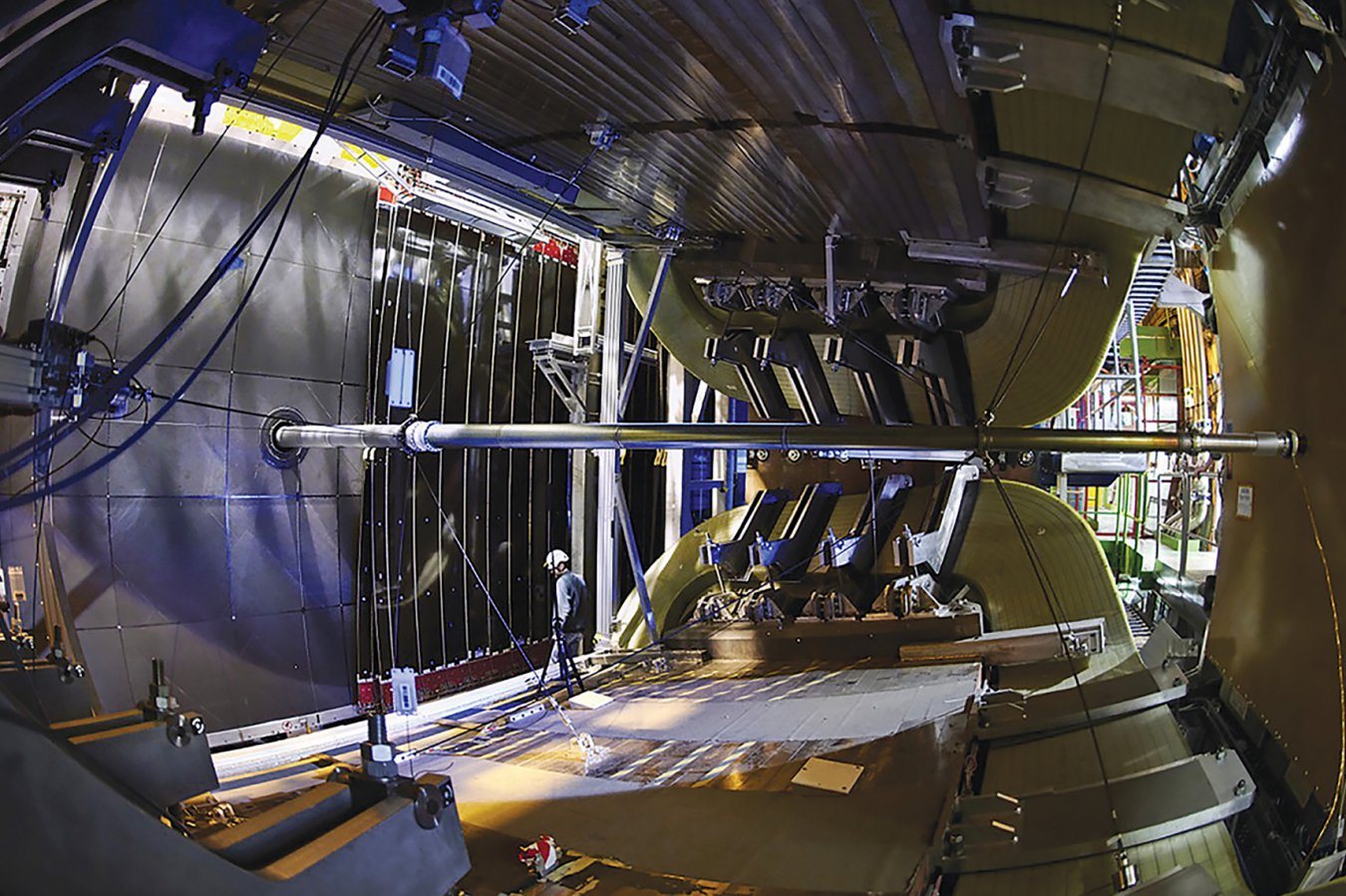
Physicists working on the LHCb experiment at CERN, the European particle physics laboratory in Switzerland, have reported the first evidence of an extremely rare decay of a beauty quark, a process theorists have sought to observe for more than four decades. The team, led by Paula Collins, says the signal points to a particle event that the standard model of particle physics predicts with high precision, making it a useful test of the theory.
In the process, a beauty quark and its antiquark annihilate each other and produce a pair of muons, heavier cousins of the electron, consisting of a particle and its antiparticle. Researchers expect this to happen only about once in every 10 billion beauty particles, which is why the event has remained out of reach until now. The LHCb team credits recent upgrades to its detector for making such a rare occurrence visible in the data.
The result is not yet conclusive. The signal has a statistical significance of 3.2 sigma, below the 5 sigma level that particle physicists normally require before declaring a discovery. Put another way, there is roughly a 0.3 per cent chance that the signal is a statistical fluctuation. The uncertainties are also relatively large, and the researchers expect that additional data will narrow them.
The finding is consistent with the standard model, which means it neither confirms nor rules out new particles beyond current theory. Outside researchers have welcomed the work as a careful step forward. Harry Cliff of the University of Cambridge and Jure Zupan of the University of Cincinnati are among the scientists who have commented on the analysis, while Zoltan Ligeti of Lawrence Berkeley National Laboratory and Cristina Lazzeroni of the University of Birmingham have also weighed in on its significance.
The work comes at a difficult moment for the program. The UK government withdrew funding for a planned upgrade to LHCb last year, a decision that raises questions about the future pace of research in this area. For now, the team's focus is on gathering more data to determine whether the rare decay is indeed being seen.
Credit. Based on reporting by Karmela Padavic-Callaghan for New Scientist. Is this your work? Write to us.
16