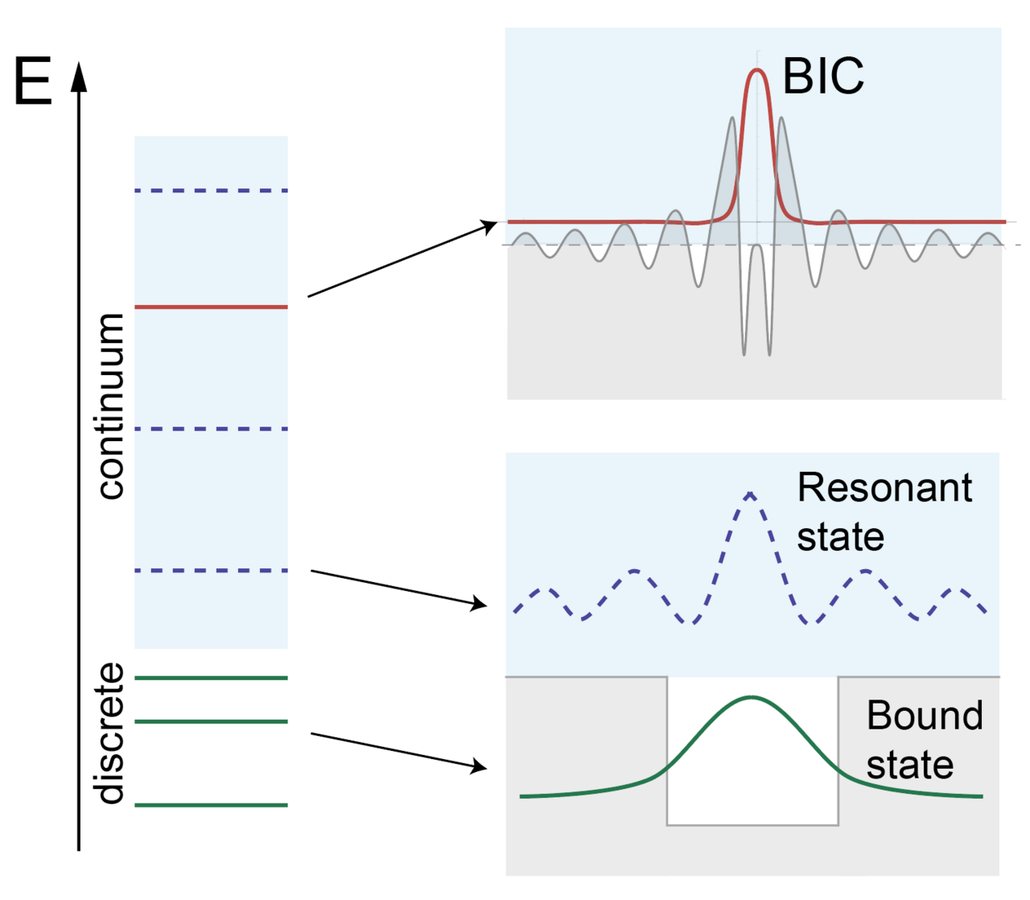
Researchers in the United States have observed bound states in the continuum, or BICs, in an electronic solid for the first time. These are static waves that stay isolated from propagating waves at similar energies. The phenomenon is well established in optics, where it has been used in lasers, sensors and directional antennas, and the team believes electronic BICs could eventually help simulate exotic many-body physics and may even matter for catalysis.
In the standard model of electronic band structure, electrons in the valence band are localized and lack the energy to move freely, while the conduction band contains higher-energy, larger orbitals that spread through the material, so an electron entering them is effectively free. In a semiconductor, the band gap is the energy needed to lift an electron from the valence band into the conduction band. In a metal, the two bands overlap and form a continuum of allowed energy levels. The Schrödinger equation, however, also permits bound states when electrons are confined not by energy barriers but by the properties of their wavefunction. Such states can sit inside the gapless band structure of a metal without coupling to the free electrons around them.
In 2025, researchers at Columbia University in New York City developed a novel two-dimensional metal, Pd5AlI2, which showed features consistent with frustrated electron movement. The group has now explained those features in terms of BICs and verified them experimentally using scanning tunnelling microscopy. The material has a tetragonal checkerboard lattice with a relatively high density of defects, and the bound states form at these defects.
Raquel Queiroz of Columbia, who developed the theoretical models, said that hybridization would normally be suppressed by a spectral gap, but in this case it is suppressed by quantum interference. «All the different ways that electrons could jump out cancel each other out and interfere destructively,» she said. Alexandru Georgescu, a team member at the University of Indiana, offered an analogy with insulators. In an insulator, a defect state is like a glass of water that needs energy to escape. In this material, he said, the electron forms a wave that interferes with itself and does not travel, even though the surface is essentially flat and a metal would normally allow it to go anywhere.
To locate the bound states and measure their energies, the team combined scanning tunnelling microscopy and scanning tunnelling spectroscopy with density functional theory. They found that the states occur above stochastic palladium vacancies in the metal lattice and are extremely well isolated from the continuum states. The researchers could only detect them because the disturbance from the microscope tip altered the band structure enough to let electrons move in and out.
When two defects sat close together, the researchers observed hybridization between them. They believe this could produce many-body effects similar to those seen in optical BIC work, and because structured surfaces are inherently easier to engineer than many other systems, the approach could allow them to model phenomena such as superconductivity. The team is now refining its technique to place BICs at predetermined sites. «There’s no reason why one couldn’t create these on demand,» said Abhay Pasupathy of Columbia, who led the experimental work. «There’s fairly easy ways to make a bunch of holes in things and one could imagine seeing what happens to the electronic structure.»
The researchers also see possible uses in catalysis, which depends on electrons attaching to under-coordinated sites. Pasupathy said that if a particular bound transition state exists, this kind of catalysis could enhance the reaction. Boubacar Kanté of the University of California, Berkeley, whose group demonstrated the first optical BIC laser, called the work «very interesting» and said it «shows the universality of wave phenomena». He noted that John von Neumann and Eugene Wigner first proposed BICs theoretically in 1929 for electronic systems, but the oscillating electromagnetic potential needed was too difficult to produce at the time. «The fact that these bound states in the continuum are now coming back to electronics is very interesting,» he said, adding that it may become a new way to engineer quantum devices, though for now the work is fundamental.
The research is described in the journal Science.
13