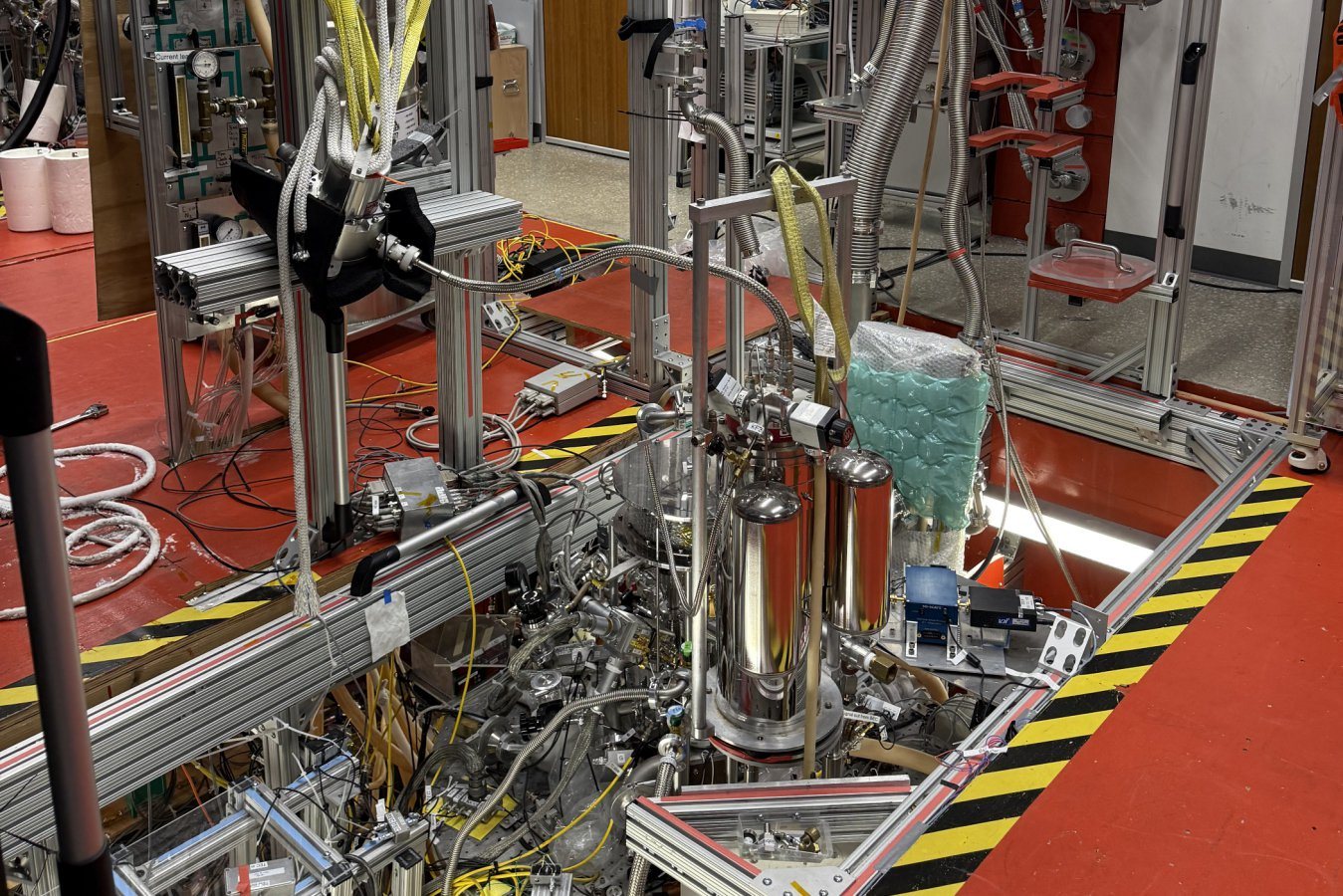
Physicists at Northwestern University in Illinois have captured a single positron — the antimatter counterpart of the electron — and kept it confined in an electromagnetic trap for months, a feat that opens the way to extraordinarily precise tests of the standard model of particle physics.
The result, reported in Physical Review Letters, addresses a long-standing experimental obstacle. Positrons carry the same mass as electrons but the opposite electric charge, and they are rare in nature. Because any positron that meets an ordinary electron annihilates almost instantly, antiparticles are notoriously difficult to isolate and study.
Gerald Gabrielse and his colleagues began by extracting positrons from a radioactive isotope of sodium, which emits one each time it decays. These particles emerge at high speed and are hard to control, so the team placed the sodium source in a special refrigerator to lower its temperature and energy. The positrons were then routed through a tungsten crystal, which slowed them further; some were annihilated in the material, but others passed through intact.
The survivors were directed into a refrigerated chamber emptied of all other particles. There, electronic components generated electromagnetic fields that acted as invisible walls, confining a single incoming positron. The researchers then drove the particle into its lowest possible energy state, a condition Gabrielse says is what allowed them to hold the otherwise elusive antiparticle for months rather than fractions of a second. Controlled bursts of microwaves could also push it into the next lowest state.
«It’s a real kick to stand in my lab and watch a positron making transitions — ‘quantum jumps’ we call them — between its lowest energy states,» Gabrielse said. «How much more fundamental, how much neater can it get?»
The experimental demands were severe. Stefan Ulmer of the Japanese research institute RIKEN, who was not involved in the work, noted that trapping an antiparticle is extremely difficult because any stray particle, flash of light or tiny vibration can disturb it. The apparatus had to be maintained just tenths of a degree above the coldest temperature physically possible.
Ulmer said the payoff could be remarkable, describing the effort as having «the potential to become one of the most precise measurements of a fundamental constant in physics.»
The immediate goal is to measure the positron’s magnetic moment, a number that quantifies how the particle responds to magnetic fields. Gabrielse’s group previously produced the most precise measurement ever made of the electron’s magnetic moment. Comparing that value with the positron’s would allow physicists to compare matter and antimatter with unprecedented precision.
The standard model predicts that the two magnetic moments should be identical, and that prediction exposes a conspicuous gap in the theory. If matter and antimatter are so alike, they should have been produced in equal amounts at the birth of the universe and annihilated completely, leaving nothing behind. «The standard model seems to be inconsistent, or at least significantly incomplete, with basic features of the universe, like why we have a universe at all,» Gabrielse said.
Finding any difference between the electron and the positron could point to an unknown mechanism that tipped the balance toward matter. According to the team’s plan, data bearing on that question should be available within the year.
11