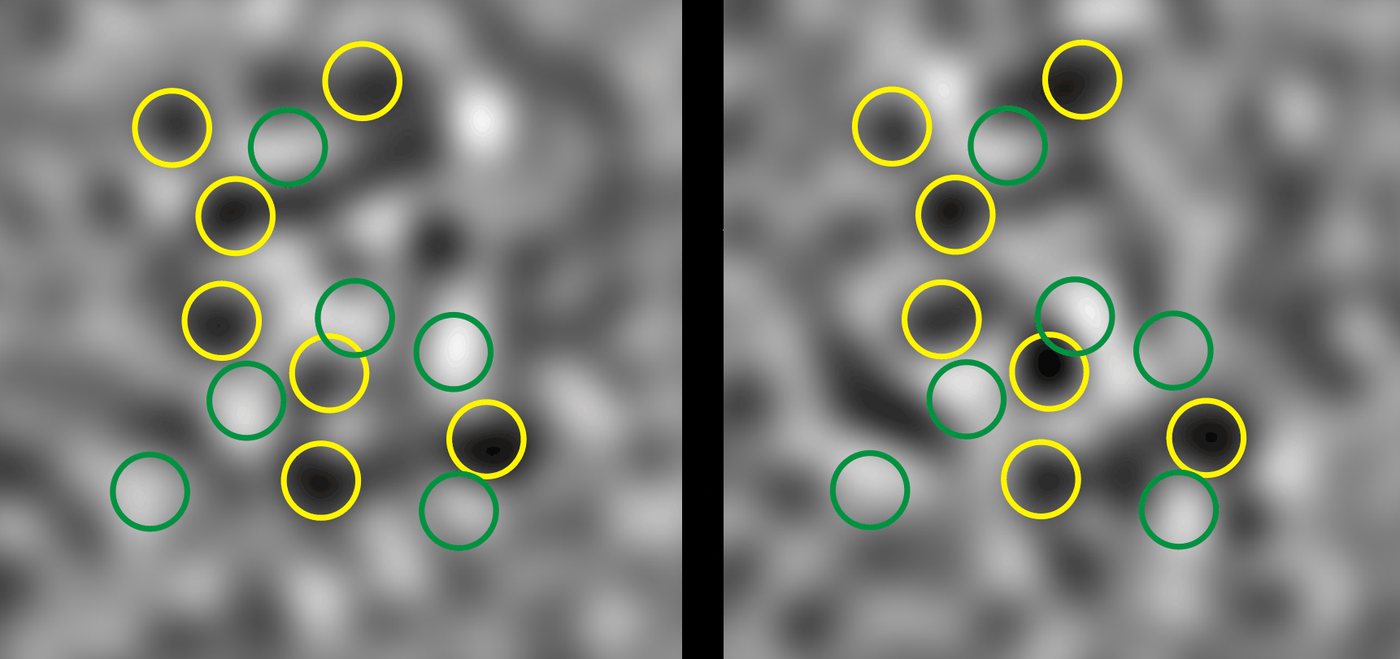
Physicists at Stanford University have observed quantum jumps in phonons, the mechanical vibrations that carry sound, marking the first time this quintessentially quantum behavior has been seen in a mechanical system. The finding, published in Science, extends a line of discovery that began with ions in the 1980s and photons in the 2000s, and it could lead to new ways of protecting quantum information from errors.
Phonons are quantized packets of vibrational energy. In the Stanford experiment, the team used thin films of lithium niobate, a piezoelectric material that generates a voltage when stressed. That voltage allows vibrational quanta to couple to superconducting qubits, which can then be read out to determine whether a phonon is present. The researchers had to extend the phonons' lifetimes from just 800 nanoseconds to about a millisecond, a four-to-five order-of-magnitude improvement, by identifying surface defects as a key source of dissipation and switching to a shadow-mask fabrication process that avoids polymer residue.
«We could see it by eye in the data, which was very satisfying,» team leader Amir Safavi-Naeini said. «I've been fascinated with the interface between the quantum world and the classical world and trying to move that interface closer to daily experience…and now we have mechanical objects.»
Because the superconducting qubits detect whether an even or odd number of phonons is present, the system performs a parity measurement. That capability could be useful for quantum error correction, where the goal is to detect errors without directly measuring the quantum states and destroying their useful properties. One common error in superconducting qubits is the loss of an excitation, such as when a phonon decays. If data is encoded into phonons in pairs, an odd number of them signals that a loss has occurred. This so-called binomial code has already been implemented for microwave photons, and it works best for long-lived particles, a further benefit of the team's improved phonon lifetimes.
The Stanford group is now collaborating with Michael Roukes and colleagues at the California Institute of Technology to explore applications in high-precision measurements of single protein masses. They are also interested in fundamental questions, such as whether entanglement can be generated between mechanical systems through gravitational fields. However, Safavi-Naeini cautions that phonon lifetimes would need to be much longer — a factor of 10 for error correction and mass spectrometry, and perhaps as much as six orders of magnitude for gravity experiments, with further modifications to the setup.
«The hope is that by figuring out the fundamental sources of loss in these materials we can build our way up to those experiments in the coming decade,» he said. «Every time you improve, you hit some new source of noise, you understand it, then you can deal with it, and then you go to the next one. It's a fun physics problem.»
The work involved multiple generations of graduate students who tackled the mechanical oscillators and then found a way to couple them to superconducting systems without destroying either. Takuma Makihara and Erik Szakiel are credited with spending most of their PhDs on that final piece. The result not only confirms that mechanical vibrations obey quantum rules but also positions phonons as a promising platform for future quantum technologies.
12