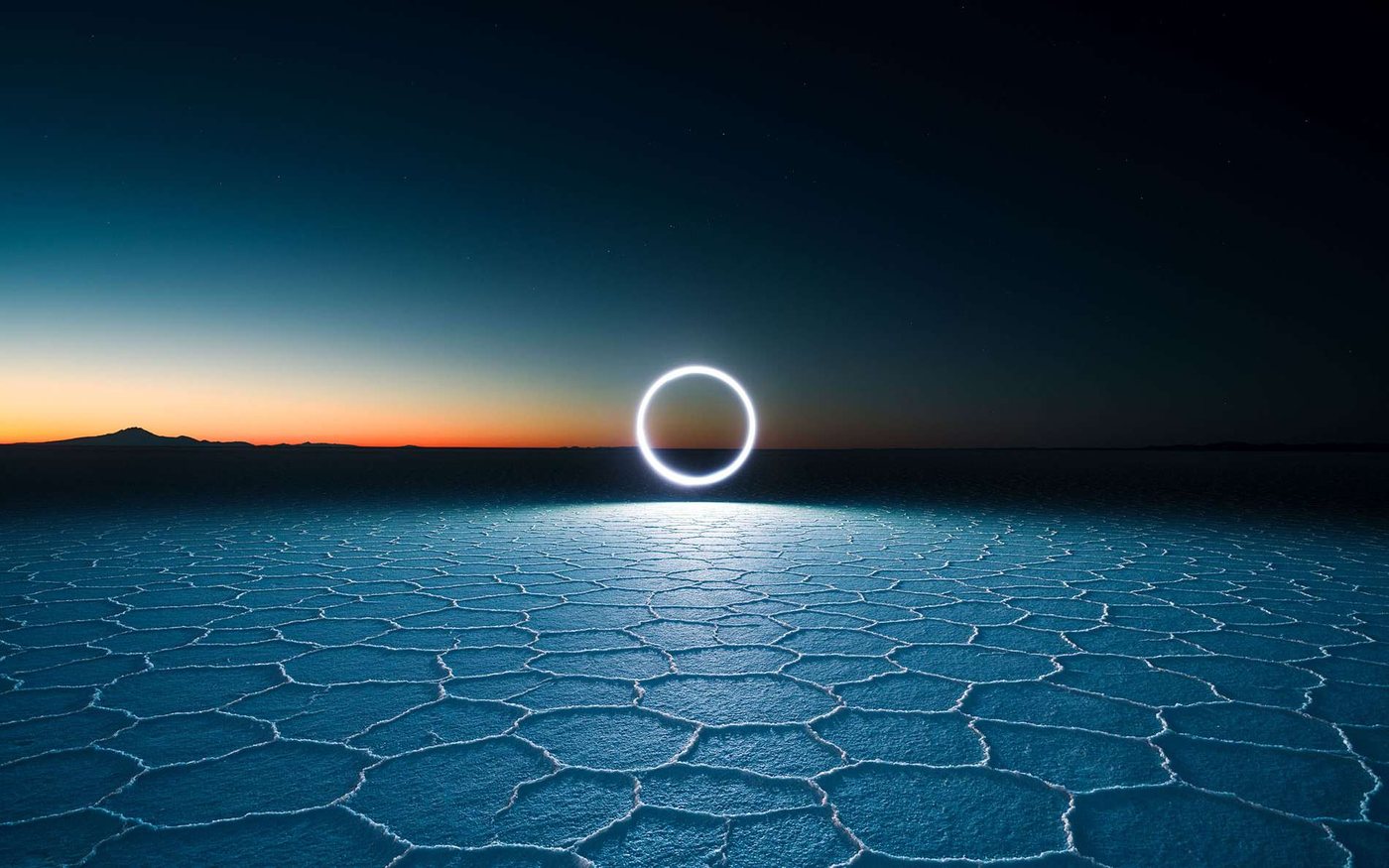
Glowing circles of light hover above desert landscapes, halos appear in the night sky, and for a moment the Earth seems to belong to another world. Yet nothing in these images is accidental or natural. Behind the striking visuals is the work of photographer Reuben Wu, who uses drones equipped with LED lights to paint luminous rings into the sky during long-exposure photographs.
The technique, which Wu has refined across multiple expeditions to remote locations, involves launching a drone along a predetermined flight path while the camera shutter remains open for several minutes. The drone's lights trace a perfect circle or arc, creating the illusion of an otherworldly phenomenon suspended above mountains, salt flats, and volcanic terrain. Because the drone itself is too small and fast to register clearly, only its light trail remains visible in the final image.
Wu's work has drawn attention not only for its visual impact but also for the way it blurs the line between documentation and fabrication. The landscapes he photographs are real, often inaccessible and devoid of human presence. The light circles, however, are entirely artificial, added through a combination of careful planning, GPS-guided flight, and post-processing. The result is a series of images that look like they could depict atmospheric optics, ball lightning, or even unidentified aerial phenomena, but are in fact the product of consumer drone technology and long-exposure photography.
The photographer has described his approach as a way to reinterpret the natural world through a technological lens, creating scenes that feel both familiar and alien. By choosing locations with minimal light pollution and dramatic geology, Wu amplifies the contrast between the ancient, untouched terrain and the precise, modern light shapes he introduces. The circles often echo the sun or moon in size and brightness, further enhancing the illusion of a natural event.
Beyond their aesthetic appeal, Wu's images raise questions about the role of technology in landscape photography and the boundaries between observation and intervention. As drone technology becomes more accessible, photographers and artists are increasingly able to manipulate scenes in ways that were previously impossible or required expensive equipment. Wu's work sits at this intersection, using tools originally developed for surveillance and delivery to create images that are contemplative rather than utilitarian.
The series has been exhibited internationally and featured in publications focused on art, science, and technology. While the light circles are not natural phenomena, they invite viewers to reconsider what they see in the sky and how readily the eye can be deceived by careful composition and timing. In an era when digital manipulation is common, Wu's insistence on capturing the light trails in-camera rather than compositing them later adds a layer of authenticity to the otherwise artificial scenes.
For observers unfamiliar with the technique, the images can be genuinely puzzling, prompting speculation about atmospheric events or optical illusions. Wu has said that this ambiguity is part of the point: the photographs are meant to evoke the wonder of natural phenomena while remaining honest about their manufactured origin. The desert landscapes, with their vast scale and silence, provide the perfect stage for this interplay between the real and the constructed.
The project also highlights the evolving relationship between photographers and drones, which have moved from niche hobbyist tools to standard equipment for aerial imaging. Wu's use of light painting from the air is a relatively new twist on a technique that dates back to the early days of photography, when artists first experimented with moving light sources during long exposures. By combining that heritage with modern flight control and LED efficiency, he has created a body of work that feels simultaneously retro and futuristic.
As the images continue to circulate online, they serve as a reminder that not everything seen in the sky is a natural phenomenon. Sometimes, it is the result of a photographer, a drone, and a carefully planned flight path, turning a remote desert into a canvas for artificial light.
12