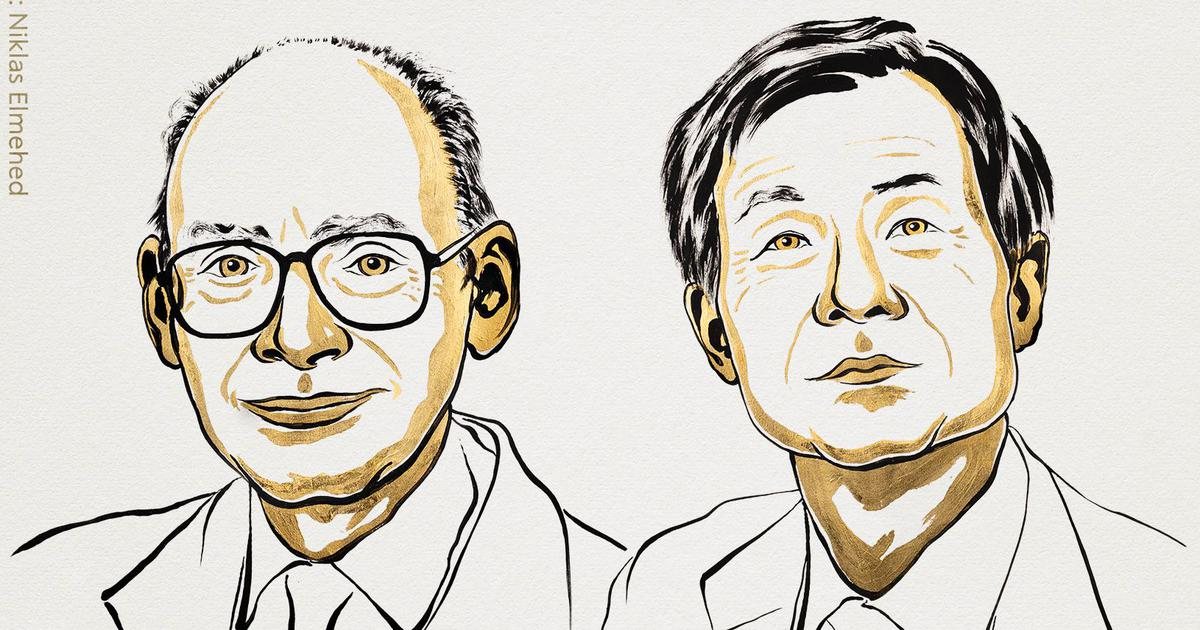
The Royal Swedish Academy of Sciences has awarded the Nobel Prize in Chemistry to Henri Kagan and Kenso Soai for discoveries that explain how mirror-image forms of molecules can be selectively produced, a finding with major implications for pharmaceutical development. The academy cited their work on «non-linear effects and autocatalysis in asymmetric organic synthesis».
Kagan, 95, is a professor at the Université Paris-Sud in France and a French citizen. Soai, 76, is a professor at the Tokyo University of Science and a Japanese citizen. The two will share equally the prize amount of 12 million Swedish kronor, roughly Rs 11.5 crore.
Many molecules, including amino acids, exist in two mirror-image variants known as enantiomers. Living organisms, however, almost exclusively use one of these forms. The academy noted that «how chemical asymmetry such as this could have emerged was long a mystery to chemists», and credited Kagan and Soai with discovering «a solution to this puzzle».
Their research focused on two related phenomena. Non-linear effects describe how the selectivity of a reaction can change in unexpected ways when a chiral catalyst itself is not perfectly pure. Autocatalysis, meanwhile, refers to reactions in which the product accelerates its own formation, potentially amplifying a small initial imbalance between mirror-image molecules. Together, these mechanisms offer a plausible route by which a slight excess of one enantiomer could have grown into the near-total one-handedness seen in biology.
The practical consequences extend well beyond origins-of-life questions. The academy stated that the discoveries have been «decisive for chemists who design reactions» used to manufacture pharmaceuticals. Because the two mirror images of a drug molecule can have different biological effects — one may be therapeutic while the other is inactive or harmful — the ability to synthesize a single desired form is a central challenge in medicinal chemistry. The work of Kagan and Soai has provided tools and theoretical grounding for addressing that challenge.
Kagan's contributions include foundational studies on asymmetric catalysis and non-linear effects, while Soai is known for discovering an autocatalytic reaction that amplifies chiral excess, now often called the Soai reaction. Their combined achievements have shaped how chemists think about selectivity and self-replication in organic synthesis.
The chemistry prize is one of several Nobel awards announced this week. On Monday, the medicine prize went to three scientists — Peter Hegemann, Georg Nagel and Karl Deisseroth — for their work on light-sensitive proteins. The literature prize will be announced on Thursday, followed by the peace prize on Friday. The economics prize is scheduled for October 12.
The recognition of Kagan and Soai highlights a field that sits at the intersection of fundamental chemistry and applied drug development. By unraveling how mirror-image molecules can be produced selectively, their research helps explain a basic feature of life and provides a foundation for making safer, more effective medicines.
11