Astronomers have detected the most distant fast radio burst ever observed, a fleeting pulse of radio energy that left its host galaxy when the universe was only about three billion years old and traveled roughly 10 billion light years before reaching Earth on March 4, 2024. The discovery, reported in the journal Science, more than doubles the distance of the next-farthest known burst and opens a new frontier for using these mysterious signals to probe the evolution of the cosmos.
The burst, designated FRB 20240304B, was captured by South Africa's MeerKAT radio telescope. Follow-up observations with the James Webb Space Telescope pinpointed its origin to a low-mass, clumpy, star-forming galaxy at a redshift of 2.148. Redshift measures how much light waves stretch as they cross expanding space, shifting them toward the red end of the spectrum; the higher the value, the more distant and ancient the source. Until now, the vast majority of the roughly one hundred fast radio bursts with identified host galaxies sat at redshifts below 0.5, with only a handful beyond 1.
«This observational bias is driven by the sensitivity limit of radio observations that are capable of detecting FRBs and localizing their coordinates,» said researchers led by Manisha Caleb of the Sydney Institute for Astronomy. The new detection pushes well past that threshold, demonstrating that current instruments can find and trace bursts from far deeper in cosmic time.
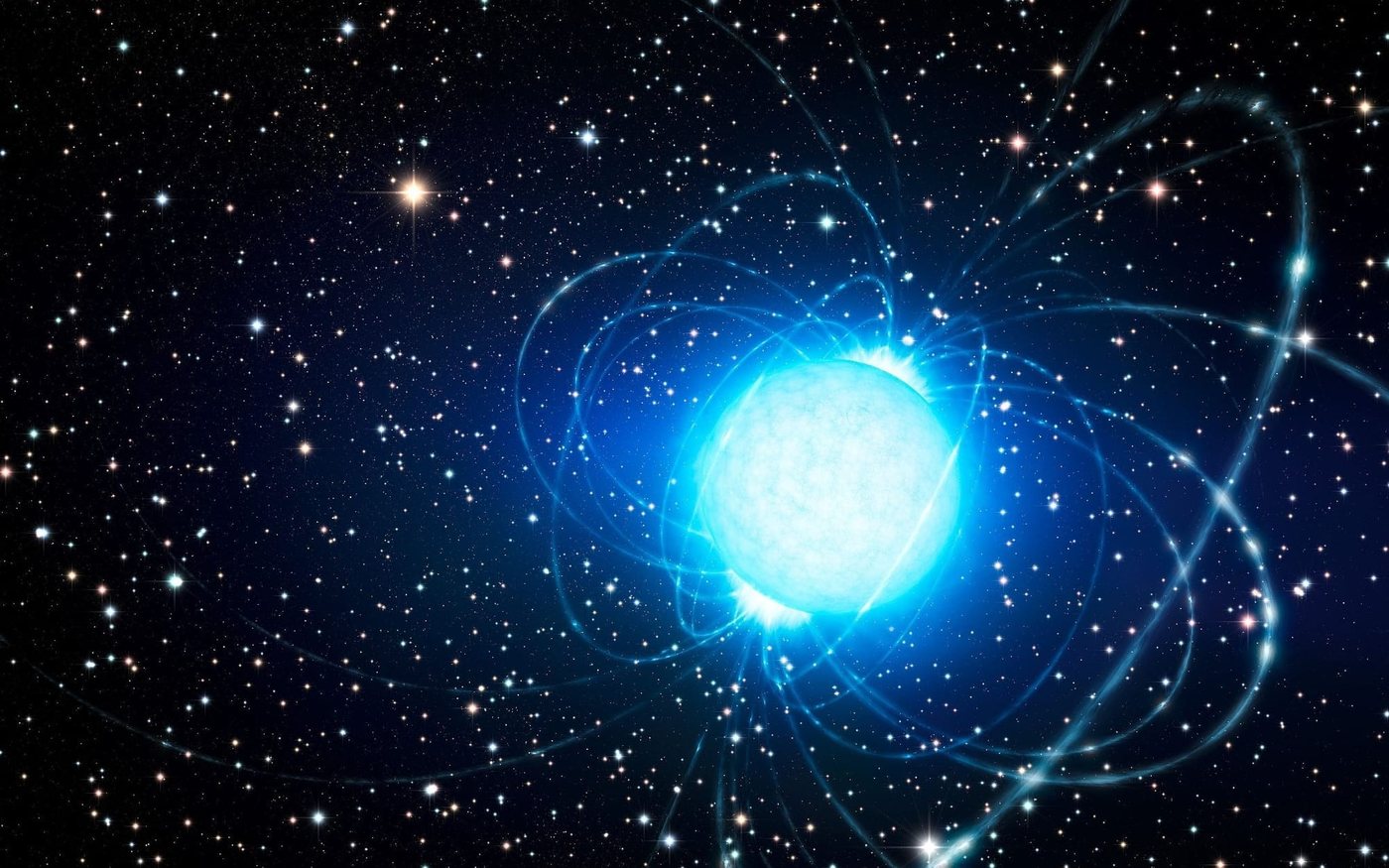
Fast radio bursts are extraordinarily energetic pulses of radio waves, but the physical process that generates them remains unknown. The diversity of the signals — some repeat, some flash only once — suggests they may arise from more than one type of source. For FRB 20240304B, the team points to a magnetar: the highly magnetized, collapsed remnant of a massive star that exploded as a supernova. The host galaxy's low stellar mass, active star formation, and low metallicity all fit that picture, the researchers concluded.
The finding matters beyond the single event. Because radio waves from distant bursts traverse billions of years of cosmic history, they carry imprints of the material they pass through, including the diffuse gas and plasma that lie between galaxies. Scientists can use those distortions to map the large-scale structure of the universe and track how it has changed over time. A burst at redshift 2.148 provides a much longer baseline for such measurements than any previous fast radio burst.
The team's result also suggests that more high-redshift bursts await discovery. If magnetars in young, metal-poor galaxies are common sources, then improved radio surveys should uncover a population of these ancient flares, each one offering an independent probe of conditions in the early universe. The researchers describe the detection as a milestone that pushes the limits of observation and sets the stage for extracting clues about cosmic evolution imprinted on signals during their vast journeys across space and time.
The burst was first spotted in March 2024 and required coordinated work across two of the world's most capable observatories: MeerKAT, which detected the radio flash, and the James Webb Space Telescope, which identified the faint host galaxy. That combination — a sensitive radio array paired with an infrared space telescope — is likely to become a standard approach for pinning down the origins of distant bursts in the years ahead.
16