Astronomers using the James Webb Space Telescope and the Hubble Space Telescope have released a new set of images that capture star formation, an unusually structured spiral galaxy, and the light-bending effects of gravity on a cosmic scale. The two observatories, operated jointly by NASA and the European Space Agency with the Canadian Space Agency also participating in Webb, target different wavelengths of light and together provide complementary views of the universe.
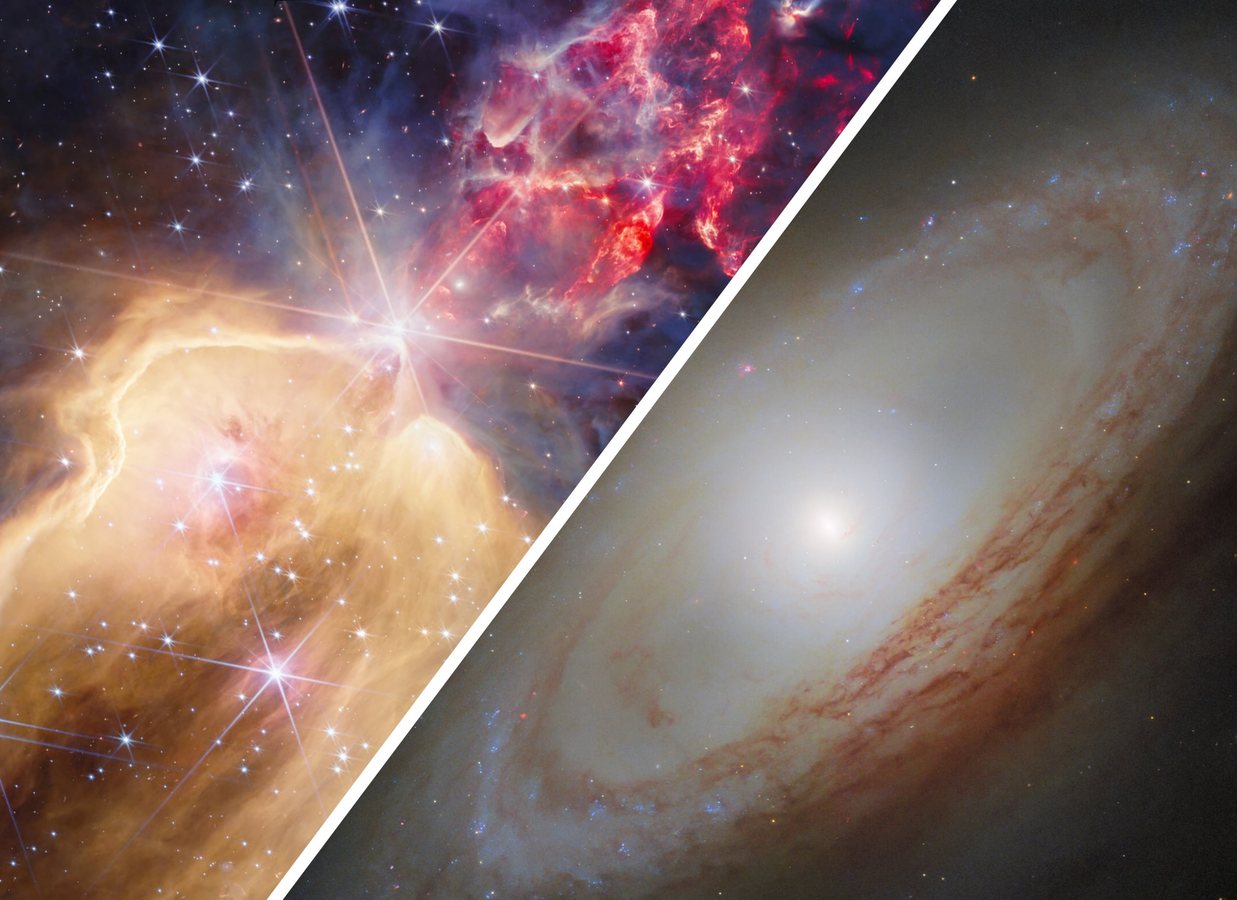
Webb's infrared sensitivity allowed it to peer through the dust of NGC 7129, a stellar nursery located about 3,300 light-years from Earth. The region is filled with clouds of dust that help trigger the birth of stars but also block the light from young stars at optical wavelengths. By observing in the infrared, Webb revealed hundreds of stars at different stages of their evolutionary lives.
At the center of NGC 7129 sits LkHα 234, the most massive star in the region, marked by six bright diffraction spikes in the Webb image. It is five to eight times more massive than the Sun and has already gathered all the mass it needs, now contracting under its own gravity. More massive stars evolve faster, and LkHα 234's outflows of hydrogen gas carved out a large gold cavity spanning 3.5 light-years to its left. Much of that gas is compressed, helping form additional stars, some of which are already visible. Two of those stars show pink, bubble-like structures known as bow shocks, created as their stellar winds push away nearby energetic gas. Together with LkHα 234, they form a photodissociation boundary where hydrogen molecules break apart into atoms.
To the right of LkHα 234, a red region of clumpy matter hides and directly forms protostars, the youngest class of stars. These protostars eject superheated material into outflows that interact with the dense matter around them, producing the red glow. Because many protostars are forming in the same area, their outflows often overlap and interact, giving the region a complex, chaotic appearance.
Hubble, meanwhile, observed NGC 4698, a spiral galaxy about 55 million light-years away in the constellation Virgo. At first glance it appears like any other spiral, but the new observations confirm that its central bulge extends perpendicular to its galactic plane. As a result, the stars and gas in the bulge rotate at a right angle to the rest of the disk. Scientists believe an outside force funneled gas into the galaxy, possibly forming a separate disk of gas and stars at its center at an angle to the main galactic plane. Some observations also suggest NGC 4698 may have merged with another galaxy in the past, and a small hydrogen arm extends from one side of it.
The white glow of the galaxy's central bulge comes from thousands of small, old, cool stars, while larger, younger blue stars trace the outer disk. A supermassive black hole at the center has a mass more than a million times that of the Sun and appears to be growing as its gravity pulls in gas, dust, and even stars. The Hubble observation was taken as part of a program focused on characterizing galaxies within the Virgo Cluster, which contains more than a thousand galaxies.
Webb also imaged the galaxy cluster MACS J0454.1-0300, where gravitational lensing bends and magnifies the light of more distant galaxies around the cluster. The cluster's galaxies appear yellow and diffuse, while the lensed background galaxies appear orange. The light in the image shows the cluster as it was when the universe was about eight billion years old. Because light travels at a finite speed and the universe is expanding, much of that light is redshifted into the infrared, making it invisible to optical telescopes like Hubble. Webb's infrared sensitivity allowed scientists to observe the cluster and the lensing effect, which magnifies objects too distant for telescopes to resolve otherwise.
15