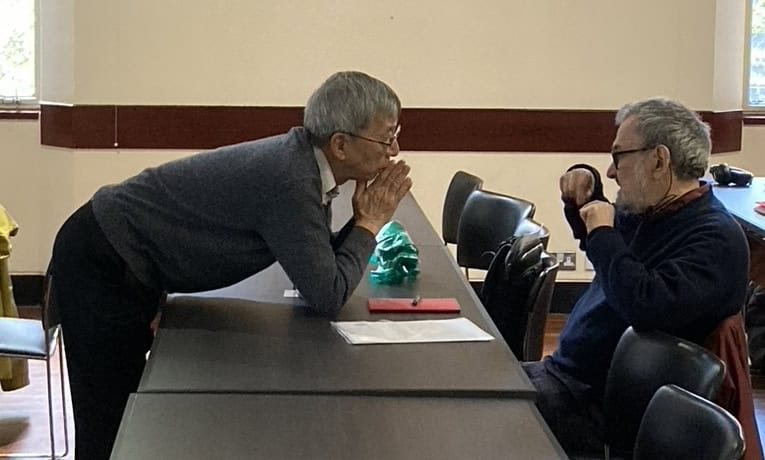
As audiences left London’s Old Vic theatre on a crisp January night, one theatregoer was overheard discussing the second law of thermodynamics with a companion. The conversation was sparked by Tom Stoppard’s Arcadia, a play that weaves chaos theory and iterated algorithms into a story of love, jealousy, and academic rivalry. The exchange raises a question: did the production fail to communicate its ideas clearly, or did it inspire a deeper curiosity about physics? For many, the answer is the latter, as theatre increasingly becomes a bridge between science and the public.
Written in 1993, Arcadia is an early example of a growing genre of plays that place scientific ideas or scientists at their core. The Old Vic’s revival was so popular that it transferred to London’s West End for an extended run in summer 2026. It was not the only major science play in London this year; Hampstead Theatre staged a new production of Michael Frayn’s Copenhagen, which imagines the 1941 meeting between Werner Heisenberg and Niels Bohr and its implications for nuclear weapons. Since its 1998 debut at the National Theatre, Copenhagen has arguably been the most successful physics play ever written.
Plays about physics fall into three main types: biographical portrayals of physicists, explorations of the process of doing science, and works that use scientific concepts to structure the narrative. Copenhagen is unique in achieving all three at once. The tradition of representing scientists on stage is not new; Christopher Marlowe’s Doctor Faustus in the 16th century featured a learned character seeking worldly knowledge at a cost. In 1823, a stage adaptation of Mary Shelley’s Frankenstein brought the novel to public prominence, reigniting suspicions about scientists as forces for good or evil.
The modern “physics play” can be traced to Bertolt Brecht’s A Life of Galileo, written in 1938 and first performed in Zurich in 1943. It depicts Galileo’s prosecution for heresy over his support of the heliocentric universe. Since then, many plays have focused on real physicists. Dava Sobel’s 2011 play And the Sun Stood Still dramatizes Copernicus’s discussions with mathematician Georg Rheticus in 1539. Craig Baxter’s Let Newton Be!, a verbatim play based on Newton’s own words, was performed at Trinity College, Cambridge, in 2009, with three actors portraying Newton at different stages of his life.
These plays do more than entertain; they engage audiences with scientific ideas in a way that lectures or textbooks often cannot. The success of Arcadia and Copenhagen suggests that audiences are hungry for stories that explore the human side of science. Whether any of these works can be called the definitive science play remains an open question, but their popularity indicates that theatre has become a vital venue for science communication.
130