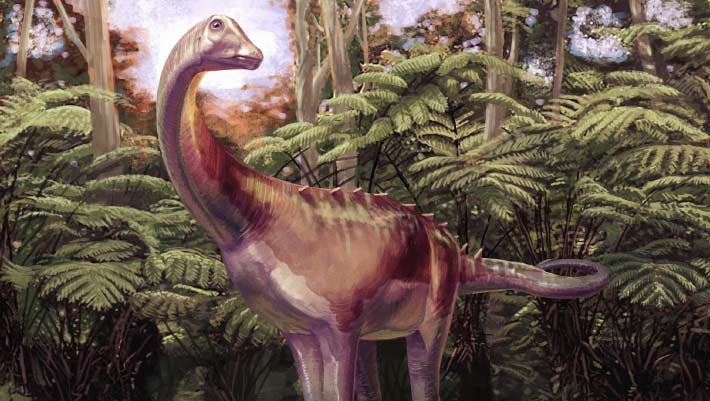
A small fossil collected on an Antarctic island more than four decades ago has been identified as the tail vertebra of a titanosaurian sauropod dinosaur that roamed the region roughly 83 million years ago. The discovery, published in the journalActa Palaeontologica Polonica, rewrites the timeline of Antarctica’s first dinosaur fossil and provides new insight into the diversity of life on the continent during the Late Cretaceous period.
The fossil was originally recovered during the 1980s from James Ross Island, a location off the Antarctic Peninsula known for its rich marine and terrestrial fossil deposits. For years, the specimen remained in museum collections without a definitive classification. Researchers from Argentina, Brazil, and the United Kingdom reexamined the bone using modern imaging techniques and comparative anatomy, confirming it belongs to a titanosaur, a group of long-necked, plant-eating sauropods that were among the largest land animals ever to exist.
Titanosaurs were widespread during the Cretaceous, with fossils found on every continent, including Antarctica. This identification marks the first confirmed dinosaur fossil from Antarctica, pushing back the known presence of dinosaurs on the continent by millions of years. Previous Antarctic dinosaur finds were limited to fragmentary remains from the Jurassic and early Cretaceous, but this specimen provides clear evidence that titanosaurs inhabited the region during the late Cretaceous, when Antarctica was still connected to South America and Australia as part of the supercontinent Gondwana.
The vertebra measures about 10 centimeters in length, indicating a relatively small individual compared to some of its gigantic relatives, which could reach lengths of over 30 meters. The bone’s structure shows features typical of titanosaurs, including a distinctive shape and internal architecture that helped paleontologists rule out other dinosaur groups. The study’s lead author, Dr. Ignacio Cerda from the Argentine Museum of Natural Sciences, noted that the fossil’s preservation is remarkable given the harsh conditions of Antarctic fossilization.
Antarctica’s fossil record is sparse due to its ice cover and remote location, making each discovery significant. The continent was once a lush, forested environment with a temperate climate, supporting a variety of plant and animal life. During the Late Cretaceous, temperatures were warmer, and dinosaurs likely migrated across land bridges that connected Antarctica to other southern landmasses. This titanosaur find supports theories that these giant herbivores had a global distribution and adapted to diverse habitats, including polar regions with seasonal light variations.
The identification also has implications for understanding dinosaur evolution and extinction. Titanosaurs were among the last surviving sauropod groups, thriving until the end-Cretaceous mass extinction 66 million years ago. Finding them in Antarctica suggests that the group was more resilient and widespread than previously thought, and that the continent played a role in their evolutionary history. The study adds to a growing body of evidence that Antarctica was a crucial region for dinosaur dispersal and biodiversity during the Mesozoic Era.
Researchers plan to continue searching for more fossils on James Ross Island and other Antarctic sites, hoping to uncover additional remains that could fill gaps in the continent’s dinosaur record. The harsh climate and logistical challenges make fieldwork difficult, but advances in satellite imagery and remote sensing are improving the chances of locating new sites. The discovery also highlights the importance of reexamining museum collections, where overlooked specimens can yield groundbreaking findings.
The fossil is now housed at the Argentine Antarctic Institute, where it will be available for further study. The research team emphasizes that this is just the beginning of understanding Antarctica’s dinosaur fauna, and that future expeditions may reveal a more complex picture of life on the southernmost continent during the age of dinosaurs.
140