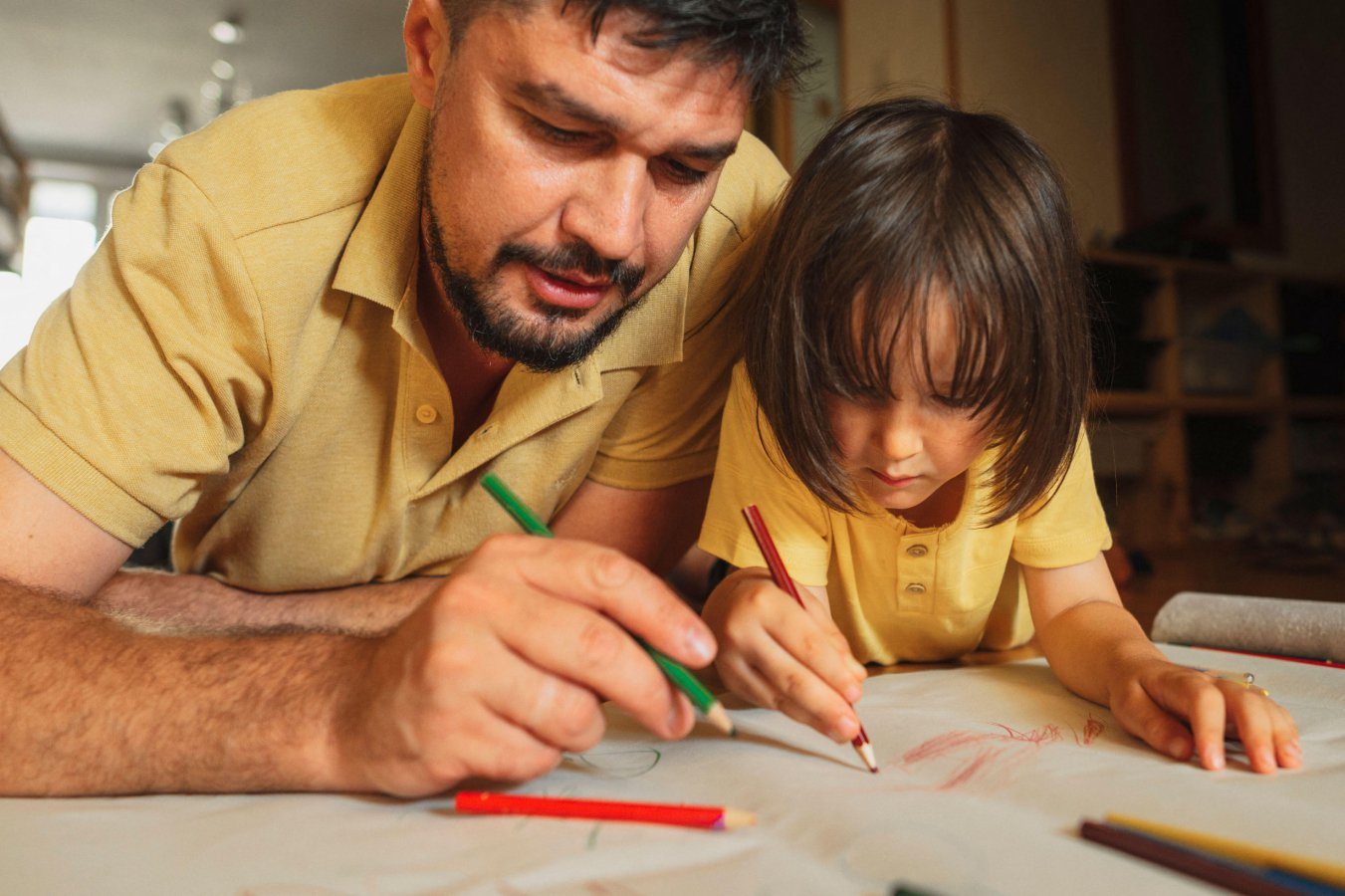
Adults may be better creative thinkers than children, according to a new study that challenges the widespread belief that creativity declines with age. Researchers at the University of Graz in Austria found that adults outperformed children on a series of creativity tests, but children showed far greater confidence in their own ideas and reported less anxiety about being judged.
«We found that adults are actually more creative thinkers,» said Mathias Benedek, a researcher at the University of Graz who led the work. «But children enjoy creativity more and are much less worried about what others think about their ideas.» The study was published in the journal PLOS One.
The research team recruited 92 children between the ages of 4 and 7, along with 70 adults whose average age was 25. Participants completed three creative tasks. In the first, they had three minutes to list as many alternative uses for a tin can as possible. They then drew freely for eight minutes, and finally drew an animal that does not exist within an eight-minute window.
Five independent judges, who were not involved in the research, were trained to assess the results objectively based on originality and whether each output fulfilled the task requirements. On the alternative-uses task, adults averaged about 4 points out of 5, while children scored around 3. One adult suggested the can could serve as a «Halloween candy box when on (a) diet,» while some children imagined it as a rattle.
Adults also scored roughly 0.5 points higher than children on the free-drawing task and about 2 points higher on the imaginary-animal task. The findings suggest that creativity draws on the ability to combine ideas from prior experience, according to Wendy Ross of King’s College London. Adults, for instance, are likely familiar with a wider variety of animals than children, giving them more raw material to draw from when inventing a fantasy creature.
After completing the tasks, participants answered questions about how well they thought they had performed, how anxious they felt about not doing well, and how much fun they had. Children rated their own performance at around 4 to 5 points on the free-drawing and animal tasks, compared with adults who gave themselves about 3 points. The children also reported lower anxiety than the adults.
«If the purpose of creativity is to have enjoyment in it, to play and to be unfettered humans, then children are doing better at that,» Ross said. Both groups, however, reported similar levels of pleasure from the animal-drawing task. Benedek suggested that the specific instruction for that task may have reduced adults’ worries about being judged for their ideas.
Ross said people should try to be more creative for their wellbeing, regardless of the quality of the final result. Engagement with the arts has been linked to reduced mental health problems and stronger social skills. «Creativity, especially when done with other people, is really beneficial to your mental wellbeing – and you don’t have to score 5 out of 5 on a ranking scale,» she said.
The study adds to a growing body of research on how creativity changes across the lifespan and what motivates people to engage in creative activity. While adults may produce more original and task-appropriate ideas, the confidence and lower anxiety seen in children could play an important role in sustaining creative engagement over time.
15