China is moving closer to launching its first commercial resupply spacecraft for the Tiangong space station, as two competing designs progress toward operational service. The China Manned Space Agency awarded contracts in late October 2024 to develop cargo services that would complement the existing Tianzhou freighter, which currently flies roughly once every nine months.
The two selected designs are the Qingzhou cargo craft, developed by the Innovation Academy for Microsatellites under the Chinese Academy of Sciences, and the Haolong reusable spaceplane from the Chengdu Aircraft Design Institute, part of the Aviation Industry Corporation of China. Both are intended to provide lower-cost, more frequent supply runs to the orbital laboratory.
The Qingzhou prototype, named Baixiang or «white elephant», began its maiden flight in March and is expected to remain in sun-synchronous orbit for up to three years. The craft did not attempt to approach or dock with the station. Instead, its 27 cubic meters of internal volume are being used to carry 1,020 kilograms of scientific research payloads, including an experiment that successfully revived and sustained a drought-tolerant desert moss, Syntrichia caninervis, in an onboard cultivation chamber using only a small amount of water.
Native to the deserts of northwestern China, the moss can withstand severe cold, dehydration, and radiation. Researchers say the findings could help assess which plants might support future life support systems on Mars. Other experiments aboard the prototype included a working microgravity refrigerator and a tethered adhesive anchor inspired by the web-shooters of the Spider-Man character. The device applies a gentle attachment without penetrating its target, a capability that could eventually be used to capture non-cooperative objects or remove orbital debris.
A second Qingzhou spacecraft is under construction and is scheduled to launch no earlier than January 2027 aboard CAS Space's triple-core Lijian-2 rocket. That mission is expected to deliver up to 1,800 kilograms of supplies to Tiangong and, several weeks later, carry away up to 2,900 kilograms of material for disposal. Qingzhou is not designed to be recovered and will burn up during atmospheric reentry.
The Haolong spaceplane, by contrast, is built to survive reentry and land on a runway. The uncrewed vehicle could fly repeated missions to the station, carrying around 2,000 kilograms in both directions. Chengdu engineer Tang Wangyuan has cited ten flights as an example of how the design would spread development and manufacturing costs across multiple missions. The company issued a tender this month for an orbital launch expected to be for this vehicle, with the contract capped at 100 million yuan, or about $14.9 million.
Landspace has previously been indicated as Haolong's carrier with its ZhuQue-3 rocket, and the company's late December 2025 prospectus cites the ZhuQue family as the spaceplane's preferred launch vehicle. The craft's wings can be folded to a span of less than five meters for launch and extended to eight meters once in orbit. The Shuang Quxian-3 and the Chang Zheng 12B and 10B rockets could also serve as potential carriers.
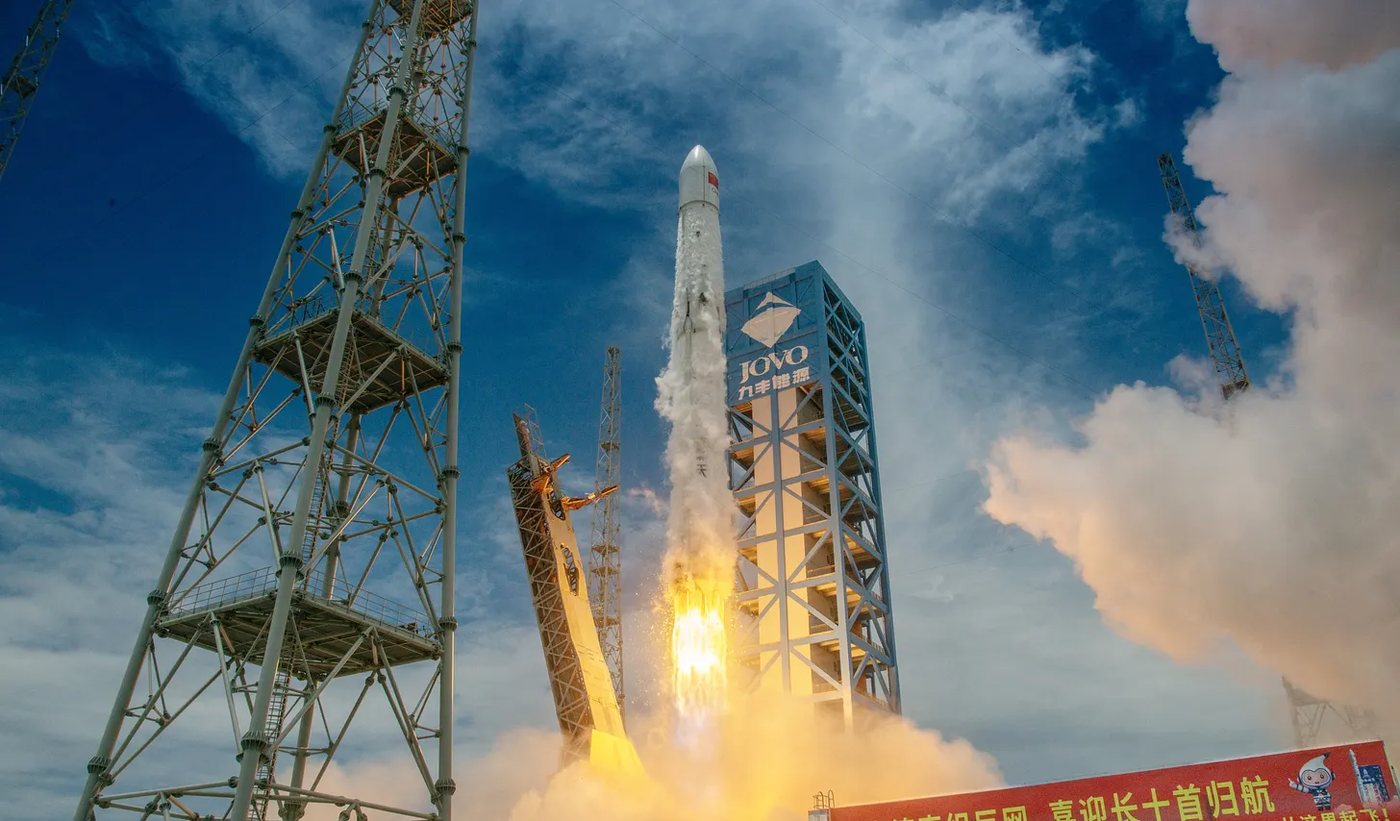
Separately, China is preparing for the first reflight of a previously flown booster. The Chang Zheng 12A made its maiden flight from the Jiuquan Satellite Launch Center at the end of 2025, reaching orbit successfully, but its first-stage landing attempt failed when one of three engines did not restart for the final landing burn, causing the stage to crash about five kilometers from its target. A second CZ-12A is expected to launch no earlier than November 3. A successful recovery would mark China's third booster landing on an orbital mission, each achieved by a different rocket type. To date, only Landspace's ZhuQue-3 has landed a first stage on land, while a Chang Zheng 10B first stage was recovered at sea.
11