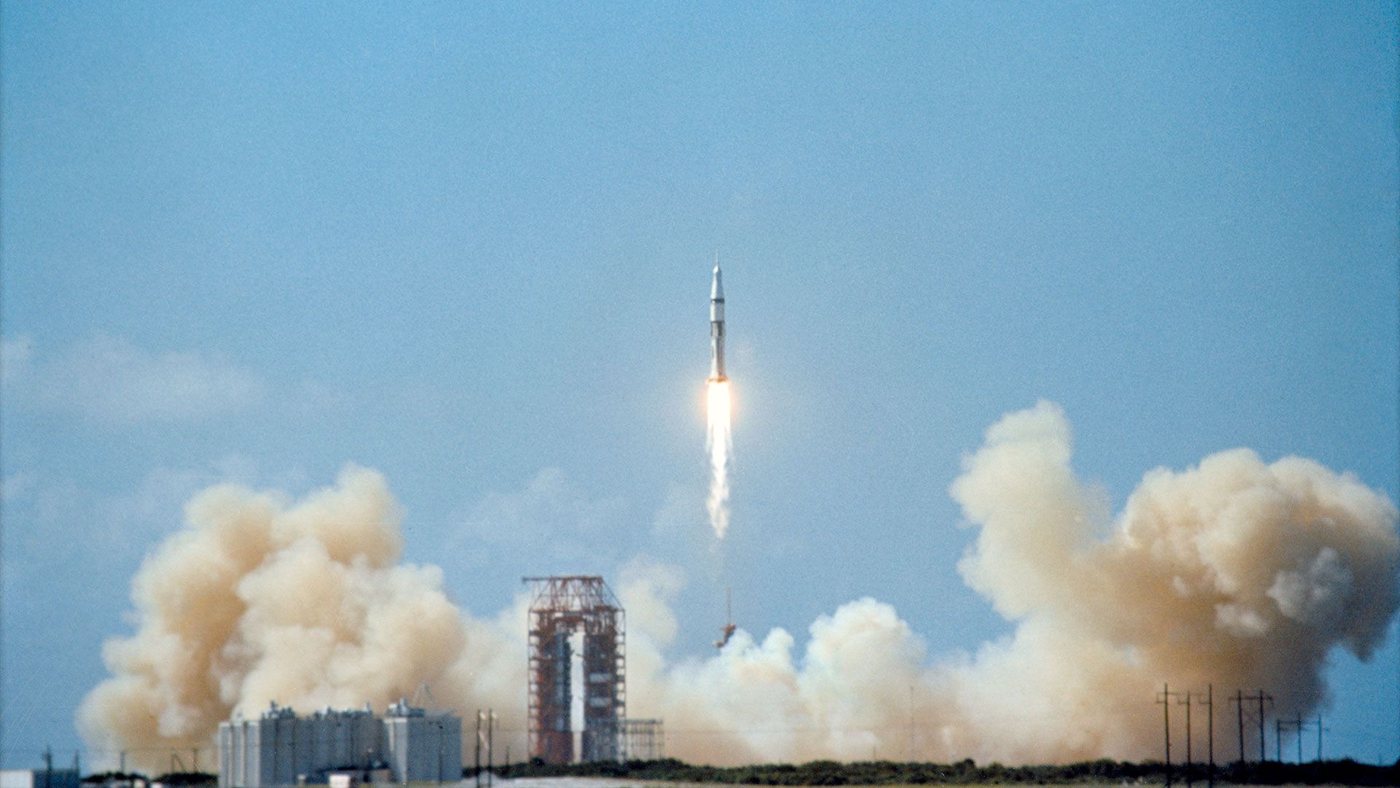
NASA launched Apollo 7 on October 11, 1968, sending the first crewed Apollo spacecraft into Earth orbit and marking a critical step toward the first Moon landing. The mission carried astronauts Walter Schirra, Donn Eisele, and Walter Cunningham, and it was the first time an Apollo crew flew in space.
The flight came after the devastating Apollo 1 fire in January 1967, which killed astronauts Gus Grissom, Ed White, and Roger Chaffee during a launch pad test. The tragedy halted crewed Apollo flights for more than a year and forced a major redesign of the command module. Apollo 7 was designed to prove the spacecraft could safely support a crew in orbit and to test the systems that would later take astronauts to the Moon.
During the 11-day mission, the crew performed a series of engineering tests, including firing the service propulsion system, the engine that would be needed for lunar missions. They also conducted the first live television broadcast from an American spacecraft, showing viewers inside the cabin and offering a look at life in orbit. The mission was considered a success and helped restore confidence in the Apollo program.
Apollo 7 splashed down in the Atlantic Ocean on October 22, 1968, after completing 163 orbits of Earth. The crew's performance and the spacecraft's reliability paved the way for Apollo 8, which flew around the Moon two months later, and ultimately for Apollo 11's lunar landing in July 1969.
The launch took place from Cape Kennedy, now known as Cape Canaveral, in Florida, using a Saturn IB rocket. The mission was the first crewed flight of the Apollo program and the only one to launch on the Saturn IB. It also marked the first time a three-person American crew flew together in space.
Apollo 7's success was not without tension. The crew suffered from head colds during the flight, and relations with mission control became strained at times. Schirra, the mission commander, had announced before the flight that it would be his last, and the crew's willingness to question procedures led to some friction. Still, the mission achieved its primary objectives and provided valuable data for future flights.
The flight also tested the spacecraft's life support, navigation, and communication systems over an extended period, proving they could sustain a crew for the duration of a lunar mission. Engineers used the data to refine procedures and hardware for later Apollo flights.
Apollo 7 was a turning point for NASA after the Apollo 1 fire. It demonstrated that the redesigned command module was ready for crewed operations and set the stage for the bold missions that followed. The mission is remembered as a crucial stepping stone that helped the United States reach the Moon before the end of the 1960s.
16