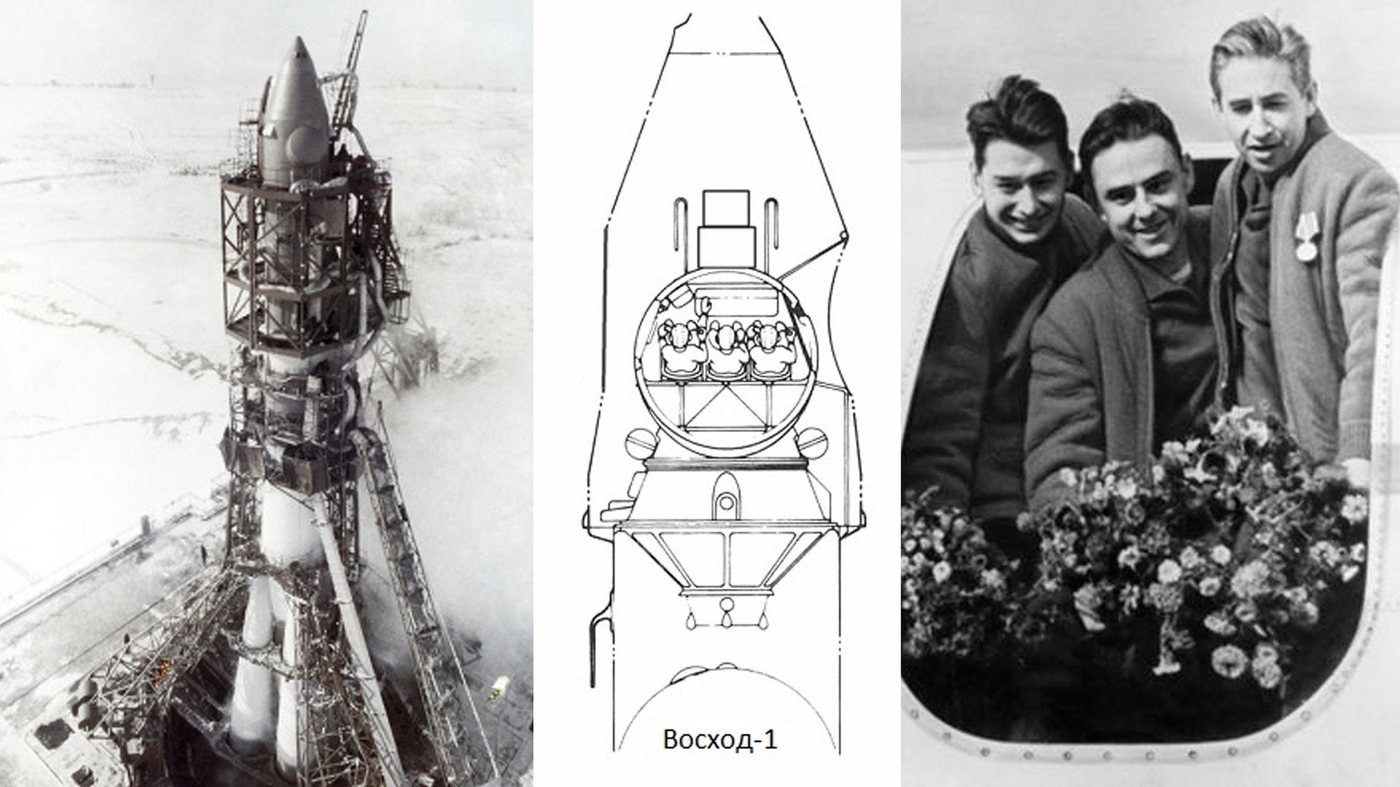
The Soviet Union launched Voskhod 1 on October 12, 1964, sending the first multi-person crew into space. The mission carried three cosmonauts — Vladimir Komarov, Konstantin Feoktistov, and Boris Yegorov — into orbit around Earth. It was a significant first in human spaceflight and a major propaganda victory for the Soviet space program during the Cold War.
Voskhod 1 was a modified version of the Vostok spacecraft, which had previously carried single cosmonauts. To accommodate three crew members, engineers removed the ejection seat and other equipment, and the cosmonauts flew without spacesuits. The mission lasted just over 24 hours, completing 16 orbits of Earth. It was a test of the Soviet Union's ability to conduct more complex missions and to beat the United States in the space race.
The crew included a physician, Boris Yegorov, who conducted medical observations during the flight. Konstantin Feoktistov was an engineer and the first civilian to fly in space. Vladimir Komarov, the mission commander, later died in the Soyuz 1 crash in 1967. The flight was a precursor to the first spacewalk, which was performed by Alexei Leonov on Voskhod 2 in March 1965.
The Voskhod 1 mission was a response to the American Gemini program, which was preparing to launch two-person crews. The Soviet Union had already achieved several firsts, including the first satellite, Sputnik 1, in 1957, and the first human in space, Yuri Gagarin, in 1961. Voskhod 1 was another attempt to maintain leadership in space exploration.
The launch took place from Baikonur Cosmodrome in Kazakhstan. The spacecraft was a spherical capsule, similar to Vostok, but with a redesigned interior. The mission was considered a success, although the crew faced some discomfort due to the cramped conditions and lack of spacesuits. The Soviet government announced the flight as a triumph, and the cosmonauts became national heroes.
Voskhod 1 was followed by Voskhod 2, which carried two cosmonauts and achieved the first spacewalk. After that, the Soviet Union focused on the Soyuz program, which is still in use today. The Voskhod missions were a stepping stone in the development of space stations and long-duration flights.
The legacy of Voskhod 1 is that it demonstrated the feasibility of multi-person crews, which became standard for future space missions. It also highlighted the risks of spaceflight, as the crew flew without spacesuits and with limited safety equipment. The mission remains a notable event in the history of space exploration.
15