SpaceX is preparing to launch its 35th commercial resupply mission to the International Space Station, a flight that will deliver the final set of roll-out solar arrays needed to sustain the orbiting laboratory through its remaining years of operation.
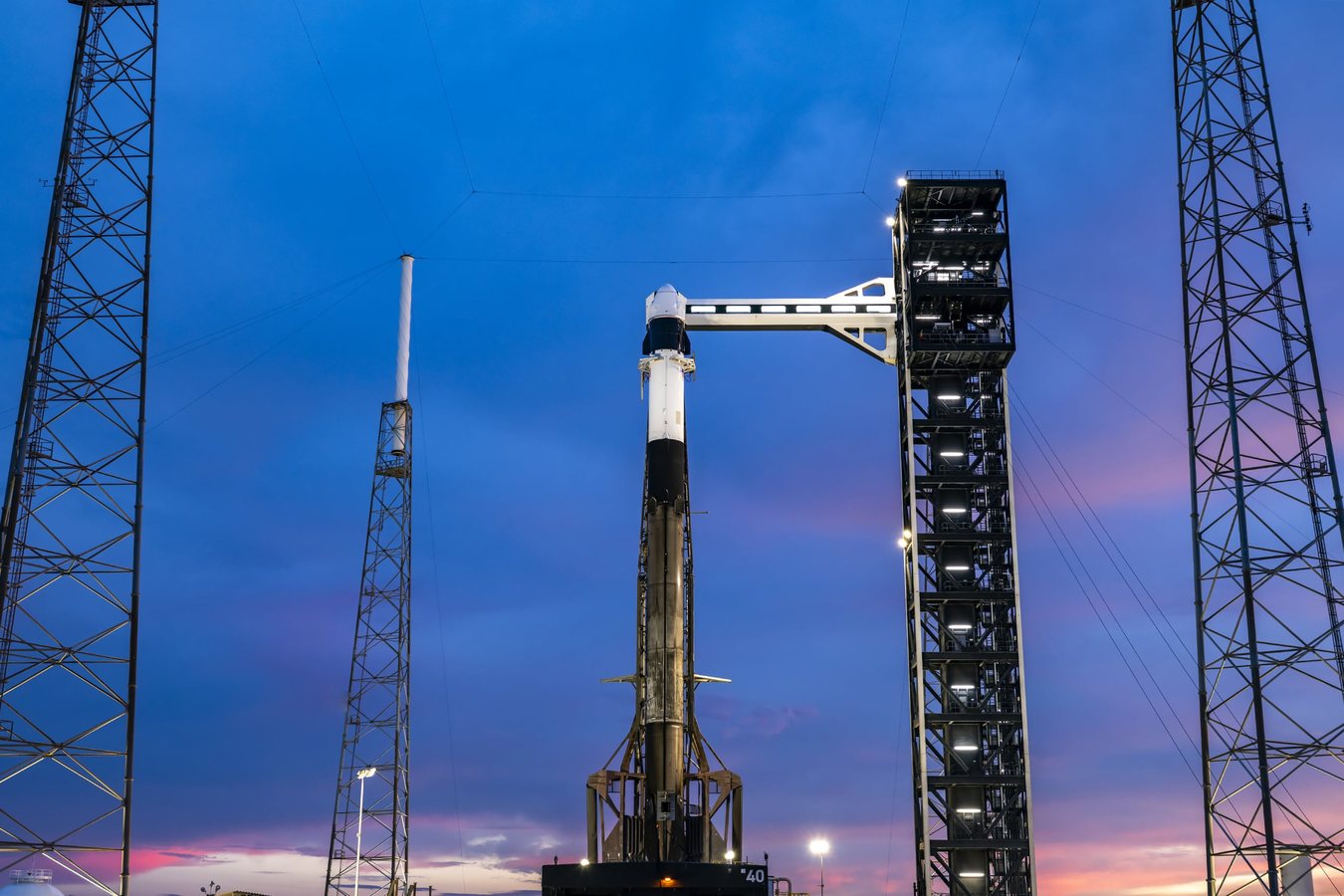
The CRS-35 mission is scheduled to lift off Tuesday, Oct. 13, at 6:33 a.m. EDT from Space Launch Complex 40 at Cape Canaveral Space Force Station in Florida. The Cargo Dragon capsule C211, making its fourth flight, will carry 2,867 kilograms of pressurized cargo and an additional 1,195 kilograms in its unpressurized trunk.
Forecasters predict a less than 5 percent chance of a weather violation on Tuesday, rising to 5 percent Wednesday and 10 percent Thursday, with cumulus clouds the only concern. After liftoff, the Falcon 9 will follow a northeast trajectory, placing Dragon in a 51.6-degree orbit matching the Station's inclination. Booster B1096, on its eighth flight, will return to Landing Zone 40 adjacent to the pad. The booster has previously supported the Amazon Leo KF-01, IMAP, Starlink 6-87, NROL-77, GPS III SV09, CRS-34, and NROL-95 missions.
Dragon will take just over 52 hours to rendezvous with the Station, docking at the Harmony module's zenith port on Thursday, Oct. 15, at 15:00 UTC. Astronauts Anil Menon and Joshua Kutryk will monitor the arrival. The port was vacated by the Crew Dragon Freedom, which returned the Crew-12 astronauts to Earth.
The most prominent payload is the last set of iROSA solar arrays, developed by Redwire and built by Boeing. These two arrays will be installed on power channel 3B on the starboard S6 truss and channel 2A on the port P4 truss. Both channels were prepared during spacewalks earlier this year by Expedition 74 and 75 crews. Six iROSA arrays, each generating 20 to 28 kilowatts, are already installed. Once the final two are attached, the Station will gain an additional 20 to 30 percent of power, improving its supply margin as the original solar arrays age and degrade.
The 593 kilograms of science experiments include studies of vision, heart tissue, glass making, and neurodegenerative diseases. LambdaVision-1 will test the manufacturing of artificial retinas in microgravity, layer by layer, in hopes that weightlessness produces more uniform and stable films. Stellar Spheroids will examine how microgravity affects 3D human heart tissue models, testing whether more advanced vascular networks can form to support disease research and drug testing.
ELF-Unconventional Glass 2 will form glass from non-traditional elements in microgravity, studying molten material behavior and returning solid samples to Earth for analysis. The MINDS experiment will study brain organoids in «organoid villages» combining cells from multiple people, aiming to better understand inflammation linked to neurodegenerative diseases and to identify new treatment targets for Alzheimer's, Parkinson's, and multiple sclerosis.
CRS-35 also carries a collapsible contingency urinal test unit for the Artemis III Orion spacecraft, along with a toilet dose pump and a pretreatment quality sensor. A robotic micro-conical tool for Station maintenance is also aboard, with external replacement units and payloads.
Dragon will spend about a month in orbit before returning to Earth off the coast of California with critical samples and hardware. The spacecraft will bring back a failed Canadarm2 joint for analysis, using a large foam clamshell carried up for the purpose. It will also return a spacesuit for refurbishment, a urine processor pump assembly, and a water processor filtration unit. Dragon's downmass capability remains essential for maintaining the Station's Shuttle-era spacesuits and other systems.
The mission will be the 113th Falcon 9 flight of 2026 and SpaceX's 119th launch overall this year. While crew and cargo Dragon flights will continue for several more years, SpaceX is beginning to phase out Dragon and Falcon 9 to focus on Starship operations.
18