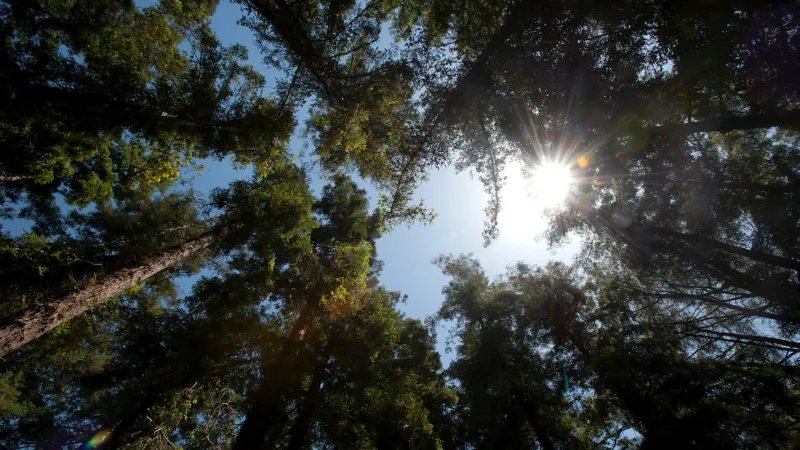
Coast redwoods, the towering giants of California's coastal forests and among the planet's most efficient carbon-storing trees, experience a slowdown in photosynthesis when temperatures climb to heat wave levels, according to new research. The finding raises concerns about the future of these ancient trees as climate change drives more frequent and intense heat events.
Photosynthesis is the process by which trees convert sunlight, water, and carbon dioxide into energy and biomass. For coast redwoods, this mechanism is exceptionally efficient, allowing them to sequester large amounts of carbon over their centuries-long lifespans. The new study indicates that under heat wave-like conditions, this critical process decelerates, potentially undermining the trees' ability to absorb carbon dioxide from the atmosphere.
The research adds to a growing body of evidence that extreme heat can disrupt fundamental plant functions. While redwoods are adapted to cool, foggy coastal environments, their limited tolerance for high temperatures may leave them vulnerable as the climate warms. If photosynthesis slows during heat waves, the trees could store less carbon, grow more slowly, and become more susceptible to other stressors such as drought and pests.
Coast redwoods are not just ecological marvels; they are also significant players in the global carbon cycle. Their massive trunks and dense wood lock away carbon for centuries, making them invaluable in efforts to mitigate climate change. Any reduction in their photosynthetic efficiency could have ripple effects on forest health and carbon budgets.
The study's authors emphasize that the slowdown occurs specifically at temperatures resembling heat waves, which are projected to become more common in the coming decades. This could challenge the resilience of redwood forests, which are already facing pressures from habitat fragmentation, changing fog patterns, and disease.
Understanding how these trees respond to heat is essential for conservation planning. If redwoods cannot maintain their photosynthetic performance under extreme heat, land managers may need to consider assisted migration or other interventions to protect the species. However, such measures are complex and may not fully compensate for the loss of function during heat events.
The research highlights the interconnectedness of climate, plant physiology, and ecosystem services. As the planet warms, even the mightiest trees may find their limits tested. The fate of the coast redwood serves as a reminder that climate change impacts are not uniform and can affect even the most robust-seeming organisms.
Further studies are needed to determine whether redwoods can acclimate to higher temperatures over time or if the observed slowdown is a permanent constraint. For now, the findings underscore the importance of reducing greenhouse gas emissions to protect these iconic forests and the carbon they store.
11