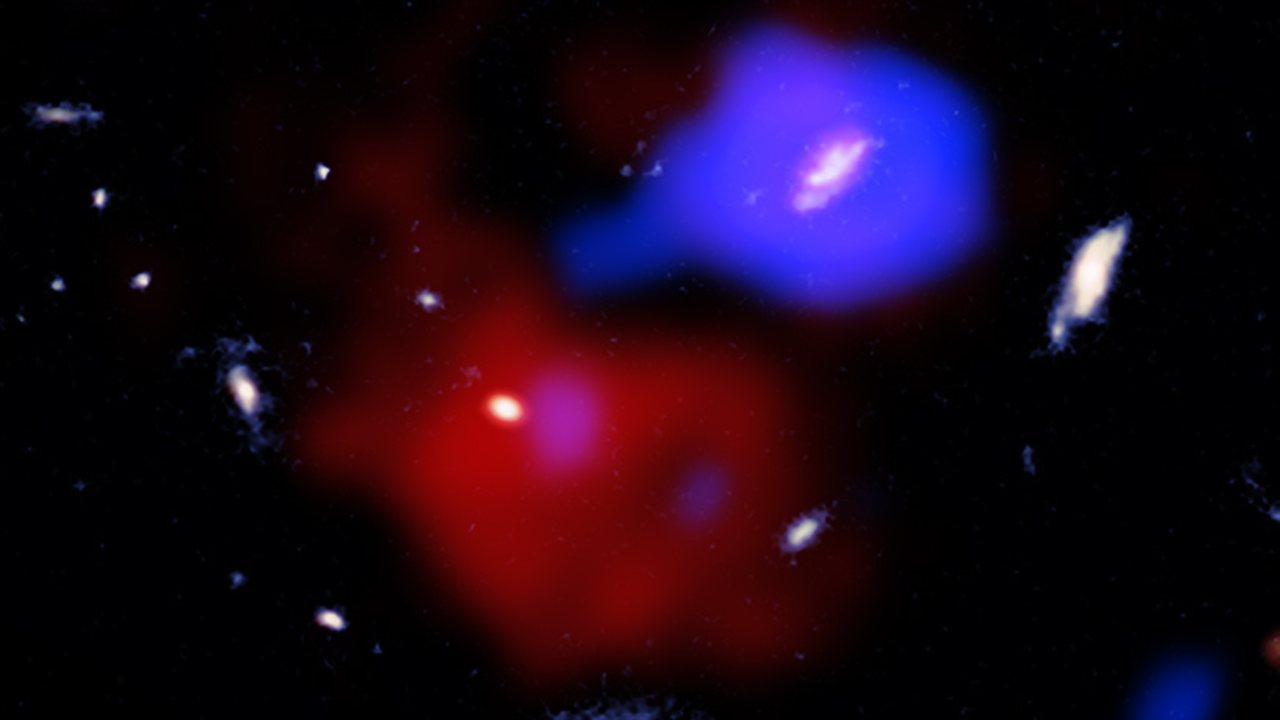

Astronomers have reported the first solid evidence of a moon-like object outside the Solar System, a discovery that challenges conventional definitions of planets and moons. The object, detected using the European Southern Observatory's Very Large Telescope (VLT) in Chile, orbits a brown dwarf in the CD-35 2722 system, located relatively close to Earth. The findings were published today in the journal Nature.
The system consists of a star with about half the mass of the Sun, a brown dwarf with a mass roughly 37 times that of Jupiter, and the newly detected object, which has a mass at least equal to Jupiter's. Brown dwarfs are too massive to be planets but lack sufficient mass to sustain nuclear fusion like stars. The new object, which researchers call an “exosatellite,” orbits the brown dwarf, not the star directly.
“The satellite we report is a giant gaseous body orbiting an extremely massive companion, itself several times the mass of Jupiter,” said Alice Zurlo, a professor at Diego Portales University in Chile, director of the Millennium Nucleus of Young Exoplanets and their Moons (YEMS), and a co-author of the study. “In the Solar System, there is a clear distinction between planets and the Sun, so defining objects like moons is simple. In the CD-35 2722 system, where the boundaries between stars, planets, and moons become blurred, the whole picture is much more complex to describe.”
Although more than 6,000 exoplanets have been discovered since the 1990s, no moon outside the Solar System had been confirmed until now. The detection was made using the radial velocity method, the same technique used to discover the first exoplanet orbiting a Sun-like star. The instrument CRIRES+ on the VLT measured tiny wobbles in the brown dwarf's motion caused by the gravitational pull of the orbiting object.
“This is one of the most suitable systems to apply this technique, which is why we chose it,” said Silvano Desidera, a researcher at the National Institute for Astrophysics (INAF) in Padua, Italy, and a co-author of the study. “To perform radial velocity measurements of the brown dwarf—and, in perspective, of actual planets—we need spectra that are not heavily contaminated by the central star, which is much brighter than the brown dwarf. The case of CD-35 2722 is perfect because the central star has low mass and is therefore less luminous, and the brown dwarf is well separated from it in the sky, as the system is close to us.”
The newly discovered object is difficult to classify using standard Solar System terminology. It behaves like a moon because it orbits an object that itself orbits a star. However, it is massive enough to be considered a planet, while the brown dwarf it orbits is neither a planet nor a star. Researchers refer to it as an “exosatellite” to capture its unique nature.
“As exotic as it may seem, this system is truly unique and represents a breakthrough: the first plausible detection of an exosatellite,” Zurlo added.
Beyond the significance of discovering a class of objects previously confined to the Solar System, finding satellites in other planetary systems can help scientists understand how diverse the processes of formation and evolution of such systems are. Only a few months ago, a study based on observations with the Very Large Telescope Interferometer (VLTI) in the HD 206893 star system hinted at the presence of a satellite, but without a definitive detection. In that case, the star's brightness was much higher, making the system less suitable for the radial velocity method.
The CD-35 2722 system, by contrast, offers a rare combination of a dim central star and a well-separated brown dwarf, allowing astronomers to obtain clear measurements. The researchers emphasize that this discovery opens a new window for studying the formation and evolution of planetary systems, including the possibility of moons around exoplanets.
“Independently of how we choose to call this object, astronomers have been searching for satellites outside the Solar System for years, without any unequivocal detection so far,” the team noted in the study. The detection of this exosatellite provides the first solid evidence that such objects exist, paving the way for future searches around other brown dwarfs and, eventually, around exoplanets themselves.