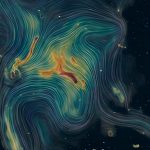
For the first time, astronomers have successfully reconstructed the structure of the magnetic field that permeates an entire galaxy cluster, from its core to its outermost regions. The groundbreaking result was achieved by combining the deepest radio observations ever conducted with the European LOFAR (Low Frequency Array) telescope of the Abell 2255 galaxy cluster, using an innovative technique for analyzing radio images. The study, accepted for publication in the journal Astronomy & Astrophysics and led by the Italian National Institute for Astrophysics (INAF), suggests that these large-scale magnetic fields are not randomly distributed but are instead shaped by gas motions during the cluster's formation.
Understanding how these magnetic fields originate and evolve represents one of the major challenges of modern astrophysics, as they profoundly influence the dynamics of hot gas in galaxy clusters and, more broadly, the formation and evolution of the largest structures in the universe. Abell 2255 is a galaxy cluster located approximately one billion light-years from Earth, spanning several million light-years across. It is one of the most interesting cosmic laboratories for studying the universe at radio wavelengths. Already known for the extraordinary complexity of its radio emission, the system hosts not only numerous radio galaxies but also a vast diffuse emission produced by the interaction between electrons moving at near-light speed and the magnetic fields that permeate the cluster's hot gas.
The LOFAR Galaxy Cluster Ultra-Deep Field project, presented in this study and resulting from collaboration between researchers at INAF and numerous European and American research institutes, represents the evolution of the previous LOFAR Galaxy Cluster Deep Field, published in 2022. In that earlier study, Abell 2255 had been observed for about 72 hours in the frequency range between 120 and 168 MHz, corresponding to wavelengths of about two meters. Over the last few years, the integration time on Abell 2255 has been extended to over 330 hours, making it the deepest radio study ever dedicated to a galaxy cluster. After a rigorous data quality selection process, the team used the best 224 hours of observation, obtaining radio images with sensitivity and resolution already comparable to those that will become routine in the future with SKA-Low, the low-frequency component of the future international Square Kilometer Array telescope currently under construction in Australia.
«Obtaining highly sensitive radio images of galaxy clusters is fundamental to understanding how electrons are accelerated to relativistic speeds and how magnetic fields are amplified on large cosmic scales,» said Andrea Botteon, INAF researcher and first author of the study. «The complexity of these studies is due to the elusiveness of the radio signal coming from electrons moving in very weak magnetic fields. We believe that the mechanism that 'turns on' these gigantic radio emissions is linked to the process of galaxy cluster formation. In this study, we combined the deepest radio observations ever made with an innovative data analysis technique that allowed us to reconstruct for the first time the topology of a galaxy cluster's magnetic field. The coherence of the magnetic field lines observed in some regions of the cluster suggests that the field morphology is intimately linked to the dynamics of the gas in which it resides, where it can be 'stretched' or 'compressed' by motions related to the cluster's own formation.»
The exceptional quality of this wealth of observations made it possible to apply a new analysis technique that directly derives the direction of the magnetic field from the morphology of the radio emission observed by LOFAR, rather than from the measurement of Faraday rotation, a well-established technique that has significant limitations at low radio frequencies. Thanks to this new approach, it was possible to map, for the first time, the geometry of the magnetic field of an entire galaxy cluster, from its core to its gravitational boundaries, in the case of Abell 2255 over an extent of more than 13 million light-years. The analysis shows that the large-scale magnetic field is not randomly oriented. In some regions it follows well-defined directions: along the extensions of the radio emission it appears predominantly elongated in the radial direction, while in regions where cosmic shock waves are present it assumes tangential orientations.
According to the authors, this is the first observational evidence that the topology of the magnetic field is shaped by the complex accretion dynamics that determines the growth of large cosmic structures and the motions of gas during the process of galaxy cluster formation. Comparison with sophisticated cosmological simulations confirms this interpretation. Behind these images also lies an important technological challenge. The project required about three years of work and the processing of nearly 200 terabytes of raw data, processed entirely on the Italian infrastructure dedicated to LOFAR data analysis, using high-performance computing systems at INAF between Bologna and Trieste. The volume of data was such that, at the initial transfer rate, the download alone would have taken almost a year. This is a concrete example of how modern computational infrastructures are now an integral part of cutting-edge astrophysical research, enabling discoveries that would have been impossible just a decade ago.
100