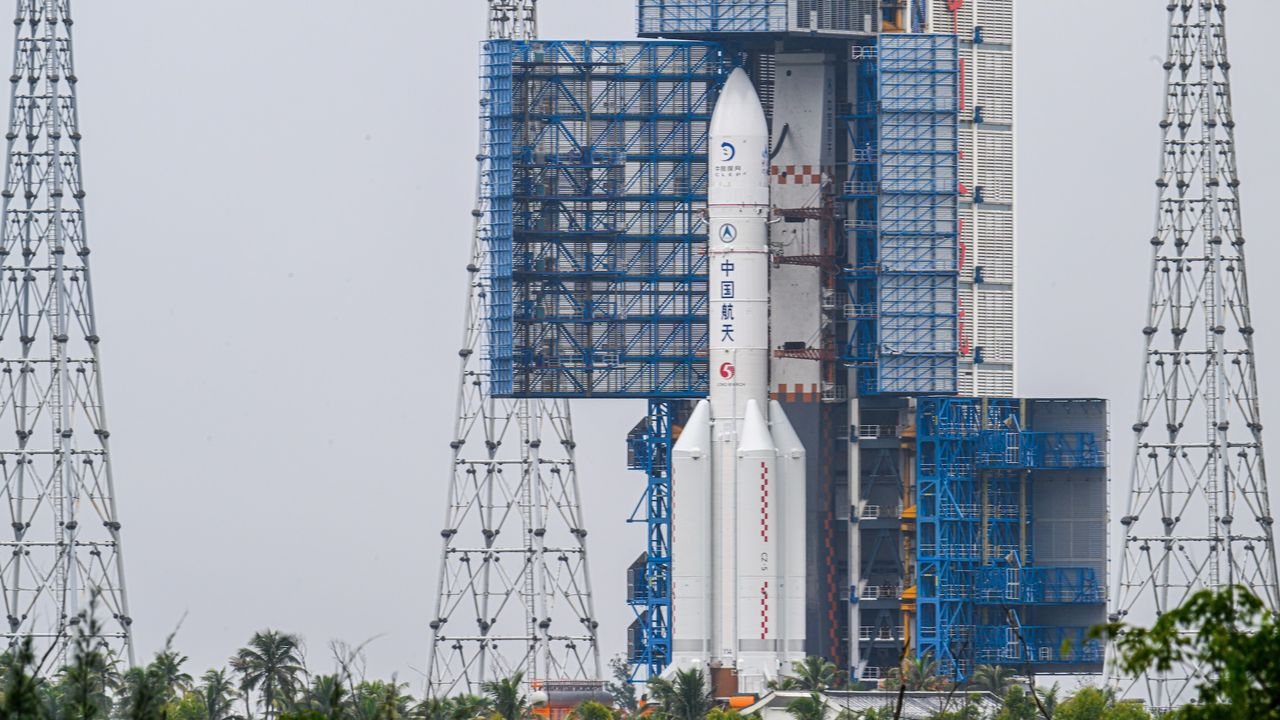
China's historic Chang'e 7 mission to the moon's south pole has been postponed due to bad weather at the launch site, according to space officials. The mission, which represents a significant step in China's lunar exploration program, was scheduled to lift off in the coming days but will now wait for more favorable conditions.
The Chang'e 7 spacecraft is designed to conduct a detailed survey of the lunar south pole, a region of intense scientific interest due to the presence of permanently shadowed craters that may harbor water ice. The mission includes an orbiter, a lander, a rover, and a flying probe that will explore the shadowed areas where sunlight never reaches. Scientists believe these deposits could be crucial for future long-term human presence on the moon, providing a potential source of drinking water, oxygen, and rocket fuel.
The launch delay was announced by Chinese space authorities, who cited unfavorable meteorological conditions at the Wenchang Satellite Launch Center on Hainan Island. No new launch date has been confirmed yet, and officials said they are monitoring the weather to determine the next available window. The mission is part of China's broader Chang'e program, named after the Chinese moon goddess, which has already achieved several milestones, including the first soft landing on the far side of the moon in 2019 and the return of lunar samples in 2020.
Chang'e 7 is considered one of the most complex missions in China's lunar series. Its flying probe, a small robotic craft, is designed to hop into shadowed craters and use instruments to detect signs of water ice directly. The rover will traverse the rugged terrain near the south pole, while the lander will conduct experiments on the surface. The orbiter will relay communications and perform remote sensing from above.
The lunar south pole has become a focal point for international space agencies. NASA's Artemis program also targets the region for crewed landings, and India's Chandrayaan-3 mission successfully landed near the south pole in 2023. The area is prized for its unique geology and the possibility of accessing resources that could support sustained exploration.
China has not yet announced a revised launch schedule for Chang'e 7. The mission is expected to proceed once weather conditions improve, with the launch window extending over the coming weeks. The delay is unlikely to affect the overall mission objectives, as the spacecraft and its instruments have already completed pre-launch preparations.
The Chang'e program is a central component of China's ambitious space agenda, which also includes the construction of the Tiangong space station and plans for a crewed lunar landing before 2030. The success of Chang'e 7 would further cement China's position as a major player in lunar exploration and provide valuable data for future international collaboration on the moon.
111