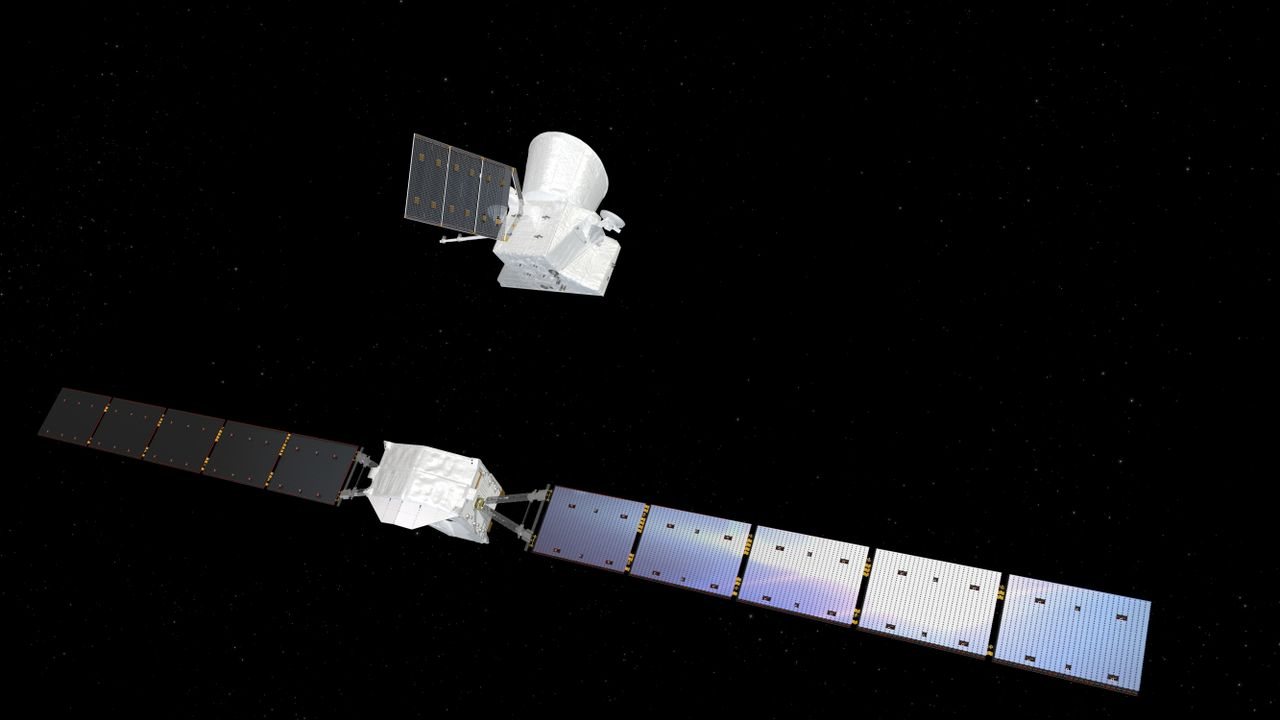
The European Space Agency and Japan Aerospace Exploration Agency have begun the final phase of the BepiColombo mission to Mercury, eight years after the spacecraft launched from Earth. On 3 September 2026, the mission's Mercury Transfer Module separated from the rest of the stacked spacecraft, marking the first critical step in what ESA describes as one of the most complex planetary arrival sequences ever attempted by the agency.
The separation occurred while mission controllers monitored the operation from the European Space Operations Centre in Darmstadt, Germany. Following the separation, the earliest possible acquisition of signal from the spacecraft was expected at approximately 15:53 CEST, when ground teams would begin checking the status of the spacecraft as it continues toward the innermost planet of the Solar System.
BepiColombo is a joint mission between ESA and JAXA, designed to study Mercury from orbit. The spacecraft has spent the past eight years travelling through the inner Solar System, using a series of gravity-assist flybys of Earth, Venus, and Mercury itself to adjust its trajectory and slow down enough to be captured by Mercury's gravity.
The arrival sequence now underway is particularly demanding because of the harsh environment around Mercury. The planet sits deep in the Sun's gravitational well, meaning spacecraft must shed a significant amount of energy to enter orbit. Additionally, the intense heat from the Sun and the planet's surface places severe demands on the spacecraft's thermal protection systems.
Once in orbit, BepiColombo will deploy into two science orbiters: the Mercury Planetary Orbiter, led by ESA, and the Mercury Magnetospheric Orbiter, led by JAXA. The two orbiters will study the planet's composition, its magnetic field, its thin exosphere, and the interaction between the solar wind and the planet's environment. Scientists expect the data to shed light on the formation and evolution of the Solar System's rocky planets, including Earth.
Mercury remains the least explored of the four terrestrial planets. Only two NASA missions, Mariner 10 in the 1970s and MESSENGER in the 2010s, have previously visited the planet. BepiColombo is the first European mission to Mercury and the first mission to send two orbiters to study the planet simultaneously.
The livestream of the arrival sequence, broadcast from the Main Control Room at ESOC, included expert analysis and behind-the-scenes insights from the mission team. The broadcast paused after the separation and resumed later for the acquisition of signal and the first status check of the spacecraft following the critical manoeuvre.
Mission controllers will now guide BepiColombo through the remaining steps of its arrival, with the spacecraft expected to be captured into orbit around Mercury in the coming period. The success of the separation was the first milestone in a sequence that will determine whether the mission can begin its planned two-year primary science phase.
90