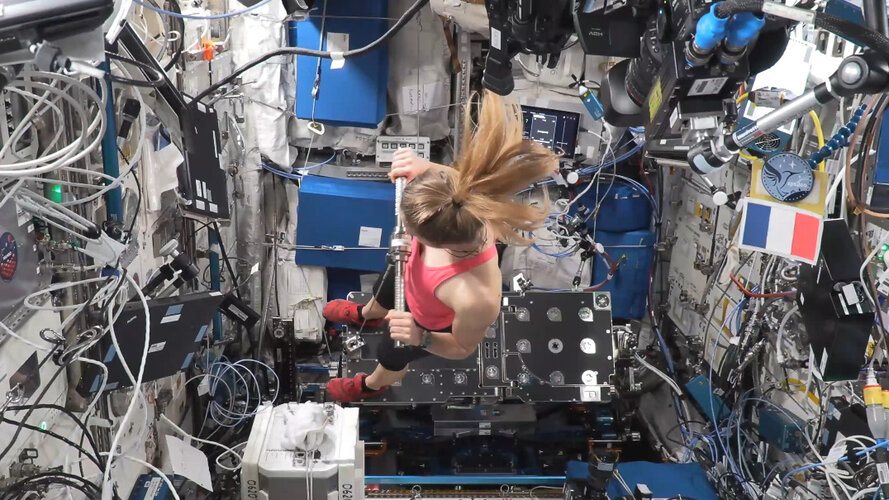
European Space Agency astronaut Sophie Adenot has started testing a novel exercise device aboard the International Space Station, marking the beginning of a two-year evaluation aimed at improving astronaut health during extended space missions. The European Enhanced Exploration Exercise Device, or E4D, was installed inside ESA's Columbus laboratory module and relies on a rope-pulling mechanism to provide resistance in microgravity.
The E4D system is designed to address one of the most persistent challenges of human spaceflight: the physical deterioration that occurs when the human body is not subjected to Earth's gravity. Astronauts on the ISS currently use a suite of exercise equipment, including treadmills, stationary bicycles, and a resistive exercise device that uses vacuum cylinders to simulate weightlifting. The new European device offers an alternative approach by using ropes and pulleys to generate resistance, which could prove lighter, more compact, and more energy-efficient for future missions to the Moon, Mars, or beyond.
Sophie Adenot, a French astronaut selected by ESA in 2022, performed the first rope-pulling workout with the E4D in the Columbus laboratory. The session was part of a broader research campaign to assess how well the device maintains muscle mass, bone density, and cardiovascular fitness over time. Researchers on the ground will monitor data from the device and from Adenot's body to compare its effectiveness against existing exercise hardware.
The E4D was developed by a consortium of European research institutions and industrial partners, led by the Italian space agency ASI and coordinated by ESA. The project is part of ESA's long-term strategy to develop technologies that support human exploration beyond low Earth orbit. Unlike current ISS exercise machines, which are bulky and require significant power and maintenance, the E4D is designed to be simpler and more adaptable, potentially reducing the mass and volume needed for exercise equipment on spacecraft.
The device works by having the astronaut pull on a rope that is connected to a flywheel or braking system, creating resistance that can be adjusted to simulate different levels of effort. This type of exercise is known as eccentric-concentric training, where muscles both shorten and lengthen under load, which is considered highly effective for maintaining strength. The rope-pulling motion also engages multiple muscle groups simultaneously, mimicking natural movement patterns more closely than isolated weightlifting exercises.
Over the next two years, the E4D will be tested by multiple astronauts on the ISS, each performing prescribed workout routines while sensors record muscle activation, joint angles, and force output. The data will be transmitted to Earth for analysis by exercise physiologists and engineers. The goal is to validate the device's performance and identify any design improvements before it is considered for use on future exploration missions.
The testing comes at a time when space agencies worldwide are intensifying their focus on crew health for long-duration missions. NASA's Artemis program aims to return humans to the Moon later this decade, and both NASA and ESA have outlined plans for crewed missions to Mars in the 2030s or 2040s. These missions would last years, far longer than the typical six-month ISS rotation, making effective exercise countermeasures critical. Without regular physical activity, astronauts can lose up to 1% of bone mass per month and experience significant muscle atrophy, cardiovascular deconditioning, and changes in vision due to fluid shifts in the head.
Current ISS exercise equipment, while effective, has limitations. The Advanced Resistive Exercise Device (ARED), for example, uses vacuum cylinders that are heavy and require regular maintenance. The T2 treadmill and the Cycle Ergometer with Vibration Isolation and Stabilization (CEVIS) are also large and generate vibrations that must be dampened to avoid disturbing microgravity experiments. The E4D's rope-pulling design could offer a quieter, lighter alternative that is easier to stow and deploy, which would be especially valuable on spacecraft where every kilogram of mass matters.
Sophie Adenot's involvement in the first test is notable as she is one of ESA's newest astronauts and is currently serving on the ISS as part of a long-duration mission. Her background as a helicopter pilot and test pilot in the French Air Force has prepared her for the rigorous demands of spaceflight and the detailed procedures required for scientific experiments. She has expressed enthusiasm for contributing to research that will help future explorers stay healthy on journeys to the Moon and Mars.
The E4D project also reflects a broader trend in space exercise science: moving from one-size-fits-all equipment to personalized, adaptable systems. Future devices might incorporate artificial intelligence to adjust resistance in real time based on an astronaut's fatigue level or biometric data. The E4D's modular design could allow such upgrades, making it a platform for ongoing innovation rather than a fixed piece of hardware.
As the two-year testing period unfolds, ESA and its partners will publish periodic updates on the device's performance. If successful, the E4D could become a standard component of future spacecraft, helping astronauts maintain their health on the long journey to Mars and beyond. For now, the rope-pulling workouts aboard the ISS represent a small but significant step toward making deep space exploration a reality.
121