The European Space Agency's Hera mission, launched two years ago today, is now executing its most critical and challenging operation since liftoff: a sustained braking maneuver to slow the small-car-sized spacecraft as it approaches its target asteroids. The maneuver marks a key milestone in the planetary defense mission, which aims to study the aftermath of NASA's DART impact on the asteroid moonlet Dimorphos.
Hera has been hurtling away from Earth since its launch, steadily gaining distance and speed. Now, the spacecraft must shed that velocity to enter a safe and controlled approach to the binary asteroid system Didymos and its moonlet Dimorphos. The braking campaign involves a series of precisely timed thruster firings designed to gradually reduce Hera's speed relative to its target, allowing it to be captured by the asteroids' gravity and begin its detailed survey.
This braking phase is considered the single most challenging activity since launch because it requires the spacecraft to operate autonomously for extended periods, with limited real-time communication from Earth. The maneuvers must be executed with high precision; any error could cause Hera to miss its target entirely or approach at an unsafe speed. Engineers at ESA's mission control have spent months planning the sequence, simulating various scenarios to ensure the spacecraft can handle the complex dynamics of approaching a small, irregularly shaped body.
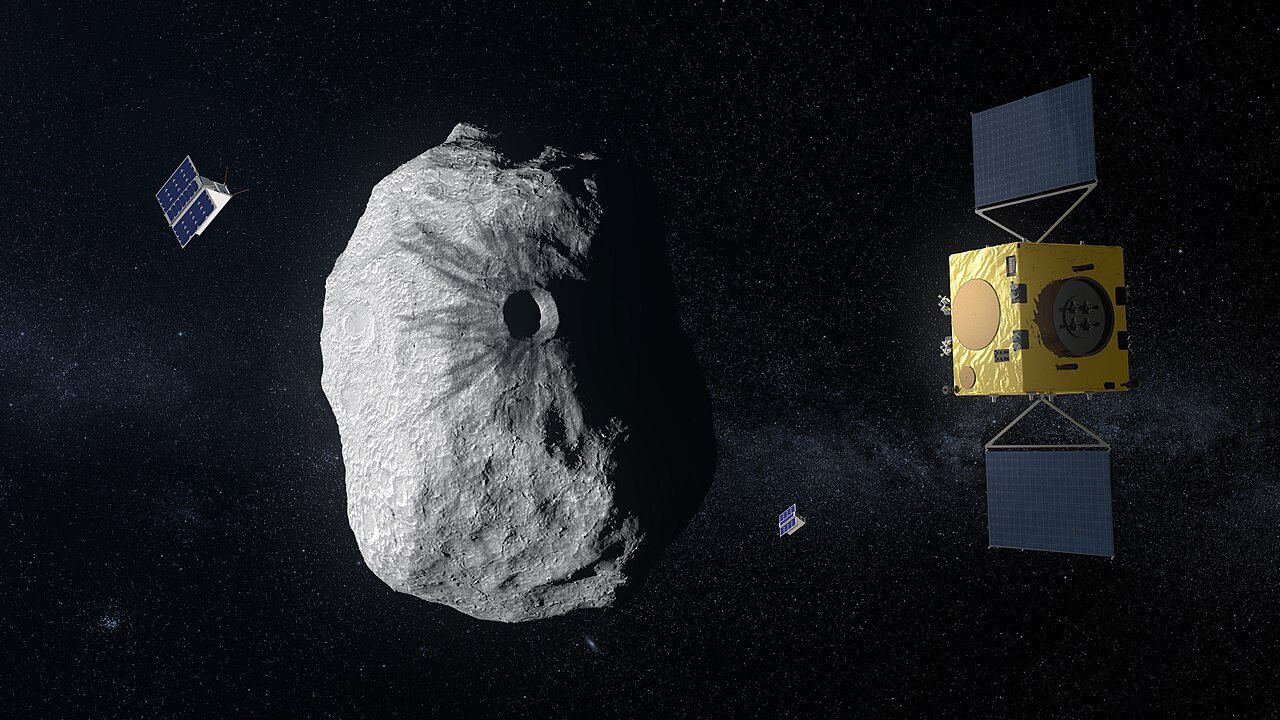
Hera's destination is the Didymos system, which became famous in 2022 when NASA's DART spacecraft intentionally crashed into Dimorphos, altering its orbit around the larger asteroid Didymos. That impact was the first full-scale test of asteroid deflection technology. Hera will now perform a detailed post-impact survey, measuring the mass, composition, and internal structure of Dimorphos, and examining the crater left by DART. This data will be crucial for understanding how effective kinetic impactors can be in deflecting hazardous asteroids away from Earth.
The mission is part of ESA's broader planetary defense efforts, which include detecting, tracking, and characterizing near-Earth objects. By studying Dimorphos up close, Hera will help scientists validate and refine models of asteroid deflection, turning a one-time experiment into a repeatable technique. The spacecraft carries a suite of scientific instruments, including a camera, a laser altimeter, and a thermal infrared imager, as well as two small CubeSats that will be deployed to inspect the asteroid's surface at close range.
As Hera begins its braking maneuvers, mission controllers will monitor the spacecraft's trajectory and systems closely. The operation will take several weeks to complete, after which Hera will enter a phase of gradual approach and eventually orbit the asteroid system. If all goes well, the mission will provide unprecedented insights into the nature of asteroids and our ability to protect the planet from future threats.
The success of Hera's braking phase is critical not only for the mission itself but also for the future of planetary defense. The data returned will inform international efforts to develop strategies for deflecting potentially hazardous asteroids, a goal that requires international cooperation and sustained investment in space science and technology. As Hera slows down to meet its target, it carries with it the hopes of a world increasingly aware of the need to safeguard Earth from cosmic hazards.
12