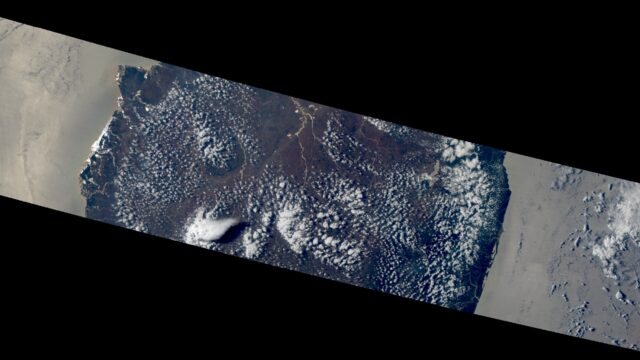
The European Space Agency's Jupiter Icy Moons Explorer, known as Juice, has completed a critical gravity assist maneuver with Earth, redirecting its trajectory toward Jupiter and providing mission teams with an unprecedented rehearsal for the operational challenges awaiting them at the gas giant. The flyby, which occurred on September 28, 2026, marked the spacecraft's penultimate Earth encounter before its scheduled arrival in the Jovian system in 2031.
According to ESA mission analyst Arnaud Boutonnet, the maneuver was essential because reaching Jupiter directly would require an impractical amount of fuel. «To go directly to Jupiter, you need to reach a certain speed,» Boutonnet explained. «That is why gravity assist maneuvers are necessary.» These operations exploit a planet's gravity to alter a spacecraft's trajectory and velocity without consuming propellant. With this latest Earth flyby, Juice has now completed three of its four planned gravity assists. The encounter shifted the probe's trajectory by approximately 20 degrees, orienting it toward Jupiter ahead of a final correction during its last Earth flyby in 2029.
The maneuver served a dual purpose beyond navigation. It offered the Flight Control Team at the European Space Operations Centre a rare opportunity to simulate the operational and scientific conditions Juice will face at Jupiter. During the flyby, the spacecraft entered Earth's shadow, spending three hours in complete darkness and six hours in partial shadow. This eclipse closely replicated the conditions Juice will encounter at Jupiter, where solar intensity is only three percent of that at Earth and eclipses can last up to five hours.
Angela Dietz, Juice's spacecraft operations manager, noted that while flybys have become routine, they still demand extensive preparation. «Flybys have become fairly routine for the mission, but they still require an enormous amount of preparation. That is why we prepared for more than a year,» Dietz said. The eclipse transformed that preparation into a dress rehearsal for Jupiter.
Juice is powered by two large solar arrays totaling 85 square meters, roughly half the area of a volleyball court. These panels will be critical at Jupiter, where sunlight is dramatically weaker. During the eclipse, battery charge dropped to 54 percent before solar panels resumed generating power. With the operational limit set at 35 percent and the spacecraft performing nominally, the result exceeded expectations. «The power data we obtained from this flyby are very important, because they will be used for future simulations of Jovian eclipses,» said Paula Betriu, a science operations engineer at ESAC.
The eclipse also tested whether Juice could continue conducting science during prolonged darkness. «Initially we thought we would not have enough power for the onboard science instruments. But after digging deeper, we realized we could keep several instruments active and make the most of the opportunity,» Dietz said. All ten scientific instruments contributed to the flyby campaign, though not simultaneously during the eclipse. «It was a demanding campaign,» said Pilar Esquej, another science operations engineer. «The eclipse imposed strict constraints, so we had to prioritize observations with extreme care and find compromises.»
Launched on April 14, 2023, Juice is on a long journey to explore Jupiter and its icy moons. The spacecraft's path has included a flyby of Venus and a lunar-Earth gravity assist in 2024, which featured a 32-minute eclipse. The recent Earth flyby set a new mission record for eclipse duration. The data gathered will inform future simulations and operational strategies, ensuring that Juice can survive and conduct science during the long, dark eclipses of the Jovian system.
As the mission progresses toward its 2031 arrival, each gravity assist and eclipse test brings engineers closer to understanding how to operate in one of the solar system's most challenging environments. The successful flyby represents a significant step in preparing for the scientific exploration of Jupiter's icy moons, where conditions may harbor subsurface oceans and potential habitability.
11