The European Space Agency's Jupiter Icy Moons Explorer, known as Juice, raced past Earth on September 28, using the planet's gravity to dramatically reshape its path toward Jupiter without burning significant fuel. The flyby changed the spacecraft's direction by 20 degrees and increased its speed by 3.5 kilometers per second, a maneuver that would have required a large amount of propellant if performed with onboard engines alone.
Gravity assists of this kind are a standard tool in deep-space navigation, but Juice's encounter offered more than a trajectory adjustment. As the spacecraft swept past, scientists took the rare opportunity to test its suite of instruments on targets that are well understood: Earth and the Moon. That calibration work allows teams to verify that the instruments are functioning as intended before the probe reaches the Jovian system, where it will study the icy moons Europa, Ganymede, and Callisto.
Juice is on a long journey to Jupiter, and the Earth flyby is one of several planetary encounters designed to build up the speed and direction needed to reach the outer solar system. The maneuver reflects the careful orbital choreography required for missions that cannot carry enough fuel to travel directly to their destinations. By borrowing energy from Earth's motion around the Sun, the spacecraft gains momentum while mission planners conserve propellant for the science phase ahead.
The flyby also served as a rehearsal for the kind of observations Juice will eventually make at Jupiter. Testing instruments on Earth and the Moon gives engineers and researchers a reference point, helping them interpret the data the spacecraft will collect later. Any issues identified during the encounter can be addressed while the probe is still relatively close to home, rather than after it has traveled hundreds of millions of kilometers.
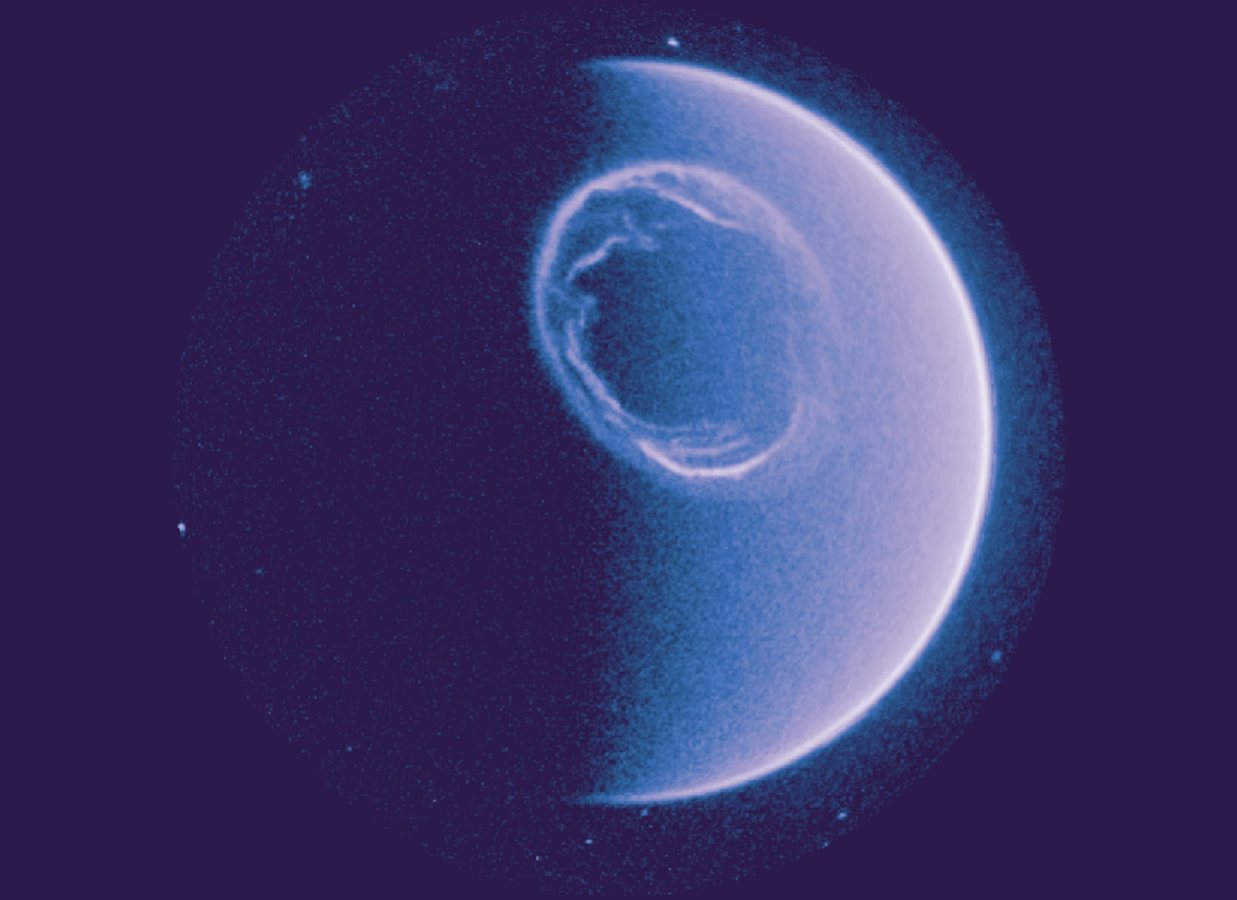
Juice is not the only European space science mission marking a milestone. The joint European Space Agency and Chinese Academy of Sciences SMILE mission, launched in May, has officially begun scientific operations after a multi-month commissioning period. SMILE is designed to investigate Earth's magnetosphere in soft X-rays and ultraviolet light, and its first ultraviolet observations captured a full ring of auroras near Earth's north pole.
SMILE arrived in its highly elliptical orbit on June 20 and has spent recent months deploying instruments and verifying electrical systems. Its four instruments — the Soft X-ray Imager, the UV Imager, the Light Ion Analyzer, and the Magnetometer — will work together to study how solar storms, geomagnetic storms, and other forms of space weather interact with Earth's magnetic field. The UV Imager's first observation of polar aurorae was made on July 24, just two weeks after it was brought online for commissioning.
Teams have noted that SMILE's Soft X-ray Imager detects too much stray light when pointed at Earth, and engineers are adjusting instrument settings and sending new software to address the issue. The spacecraft's current orbit points it farther from Earth, and as the northern hemisphere moves into winter, reduced light from the north pole should ease the problem. A minimum is expected in mid-October, when SMILE will attempt its first good observation of the magnetopause and the northern polar cusp.
Both missions illustrate how space agencies use planetary encounters and orbital commissioning to prepare spacecraft for the science they were built to do. For Juice, the September 28 flyby is a step on a path that will eventually carry it to Jupiter and its icy moons. For SMILE, the start of science operations marks the beginning of a primary mission expected to last three years, with possible extensions if the spacecraft remains healthy.
14