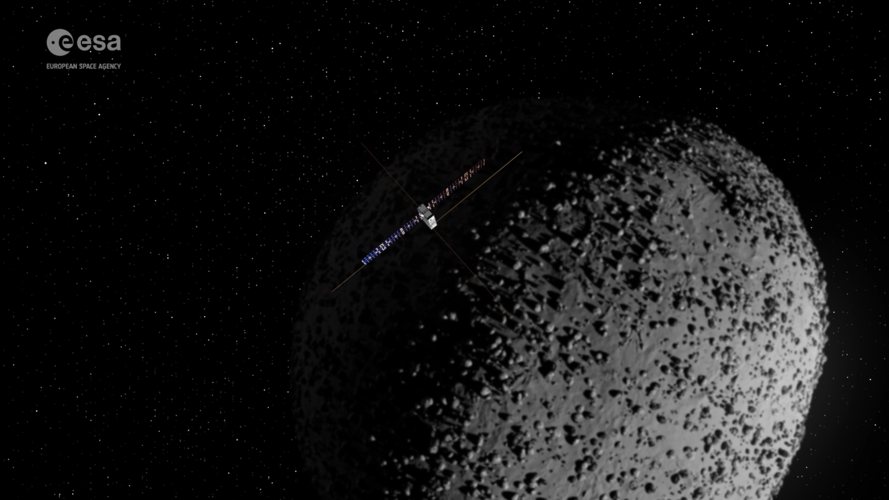
The European Space Agency’s Hera spacecraft is set to arrive in November at Dimorphos, a small asteroid that NASA’s DART mission struck on 26 September 2022. The arrival will allow scientists to study the aftermath of the first deliberate attempt by humans to change the orbit of a natural object in the Solar System.
Hera is ESA’s first mission dedicated to planetary defence. The spacecraft is roughly the size of a small car and is designed to gather detailed data on the kinetic impact method of asteroid deflection. Its target, Dimorphos, measures about 151 meters across and orbits a larger parent body, Didymos, which is about 780 meters in diameter. Together the two bodies form a binary asteroid system.
DART’s impact was historic because it changed Dimorphos’s orbit around Didymos, the first such change in the Solar System caused by human action. The collision produced a brightening that was visible from distant Earth telescopes, but nobody knows what the impact did to Dimorphos itself. Hera is going there to perform a close-up survey of the crash site, with the aim of turning DART’s kinetic impact experiment into a well-understood technique for deflecting a dangerous asteroid.
A related account published after the Hera spacecraft captured its first clear view of the two asteroids describes the mission as closing in on the pair. According to that report, the spacecraft will investigate the mysterious aftermath of the collision and try to explain why the asteroid shifted far more than scientists had predicted. That discrepancy between prediction and result is among the central questions Hera is expected to address, and it bears directly on how reliable kinetic impact will be as a planetary defence tool in future.
Scientists also hope Hera will produce science beyond its planetary defence goal. Past spacecraft close encounters with asteroids have revealed these bodies to be dynamic environments with complex histories, and many outstanding questions remain unanswered. ESA has highlighted 10 asteroid mysteries that the mission is expected to help explore, reflecting how much the agency hopes to learn from a close survey of a binary system.
Hera’s work also connects with other recent research on asteroid material. Scientists studying pristine samples from the asteroid Ryugu have found all five nucleobases used in DNA and RNA, in material about 4.5 billion years old. The finding indicates that key ingredients for life existed in space billions of years ago, and it adds to growing evidence from other asteroids and meteorites that these molecules were widespread throughout the early Solar System.
Taken together, the two lines of research show how asteroids serve both as hazards to be managed and as archives of the early Solar System. Hera’s observations of Didymos are expected to clarify how asteroids respond to impacts and how their orbits can be altered, knowledge that could matter if humanity ever needs to redirect a hazardous space rock.
Source: esa.int
16