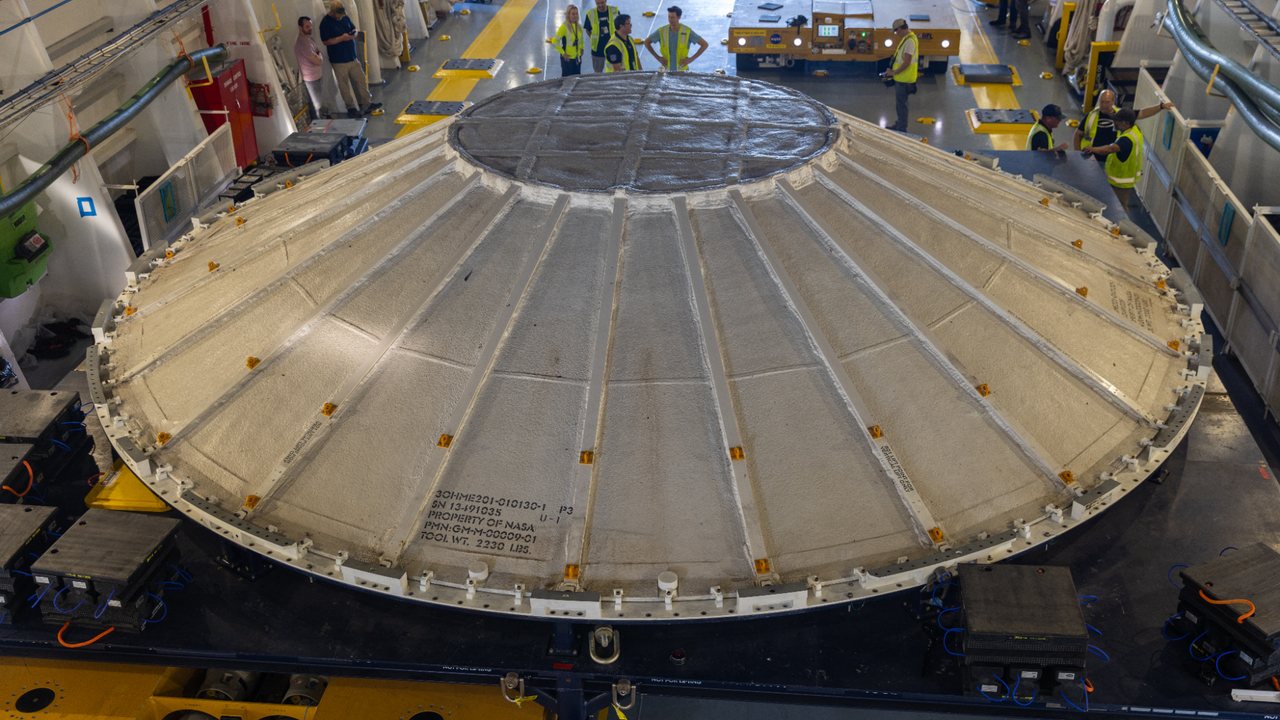
A spacecraft component that bears a striking resemblance to a classic flying saucer has arrived at NASA's Kennedy Space Center in Florida, marking a significant milestone for the agency's Artemis 3 mission, which aims to land astronauts on the Moon for the first time in over five decades. The delivery, which occurred in late June 2026, coincides with World UFO Day on July 2, adding a touch of cosmic coincidence to the event.
The module, officially known as the Human Landing System (HLS) ascent element, is being developed by SpaceX under a contract awarded by NASA. Its distinctive shape, with a wide, disc-like body and a rounded top, has drawn immediate comparisons to the stereotypical flying saucer of popular culture. The component is designed to carry astronauts from the lunar surface back to lunar orbit after their exploration of the Moon's south pole region.
Artemis 3 represents a cornerstone of NASA's broader Artemis program, which seeks to establish a sustainable human presence on the Moon and prepare for future crewed missions to Mars. The mission will be the first to land astronauts on the lunar surface since Apollo 17 in 1972, and it will also make history by including the first woman and the first person of color on a lunar landing.
The ascent element is a critical piece of the Starship-based Human Landing System. After the Starship lander touches down on the Moon, astronauts will conduct surface activities, including scientific experiments and sample collection. When their time on the surface concludes, they will board the ascent element, which will launch from the top of the lander and carry them back to the Orion spacecraft waiting in lunar orbit. Orion will then transport the crew back to Earth.
NASA officials have emphasized the importance of this delivery, as it allows engineers to begin integration and testing of the ascent element with other components of the Artemis 3 mission. The module will undergo a series of checks and preparations at Kennedy Space Center before being mated with the rest of the Starship lander. This process is essential to ensure that all systems function correctly in the harsh environment of space and on the lunar surface.
The arrival of the ascent element also highlights the rapid pace of development for the Artemis 3 mission. NASA and SpaceX have been working closely to meet the ambitious timeline, which targets a launch no earlier than 2026. The delivery of this key component brings the mission one step closer to reality, though significant work remains, including uncrewed test flights of the Starship system and the final integration of all mission elements.
The timing of the delivery, just days before World UFO Day, has not been lost on space enthusiasts and the public. World UFO Day, observed annually on July 2, commemorates the 1947 Roswell incident and encourages the study of unidentified flying objects. The visual similarity of the ascent element to a flying saucer has sparked playful comparisons on social media, with some noting that NASA now has its own version of the iconic shape.
Beyond the cultural resonance, the ascent element represents a technological achievement. It is designed to be fully reusable, a key feature of SpaceX's approach to reducing the cost of space travel. The module's propulsion system uses methane and liquid oxygen, which can potentially be produced on Mars using local resources, a capability that would be crucial for future missions to the Red Planet.
The Artemis 3 mission is part of a larger international effort to explore the Moon. The mission will also deploy scientific instruments and conduct experiments that will inform the long-term goal of establishing a lunar base. The data and experience gained from Artemis 3 will be invaluable for planning subsequent missions, including Artemis 4 and beyond, which will focus on building infrastructure and conducting more extensive surface operations.
NASA has also emphasized the importance of international collaboration in the Artemis program. The agency has partnered with space agencies from Europe, Canada, Japan, and other nations to contribute components and expertise. The Orion spacecraft, which will carry astronauts to lunar orbit, is built by Lockheed Martin, while the European Space Agency provides the service module that powers and propels Orion.
As the ascent element begins its journey through the integration process at Kennedy Space Center, the space community is watching closely. The successful delivery of this component is a tangible sign of progress, but many challenges remain. The Starship system has yet to complete an uncrewed lunar landing test, and the overall timeline for Artemis 3 depends on the success of these precursor missions.
Nevertheless, the arrival of the «flying saucer» module has injected a fresh wave of excitement into the Artemis program. For the first time in decades, a key piece of hardware designed to carry humans from the lunar surface is physically present at NASA's launch site. The countdown to the next human footsteps on the Moon has taken another step forward.
133